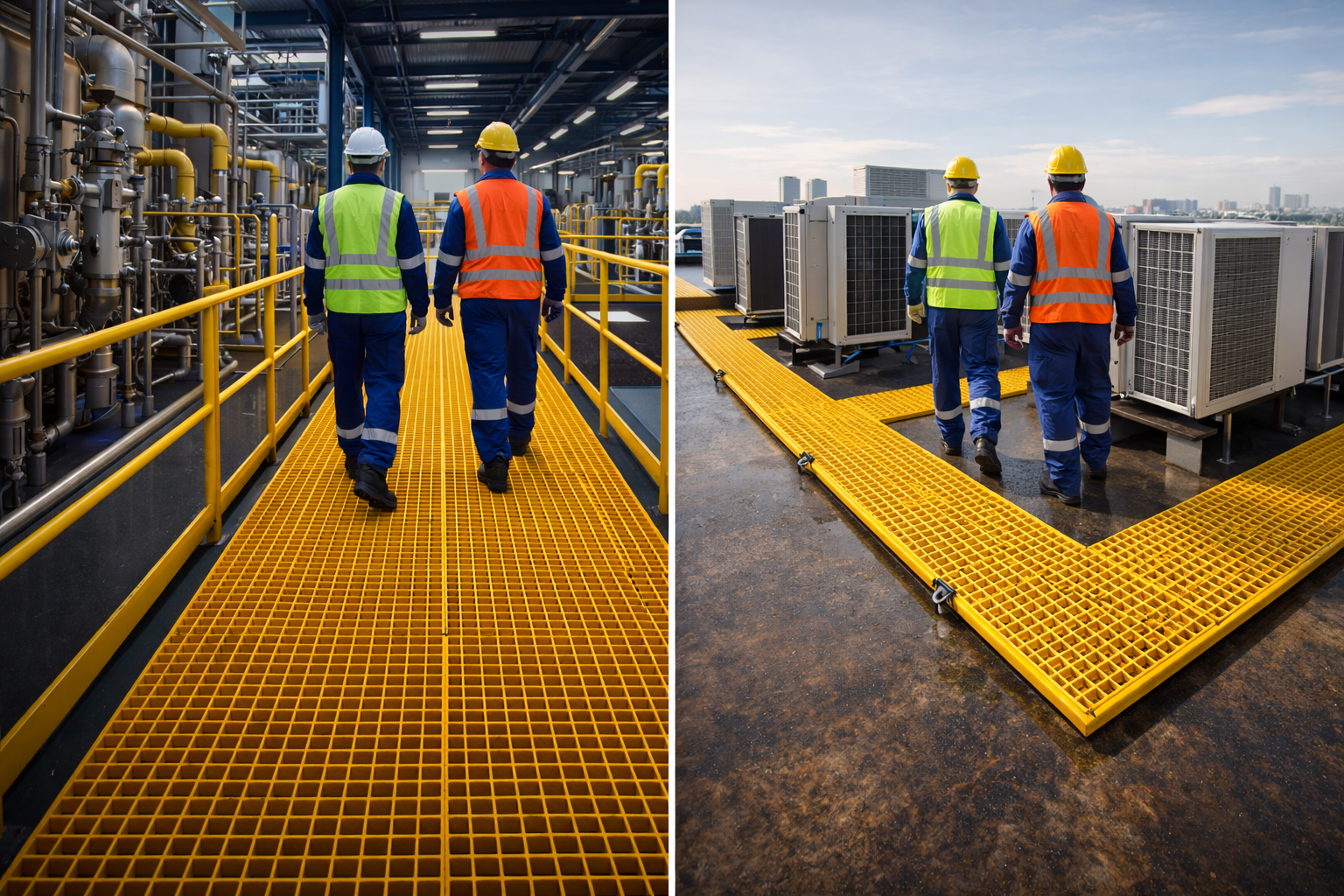
What is FRP Grating?
FRP grating is manufactured by combining high-strength glass fibre rovings with a thermosetting resin matrix — typically polyester, vinyl ester, or phenolic resin — using either a pultrusion or open-mould moulding process. The result is a rigid, load-bearing grid panel with an inherently gritty, anti-slip surface texture.
Unlike metal gratings that rust or degrade under chemical exposure, or wooden platforms that warp and splinter, FRP grating maintains its structural integrity and appearance across decades of use — even in harsh chemical, marine, and high-humidity environments.
Available FRP Grating Types
| Moulded FRP Grating | Bi-directional strength; ideal for platforms, walkways, stair treads |
| Pultruded FRP Grating | Unidirectional high load; suited for heavy-duty industrial floors |
| Mini-mesh Grating | Small apertures for foot safety in chemical plants and labs |
| Phenolic FRP Grating | Fire-retardant grade for offshore and high-risk zones |
Did You Know?
FRP grating can be customised in mesh size, thickness (25mm–50mm), resin type, and colour — making it adaptable to virtually every industrial application.
Why Industries Prefer FRP Over Steel or Wood
For decades, industrial facilities defaulted to steel or hardwood gratings. However, escalating maintenance costs, corrosion failures, and workplace safety incidents have pushed procurement teams to re-evaluate. FRP grating consistently wins this comparison on total lifecycle cost and performance.
| Performance Factor | FRP Grating | Mild Steel | Stainless Steel | Wood/GI |
|---|---|---|---|---|
| Corrosion Resistance | ✔ Excellent | ✘ Poor | ~ Moderate | ✘ Very Poor |
| Weight (relative) | ✔ Very Light | ✘ Heavy | ✘ Heavy | ~ Medium |
| Anti-Slip Surface | ✔ Integral Grit | ~ Add-on only | ~ Add-on only | ✘ Slippery when wet |
| Electrical Conductivity | ✔ Non-conductive | ✘ Conductive | ✘ Conductive | ~ Variable |
| Maintenance Requirement | ✔ Minimal | ✘ High (paint/coating) | ~ Low | ✘ Very High |
| Installation Ease | ✔ Easy (no welding) | ✘ Welding needed | ✘ Specialist needed | ~ Moderate |
| Chemical Resistance | ✔ High | ✘ Low | ~ Moderate | ✘ Very Low |
| Typical Design Life | ✔ 25–30+ Years | ~ 8–12 Years | ~ 15–20 Years | ✘ 3–5 Years |
On a lifecycle cost basis, FRP grating delivers 40–60% lower total ownership cost over 25 years compared to mild steel, when painting, re-coating, and replacement cycles are factored in.
FRP Grating for Industrial Walkways and Platforms
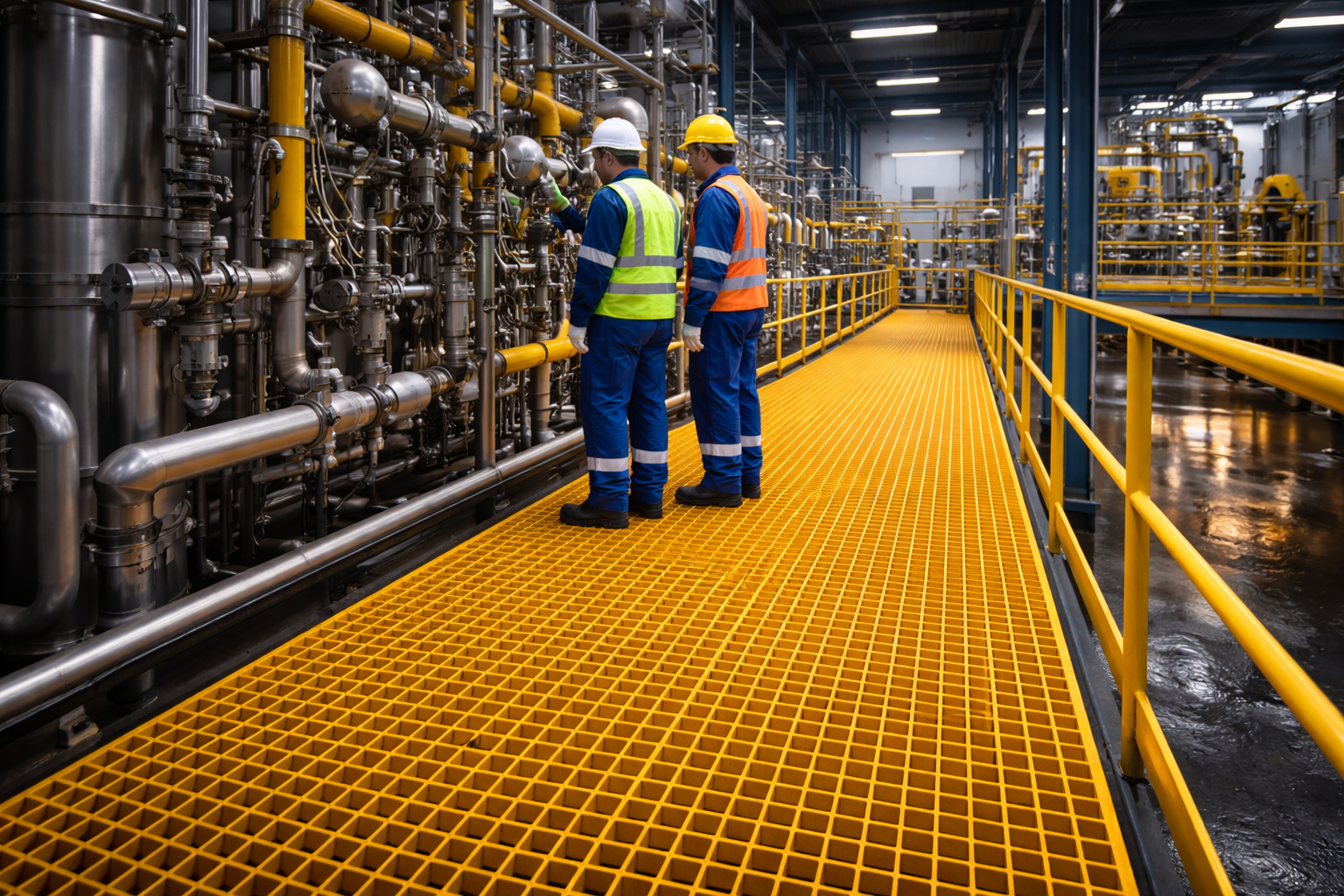
Industrial walkways are high-traffic zones where worker safety is non-negotiable. Slips, trips, and falls remain among the top causes of lost-time injuries in manufacturing and process plants. FRP grating addresses this risk at its root.
Why FRP is the Preferred Choice for Walkways
- Integral anti-slip grit surface reduces slip accidents even in wet or oily conditions
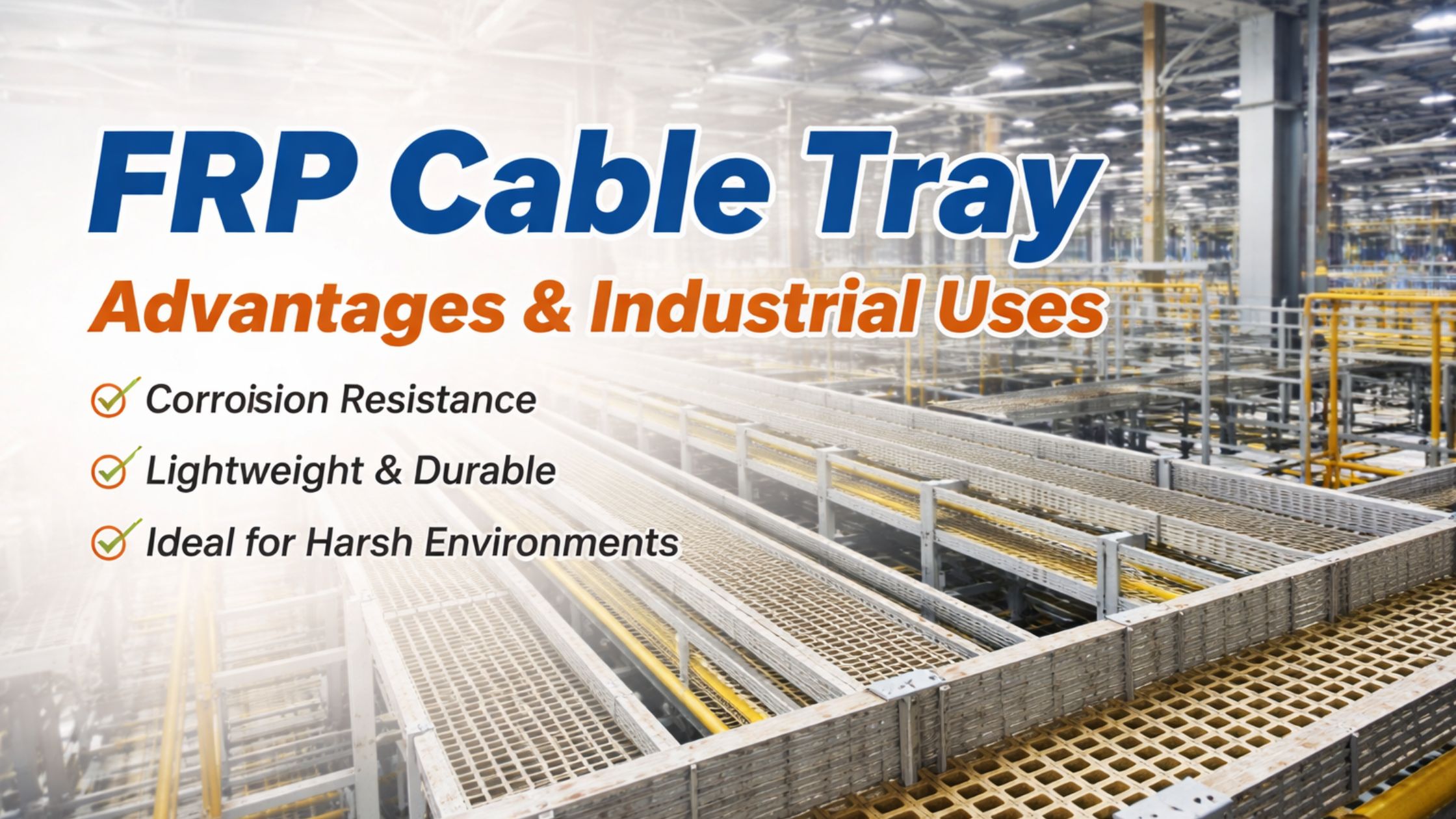
- Non-conductive material eliminates electrocution risk near electrical panels and cable trays
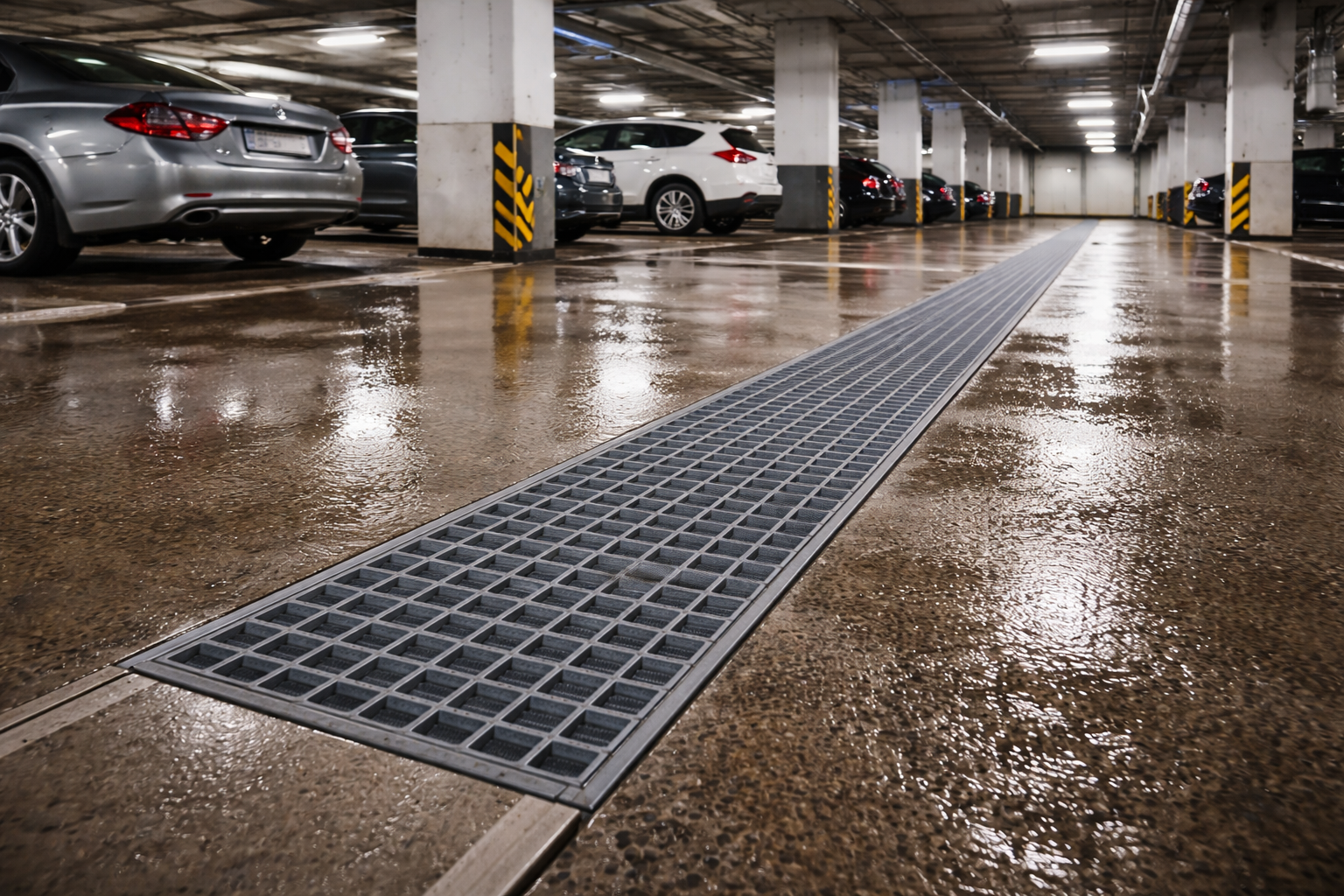
- Open mesh design provides excellent drainage, preventing water pooling
- Lightweight panels allow quick, weld-free installation and future panel replacement
- Available in high-visibility yellow for safety demarcation in process zones
Industries Using FRP Walkways
⚡ Power Stations
🛢️ Oil & Gas Refineries
💊 Pharmaceuticals
🚰 Water Treatment Plants
🏗️ Steel Plants
🌊 Marine & Ports
🧪 Fertilizer Units
Load-Bearing Capacity
FGPL FRP walkway grating panels are designed to carry distributed loads of 500–700 kg/m² and point loads up to 250–350 kg depending on panel thickness and span configuration — meeting IS and international safety standards.
FRP Grating for Factory Flooring and Mezzanine Floors
Factory floors and mezzanine levels are subjected to continuous mechanical stress — forklift movement, heavy machinery vibration, chemical spills, and constant foot traffic. FRP grating rises to this challenge with a combination of structural performance and chemical inertness that steel simply cannot replicate without costly coatings.
Mezzanine Storage Floors
FRP panels provide uniform load distribution across mezzanine frames, reducing the dead load on the supporting structure while offering safe, walkable surfaces.
Chemical Processing Floors
In battery rooms, acid storage, and plating lines, FRP’s chemical resistance protects against degradation from spills of sulphuric acid, caustic soda, and chlorine.
Pharma & Clean-Room Platforms
FRP grating can be provided in smooth-top versions suitable for hygienic environments where drainage and cleanability are required alongside structural strength.
Equipment Service Platforms
Platforms around large motors, compressors, and turbines benefit from FRP’s combination of non-conductivity, light weight, and excellent vibration absorption.
Mezzanine Floor Specification Guide
| Panel Thickness | 38mm (standard) or 50mm (heavy-duty) |
| Mesh Opening | 38×38mm or 50×50mm (open area: 65–75%) |
| Standard Panel Size | 1000×2000mm, 1000×3000mm, or custom cut |
| Maximum Span (38mm) | Up to 1.2m without intermediate support |
| Load Rating | Up to 700 kg/m² distributed load |
| Resin Options | Isophthalic polyester, vinyl ester, fire-retardant |
FRP Grating for Cooling Tower Walkways
Cooling towers represent one of the most demanding environments for structural materials. Constant moisture saturation, chlorinated water, biocide chemicals, and high thermal cycling destroy mild steel grating within just a few years. FRP grating was practically designed for this application.
Cooling Tower Specific Challenges Solved by FRP
- Continuous water immersion: FRP does not absorb water or degrade in saturated environments
- Chemical exposure: Chlorine, biocides, and descaling agents have no effect on FRP’s vinyl ester or polyester matrix
- Biological growth: FRP resists algae and microbial colonisation better than wood or carbon steel
- Temperature cycling: FRP maintains dimensional stability from -40°C to +120°C
- Non-sparking surface: Critical in any environment near process gases or flammable vapours
Real-World Case
A major thermal power plant in Gujarat replaced their original galvanised steel cooling tower walkways with FGPL’s vinyl ester FRP grating. After 8 years of operation, the FRP panels showed no corrosion, no structural degradation, and required zero maintenance intervention — versus a complete steel panel replacement that would have been required at the 4-year mark.
FGPL supplies FRP grating panels in natural grey, safety yellow, or custom colours for cooling tower applications, along with matching stair treads, handrail posts, and caged ladder components to provide a complete composite access system.
FRP Grating for Rooftop Walkways and Maintenance Areas
Rooftop access for maintenance of HVAC systems, solar panels, signage, and telecom equipment requires a flooring solution that is both safe for workers and non-damaging to the waterproofing membrane below. FRP grating fulfils both requirements uniquely well.
Solar Panel Access Paths
FRP walkways protect rooftop waterproofing from traffic while providing anti-slip paths to reach solar arrays for cleaning and inspection.
HVAC & Chiller Platforms
Service platforms around rooftop HVAC units benefit from FRP’s light weight, which minimises additional dead load on the roof slab structure.
Telecom Equipment Areas
FRP’s non-conductivity and RF transparency make it a natural choice around antenna masts and telecom towers on building rooftops.
General Maintenance Corridors
Permanent rooftop walkways allow safe, year-round access for facility maintenance teams without the need for temporary scaffolding.
Rooftop Installation Advantages
- Panels can be carried and installed by two workers without lifting equipment
- Non-penetrative clip fixing systems protect waterproofing membranes
- UV-stabilised resin formulations prevent colour fade and surface degradation
- Panels can be cut on-site with standard circular saw blades to fit around ducts and equipment
Key Benefits: Anti-Slip, Lightweight, Rust-Free, Easy Installation
Whether you’re specifying for a new plant or upgrading an existing facility, FRP grating delivers a combination of safety, structural, and operational benefits that justify the investment at every level.
Anti-Slip Surface
Moulded-in silicon carbide or quartz grit provides a permanent, high-traction surface that remains effective even when wet, oily, or covered in process dust.
Lightweight Construction
FRP grating weighs 70–75% less than equivalent steel — reducing structural load, crane hire costs, and manual handling injury risk during installation.
Rust-Free & Corrosion-Proof
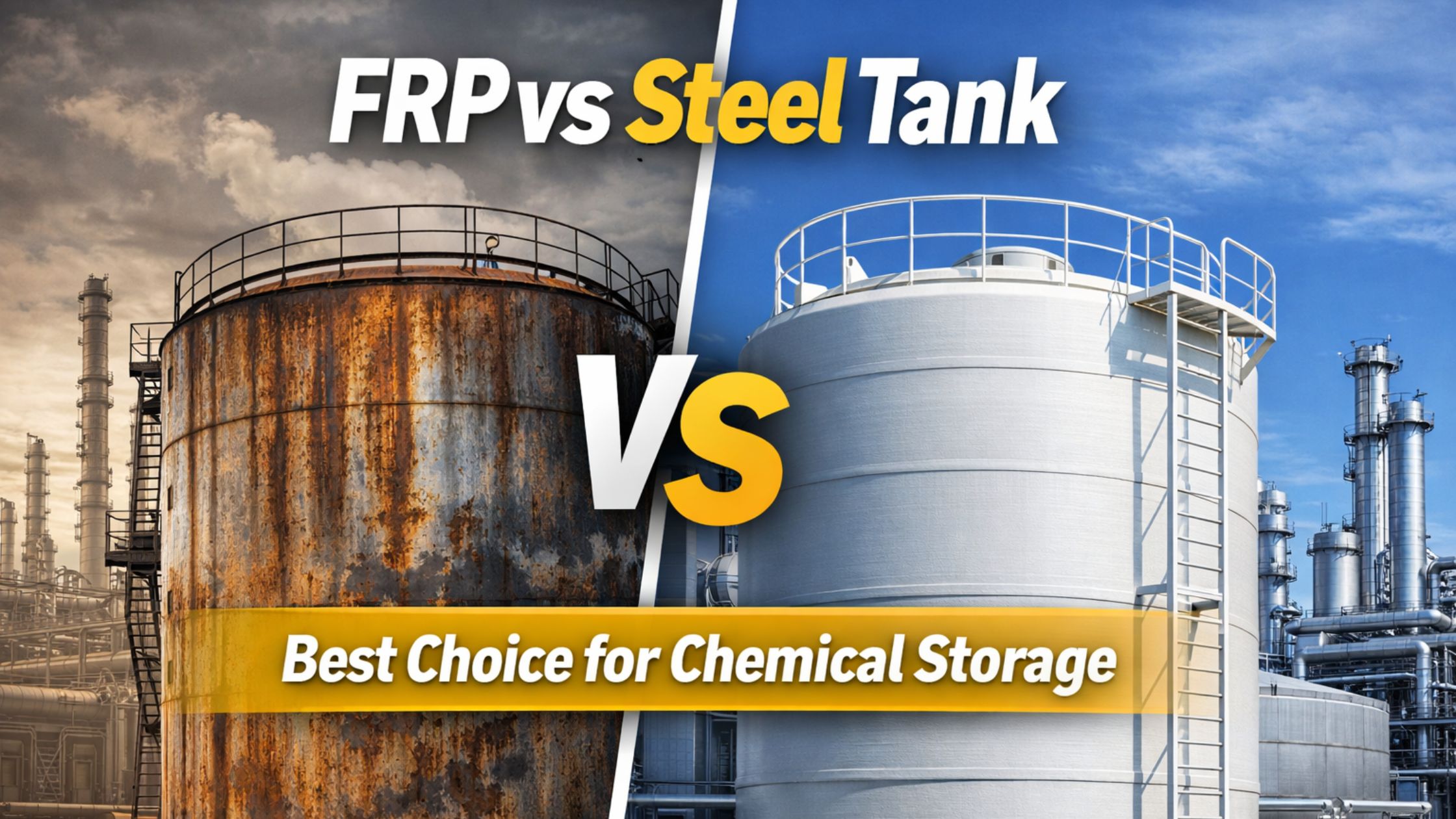
No painting, galvanising, or protective coating required. FRP is inherently inert to moisture, salt, acids, alkalis, and most industrial solvents.
Non-Conductive
Dielectric strength exceeds 35 kV — providing passive electrical isolation for workers in substations, battery rooms, and switchgear areas.
Fire-Retardant Options
Phenolic and fire-retardant polyester grades meet BS 476, ASTM E84 Class 1 flame spread, and IMO fire safety standards for offshore and high-risk zones.
Easy Installation
No welding, grinding, or hot work permits required. Standard hand tools suffice. Panels clip into support frames and can be removed and reinstalled without damage.
Long Design Life
With virtually zero maintenance requirements, FGPL FRP gratings carry a design life of 25–30 years in standard industrial environments — cutting total lifecycle costs significantly.
Colour & Custom Fabrication
Available in standard grey, safety yellow, green, or any custom colour. Panels can be pre-cut to exact project dimensions for zero-waste site installation.
Load Capacity Reference
| Panel Thickness: 25mm | Light duty — pedestrian walkways, access platforms |
| Panel Thickness: 38mm | Medium duty — factory floors, mezzanines, cooling towers |
| Panel Thickness: 50mm | Heavy duty — vehicular access, heavy equipment platforms |
| Pultruded Profile | High-span — bridge decking, offshore platforms, jetties |
Technical Specification Note
FGPL FRP gratings comply with BS 4592, IS 14570, ASTM D-790 (flexural strength), ASTM D-638 (tensile strength), and ASTM E84 (fire spread index) standards. Test certificates available on request.
Why Choose FGPL for Industrial FRP Grating Solutions?
Fibrograts Pvt Ltd has established itself as one of India’s trusted manufacturers and suppliers of FRP / GRP composite products. Our integrated manufacturing capability — from resin selection to finished panel — allows us to deliver quality, consistency, and customisation that imported or broker-sourced products cannot match.
In-House Manufacturing
Controlled production from raw fibre and resin through to finished panels — no outsourcing, no quality compromises.
Custom Fabrication
All panels pre-cut to your exact BOM dimensions. Notches, cutouts, and shaped panels available at no extra lead time.
ISO Certified Quality
Every batch is tested for flexural strength, load deflection, and fire performance. Third-party test reports provided on request.
Pan-India Supply
Stocked inventory for standard sizes. Project-specific fabrication dispatched within 7–14 working days to any location across India.
Technical Support
Our application engineers provide load calculations, panel layout drawings, and on-site installation guidance for large projects.
Competitive Pricing
Direct manufacturer pricing without middleman margins. Volume discount structures available for large project orders.
FGPL supplies FRP grating to clients across power generation, chemicals, petrochemicals, pharmaceuticals, water infrastructure, marine, defence, and general industry. Request a quotation with your project drawings for a customised offer.
Frequently Asked Questions
Common questions from procurement managers, safety engineers, and facility managers evaluating FRP grating for the first time.
+
+
+
+
+
+
+
+