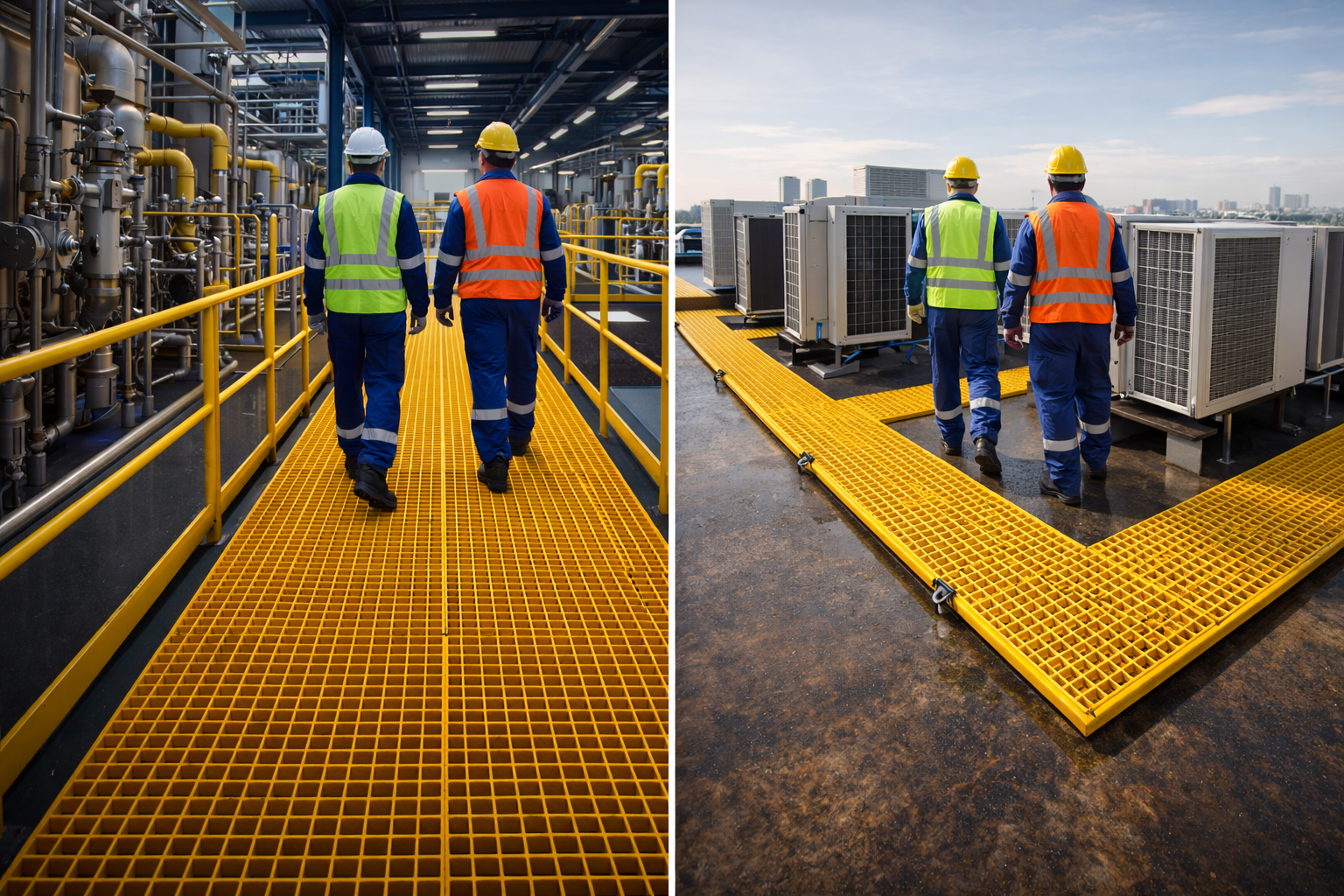
Challenges in Chemical and Industrial Environments
Plant engineers and safety managers across chemical, wastewater, oil & gas, and power sectors face a common set of structural flooring challenges that conventional materials simply are not equipped to handle reliably over the long term.
Chemical Corrosion
Acids, alkalis, solvents, and chlorinated compounds attack mild steel grating, causing rapid section loss and structural failure within 2–5 years in active chemical zones.
Constant Moisture
Wastewater plants, cooling systems, and offshore platforms maintain near-permanent moisture saturation — accelerating rust formation in carbon steel and biological degradation in timber.
Electrical Hazard
Conductive metal grating near live electrical equipment, substations, and control rooms creates electrocution risk — a critical HSE liability in process plant environments.
High Maintenance Cost
Repainting, re-coating, and replacing corroded steel grating every 3–7 years creates recurring CAPEX and forces plant shutdowns for safety-critical access replacement work.
Heavy Structural Load
Dense steel grating adds significant dead load to elevated platforms, mezzanines, and offshore structures — increasing structural engineering requirements and material cost.
Fire & Explosion Risk
In refineries and gas processing facilities, sparking from metal-on-metal contact at grating level creates ignition risk in areas with flammable vapour accumulation.
🔄
The FRP Answer to All Six Challenges
FRP grating is inherently corrosion-proof, non-conductive, non-sparking, fire-retardant capable, and 70% lighter than steel — addressing every challenge listed above through material science rather than coatings or maintenance regimes.
Why FRP Grating Performs Better Than Metal Grating
The performance advantage of FRP over metallic gratings in aggressive industrial environments is not marginal — it is categorical. The comparison below reflects real-world field performance data from process industry installations across India and internationally.
Resin Grade Selection for Chemical Environments
The key to FRP grating’s chemical resistance lies in resin selection. FGPL offers three primary resin systems matched to specific environmental severity:
Isophthalic Polyester
General industrial use. Suitable for mild acids, alkalis, and humid environments. Most cost-effective grade.
🟠
Vinyl Ester
Superior resistance to concentrated acids, solvents, and chlorinated compounds. Preferred for chemical and wastewater plants.
Phenolic Resin
Maximum fire resistance. BS 476 Class 1 compliant. For refineries, offshore platforms, and high fire-risk zones.
Fire-Retardant Polyester
Balanced fire resistance and chemical performance. Suitable for power plants and general process industry.
FRP Grating for Chemical Plants
Chemical manufacturing plants represent the most demanding test for any flooring material. Sulphuric acid, hydrochloric acid, caustic soda, ammonia, chlorine gas, and dozens of organic solvents are handled daily at temperatures ranging from sub-zero to above 100°C. FRP grating manufactured with vinyl ester or high-performance polyester resin is the material of choice across this sector globally.
Chemical Resistance Reference — FGPL Vinyl Ester FRP
Note: EXCELLENT = no degradation, GOOD = minor surface effect. Full chemical resistance charts available from FGPL technical team.
📋
Specification Note
For chemical plant applications, FGPL recommends vinyl ester resin moulded grating, 38mm depth, with silicon carbide anti-slip surface and secondary veil layer for maximum chemical barrier performance. Custom mesh sizes (25×25mm mini-mesh) available for areas where chemical containment and minimal spill-through is required.
FRP Grating for Wastewater Treatment Plants
Wastewater treatment plants (WWTPs) operate in perpetually humid, chemically complex, and biologically active environments. Hydrogen sulphide (H₂S) generated during anaerobic digestion is particularly destructive — corroding steel at accelerated rates that shock maintenance teams unfamiliar with the phenomenon. FRP grating is now the de-facto standard for new WWTP construction globally.
The H₂S Problem — Solved by FRP
Hydrogen sulphide (H₂S) produced in septic and anaerobic zones dissolves in condensation water to form sulphuric acid at pH levels as low as 1–2. This concentrated acid attacks steel grating at a rate of 0.1–1.0mm section loss per year, making structural failure a real risk within 3–5 years in unprotected installations.
✅
FRP Solution
Vinyl ester FRP grating is completely unaffected by H₂S and biogenic sulphuric acid at the concentrations typically found in wastewater treatment environments. FGPL-supplied FRP grating installed in WWTP projects across Maharashtra and Gujarat has been in continuous service for over 12 years with no structural degradation or maintenance intervention.
Additionally, FRP’s open mesh design (65–75% open area) provides unobstructed drainage, preventing the liquid pooling that accelerates corrosion and creates slip hazards on conventional solid-top or closely-spaced steel grating.
FRP Grating for Oil & Gas Industry Platforms
The oil and gas sector demands that every structural material meet the dual requirement of extreme chemical resistance and fire safety — a combination that historically drove the entire offshore and onshore process industry towards stainless steel at enormous cost. FRP grating — particularly phenolic grade — now offers a credible, compliant, and significantly more cost-effective alternative.
🏭 Refineries
🌊 Offshore Platforms
⛽ LNG Terminals
🔧 Pipeline Stations
🧯 Gas Processing Plants
🚢 FPSO Vessels
🏗️ Petrochemical Plants
Key FRP Properties for Oil & Gas Environments
- ▸Non-sparking surface: Critical in areas where hydrocarbon vapour accumulation creates explosive atmospheres (ATEX/HAZLOC zones)
- ▸Phenolic fire rating: Phenolic FRP meets IMO FTP Code Annex 1 Part 2 — mandatory for passenger and cargo vessels and recommended for offshore installations
- ▸Hydrocarbon resistance: FRP resists crude oil, diesel, kerosene, LPG condensate, and most refined products without swelling or structural degradation
- ▸Offshore corrosion resistance: Completely unaffected by salt spray, seawater immersion, and the combined marine-chemical environment of offshore platforms
- ▸Lightweight for offshore weight budgets: Weight savings of 70% vs steel gratings directly reduce topside structural steel requirements and platform jacket cost
🔥
Fire Safety Compliance
FGPL phenolic FRP grating achieves a flame spread index below 25 (ASTM E84 Class A), smoke density rating below 450, and meets IMO FTP Code requirements. Fire test certificates issued by accredited NABL laboratories are available for project submissions and safety audits.
FRP Grating for Power Plants and Refineries
Power generation and refinery operations combine the corrosive chemistry of process industries with high temperatures, continuous vibration, and stringent electrical safety requirements. FRP grating addresses all three simultaneously — making it a natural specification choice for plant engineers in these sectors.
Electrical Safety in Switchyards & Substations
FRP grating’s dielectric strength of 35 kV/mm makes it the preferred passive insulation solution in switchyards, substations, and battery rooms. Unlike rubber matting which cracks, hardens, and disintegrates over time, FRP grating provides permanent structural flooring with maintained insulation properties across its entire 25+ year service life.
⚡
Refinery Application Note
In petroleum refineries, FGPL FRP grating is routinely specified for crude distillation unit (CDU) platforms, hydrocracker area access, and desalter unit walkways — where combined exposure to H₂S, chloride-containing brine, hydrocarbons, and high-pressure steam would destroy mild steel grating within 3–4 years at replacement costs exceeding ₹15–20 lakh per major walkway zone.
Safety Benefits of FRP Grating in Hazardous Areas
Safety is not a secondary consideration in process industries — it is the primary specification driver. FRP grating delivers a multi-layered safety profile that no metallic grating system can match without elaborate and maintenance-intensive add-on systems.
📜
Regulatory & Standards Compliance
FGPL FRP grating products comply with IS 14570, BS 4592 (Part 4 — GRP grating), ASTM D-790, ASTM D-638, ASTM E84, IMO FTP Code, and OSHA walkway surface requirements. Documentation for all standards available on request for project QA submissions.
Why FGPL is a Trusted FRP Grating Manufacturer in India
Fibrograts Pvt Ltd (FGPL) has built its reputation by supplying high-performance FRP grating to some of India’s most demanding process industry projects — including chemical complexes, municipal wastewater plants, power generation facilities, and offshore support installations.
Resin Engineering Expertise
We formulate and select resin systems specifically matched to your plant’s chemical inventory — not generic catalogue specifications.
Project-Specific Fabrication
All panels cut to your exact BOM dimensions with notches, cutouts, and shaped sections. Zero-waste site installation.
Certified Quality
ISO-certified manufacturing with NABL-accredited test reports covering mechanical, fire, and chemical resistance performance.
Technical Application Support
Our engineers provide chemical compatibility assessments, load calculations, and platform layout drawings at no charge for project orders.
Fast Project Delivery
Standard sizes from stock. Custom fabricated panels dispatched within 7–14 working days to any location across India.
Export Capability
FGPL supplies FRP grating for export projects in the Middle East, Southeast Asia, and Africa with full export documentation support.
Whether you are specifying for a new greenfield plant, upgrading an existing facility, or responding to a safety-critical corrosion failure, FGPL’s technical team is ready to support your project from specification to installation.
Frequently Asked Questions
Questions most frequently asked by plant engineers, safety managers, and procurement teams evaluating FRP grating for chemical and process industry applications.