What Is Soap Stock? The Starting Point
Soap stock is a by-product generated during the alkali (caustic) refining of crude vegetable oils — including palm, soybean, sunflower, rapeseed, and cottonseed oil. When crude oil is treated with caustic soda (NaOH) to neutralize free fatty acids (FFAs), those fatty acids react with the alkali to form fatty acid soaps. This soapy mixture — along with entrained neutral oil, phospholipids, pigments, and water — is separated by centrifugation and collectively called soap stock.
30–60%
10–25%
15–35%
5–10%
Trace–5%
On average, a refinery generates 3–8% of its crude oil input as soap stock. For a plant handling 500 MT/day, that represents 15–40 MT of soap stock daily — a significant volume that must be managed responsibly and profitably.
What Is Acid Oil? Definition & Industrial Importance
Acid oil is produced when soap stock undergoes acidulation — treatment with a strong mineral acid (typically sulfuric acid or hydrochloric acid) to split the fatty acid soaps back into free fatty acids. The resulting oil-like liquid, separated from the aqueous phase, is acid oil. Typical acid oil contains 75–95% fatty acids by weight.
- →Animal feed supplement (poultry, swine, aquaculture) — rich, cost-effective energy source
- →Biodiesel feedstock — extensively used across Europe and Southeast Asia
- →Soap & detergent manufacturing — as an industrial fatty acid source
- →Oleochemicals — production of fatty acid esters, soaps, surfactants
- →Industrial lubricants and rubber & paint processing aids
- →Release agents in construction and manufacturing industries
⚠️ Note: Acid oil is not suitable for human consumption due to its impurities, high FFA content, and strong odour. It is strictly an industrial and animal-grade product.
What Is a Soap Stock Splitting Plant?
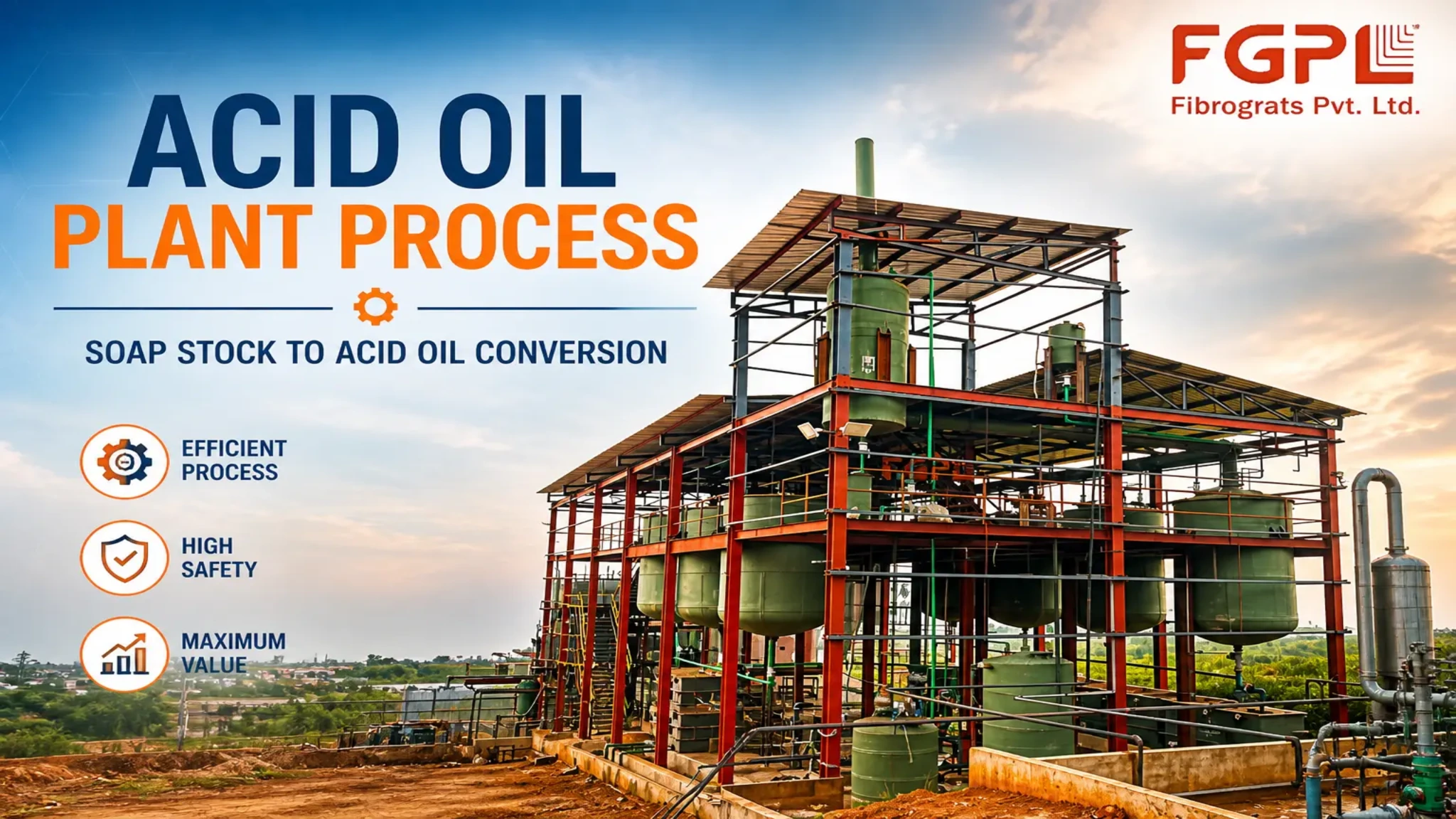
A Soap Stock Splitting Plant — also called an Acid Oil Plant or Soapstock Acidulation Plant — is a dedicated industrial facility designed to continuously process soap stock into acid oil using controlled acid treatment. These plants are typically installed adjacent to edible oil refineries, allowing soap stock to be piped directly from the refinery’s centrifuges.
- Continuous, automated operation with minimal manual intervention
- Corrosion resistance — since the process involves concentrated acids
- Maximum acid oil yield with minimum sludge generation
- Low acid consumption per tonne of soap stock processed
- Compliance with environmental standards on effluent acidity
How Does the Splitting Process Work? Step-by-Step
The soap stock splitting (acidulation) process follows a series of well-defined chemical and physical steps. Here is how a modern acid oil plant operates:
Key Components of an Acid Oil Plant
A well-designed plant consists of these major components, each engineered for corrosion resistance and operational reliability:
| Component | Function & Material Notes |
|---|---|
| Feed Storage Tank | Receives and stores incoming soap stock. FRP construction preferred for acid/chemical resistance. |
| Acid Dosing System | Precisely meters H₂SO₄ or HCl into the reactor. Includes acid storage, metering pump, and flow controller. |
| Reactor / Agitator Vessel | Main reaction vessel. High-grade FRP or rubber-lined SS; mechanical agitator ensures uniform mixing. |
| Separation Settler | Gravity separator for oil-water separation. Large residence-time tank in FRP or coated steel. |
| Wash Water System | Hot water stage to remove residual acid and sulfate salts from the separated acid oil. |
| Vacuum Dryer | Removes moisture to below 1%. SS or FRP construction with vacuum pump. |
| Corrosion-Proof Piping | All acid-contact pipelines, valves, and fittings in FRP, HDPE, or acid-grade alloys. |
| Effluent Treatment Unit | Neutralizes and settles acidic wastewater before discharge or reuse per regulatory norms. |
| Finished Product Storage | Insulated FRP or coated steel tanks sized for 3–7 days of production capacity. |
Why Corrosion Resistance Is Critical
The soap stock splitting process is among the most corrosive industrial processes in the oils & fats industry. Concentrated sulfuric acid, hot fatty acids, and acidic wastewater attack conventional metals rapidly — causing equipment failure, product contamination, and serious safety hazards.
This is why leading manufacturers use Fibre-Reinforced Plastic (FRP) as the material of choice for critical components. FRP offers:
-
Excellent resistance to concentrated H₂SO₄, HCl, and fatty acids -
Zero metal contamination of the acid oil product -
Light weight vs. metal — reducing civil and structural costs -
Long service life (15–25 years) with minimal maintenance -
Leak-proof construction when properly fabricated
💡 Stainless steel (SS 316/317L) is an alternative for high-temperature or high-pressure applications. The choice between FRP and SS depends on capacity, budget, acid type, and operating temperatures.
Global Applications: Who Uses Acid Oil Plants?
Acid oil plants are installed wherever edible oil refining takes place — effectively every continent. Major markets include:
Key Performance Metrics
When evaluating an acid oil plant — for purchase or performance benchmarking — these KPIs matter most:
| Parameter | Industry Average | Best-in-Class Target |
|---|---|---|
| Acid oil yield from soap stock | 70–80% | 85–95% ✓ |
| H₂SO₄ consumption per MT | 120–180 kg/MT | <100 kg/MT ✓ |
| Effluent pH after treatment | pH 1–2 | pH 3–4 ✓ |
| Moisture in finished acid oil | 2–5% | <1% ✓ |
| FFA content in acid oil | 75–85% | 85–95% ✓ |
| Sludge generated per MT | High (>30%) | Low (<15%) ✓ |
Regulatory & Environmental Considerations
- Effluent Treatment: Acidic wastewater must be neutralized before discharge. Most countries set limits on pH, COD, and TDS in industrial effluent.
- Fume Control: Acid vapor from the reactor is hazardous. Modern plants incorporate fume scrubbers to neutralize acid fumes before venting.
- Acid Storage Safety: Concentrated H₂SO₄ storage requires secondary containment, spill management, and PPE protocols per local standards (OSHA, CPCB, EU REACH).
- Product Quality Standards: Acid oil for animal feed must comply with EU Regulation 68/2013 (catalog of feed materials) or equivalent national standards in the target market.
Choosing the Right Acid Oil Plant Manufacturer
Not all acid oil plants are equal. When selecting a manufacturer, consider:
- Track Record: How many plants have they supplied? A manufacturer with 150–200+ installations has field-proven designs across diverse operating conditions.
- Material Quality: Do they use industrial-grade FRP, HDPE, or SS for acid-contact components? Mild steel construction is a false economy in this application.
- Process Efficiency: Can they demonstrate acid oil yields above 90% and acid consumption below 100 kg/MT?
- Customization: Can the plant be scaled to your capacity — from 5 MT/day to 500+ MT/day?
- After-Sales Support: Do they offer commissioning, operator training, and spare parts supply?
- Environmental Compliance: Is the plant designed with proper fume scrubbing and effluent treatment?