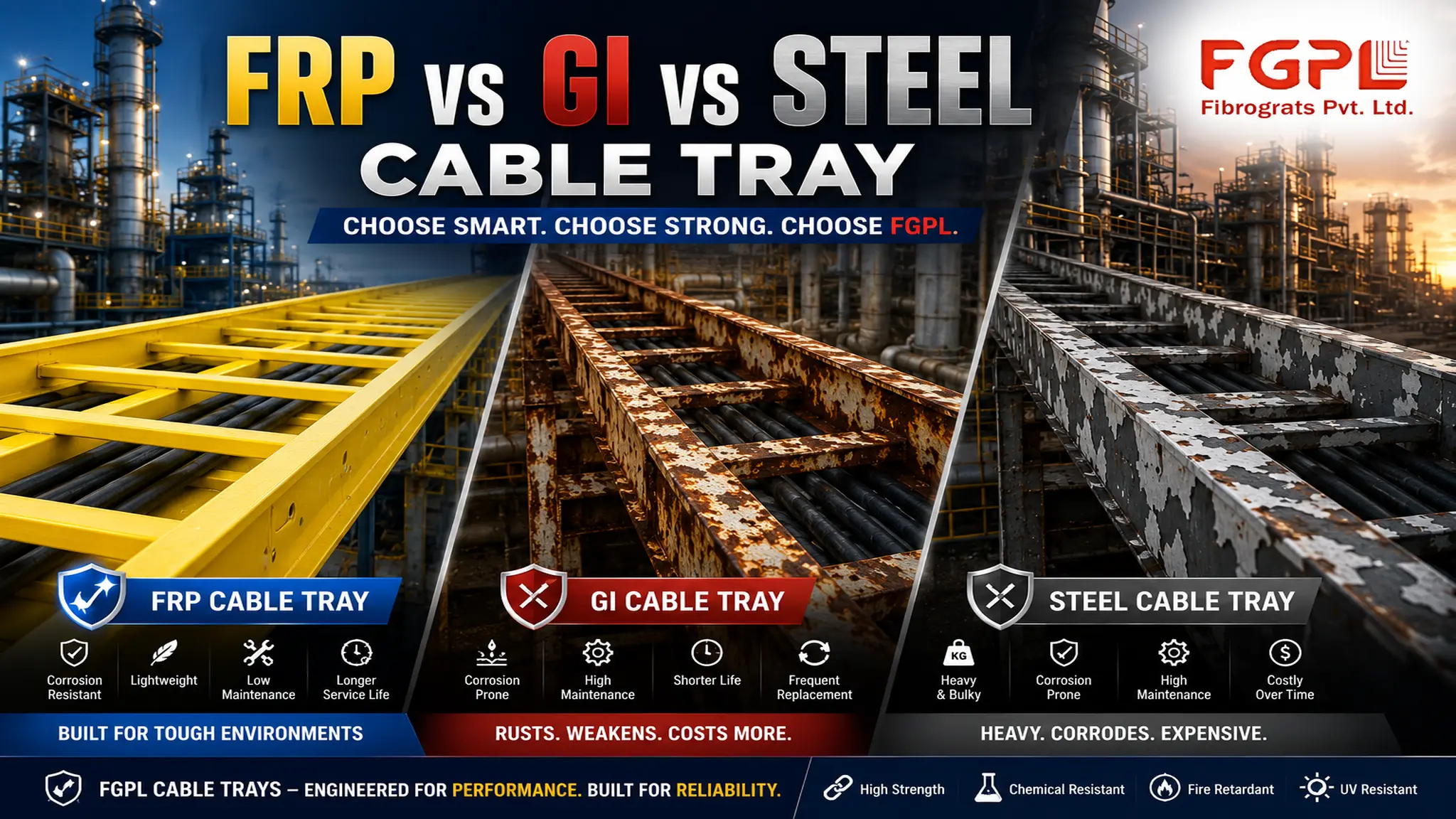
FRP vs GI vs Steel Cable Tray: Which Is Best for Industrial Use?
Walk through any older chemical plant, fertilizer facility, or coastal power station in India and you will find the same story: GI or MS cable trays eaten through by rust, sagging under their own weight, and coated in layers of paint that have long since cracked and peeled. In many cases, these trays are actively causing the problems they were supposed to prevent — damaged cables, short circuits, and costly downtime.
India’s industrial environments are uniquely harsh. High humidity, chemical fumes, salt-laden coastal air, acidic process environments, and extreme temperature cycles combine to destroy metallic cable management systems far faster than lab tests suggest. What lasts 20 years in a European facility may corrode out in 5 years in a Tamil Nadu coastal plant or a Gujarat chemical complex.
This is precisely why FRP (Fibre Reinforced Plastic) cable trays have seen rapid adoption across Indian industries over the past decade. But are they always better? And how exactly do they compare to the GI and steel trays that engineers have relied on for generations?
Let us go through the comparison point by point.
What Are FRP and GI Cable Trays?
FRP Cable Tray
FRP stands for Fibre Reinforced Plastic — sometimes also called GRP (Glass Reinforced Plastic). FRP cable trays are manufactured by embedding high-strength glass fibres into a polymer resin matrix — typically polyester, vinyl ester, or epoxy — through a process called continuous pultrusion. The result is a composite material with a glass fibre content of 60–65%, giving it exceptional strength for its weight.
Fibrograts (FGPL), one of India’s leading FRP cable tray manufacturers, produces trays in this manner at their fully automated plant in Indore, Madhya Pradesh, supplying to industries across 20 states and 10 countries.
GI / MS / Steel Cable Tray
GI (Galvanised Iron) and MS (Mild Steel) cable trays are made by roll-forming or welding steel sheets and then applying a protective zinc coating (galvanising) or paint. They have been the traditional default choice for cable management in Indian industrial facilities for decades, primarily because of their availability, familiarity, and low initial purchase cost.
Key distinction: FRP trays are engineered composites designed for long-term performance in aggressive environments. GI/Steel trays are commoditised metal products that rely on a surface coating for protection — a coating that eventually fails.
Head-to-Head Comparison: FRP vs GI vs Steel Cable Tray
The table below gives you a comprehensive side-by-side comparison across all the parameters that matter most for Indian industrial projects.
| Parameter | FRP Cable Tray | GI Cable Tray | MS/Steel Cable Tray |
| Material | Glass fibre + polymer resin | Galvanised (zinc-coated) steel | Mild steel + paint/epoxy coat |
| Weight | ~1/3rd of steel | Heavy | Heaviest |
| Corrosion Resistance | Excellent — inherent | Moderate — coating-dependent | Poor — rusts rapidly |
| Electrical Conductivity | Non-conductive | Conductive | Conductive |
| Earthing Required | No | Yes — mandatory | Yes — mandatory |
| Fire Behaviour | Self-extinguishing (FR grade) | Conducts & distributes heat | Conducts heat, warps |
| UV Resistance | UV stabilised — outdoor ready | Needs coating — degrades | Poor — needs frequent painting |
| Thermal Conductivity | Low — does not distribute heat | High — spreads heat to cables | High — significant heat dispersion |
| Magnetic Properties | Non-magnetic | Magnetic — causes EMI | Magnetic — causes EMI |
| Installation Ease | No hot-work permit needed | Cutting/welding may be needed | Welding often required |
| Maintenance | Near-zero | Periodic painting required | Frequent — rust treatment, painting |
| Lifespan (Indian conditions) | 25–40 years | 5–12 years | 3–8 years |
| Initial Cost | Moderate | Low | Low–Moderate |
| Total Cost of Ownership | Significantly lower | High — maintenance & replacement | Highest — frequent replacement |
| Suitable for Chemical Environments | Yes — ideal | No | No |
| Suitable for Coastal/Marine | Yes — marine grade available | No | No |
1. Weight — The Installation Advantage
FRP cable trays weigh approximately one-third of equivalent steel trays and one-fourth of aluminium trays. This seemingly simple fact has enormous practical implications on a large industrial project.
When cable trays run for hundreds of metres across a large plant, the cumulative weight difference is significant. Lighter trays mean:
For large EPC projects — fertilizer plants, refineries, power stations — where cable tray runs can extend over kilometres, this weight saving translates into measurable cost reduction at the project level.
2. Corrosion Resistance — The Core Argument
This is where FRP wins most decisively against GI and MS cable trays, and it is the primary reason engineers in India are switching. Corrosion is not a minor inconvenience — it is a safety and business risk.
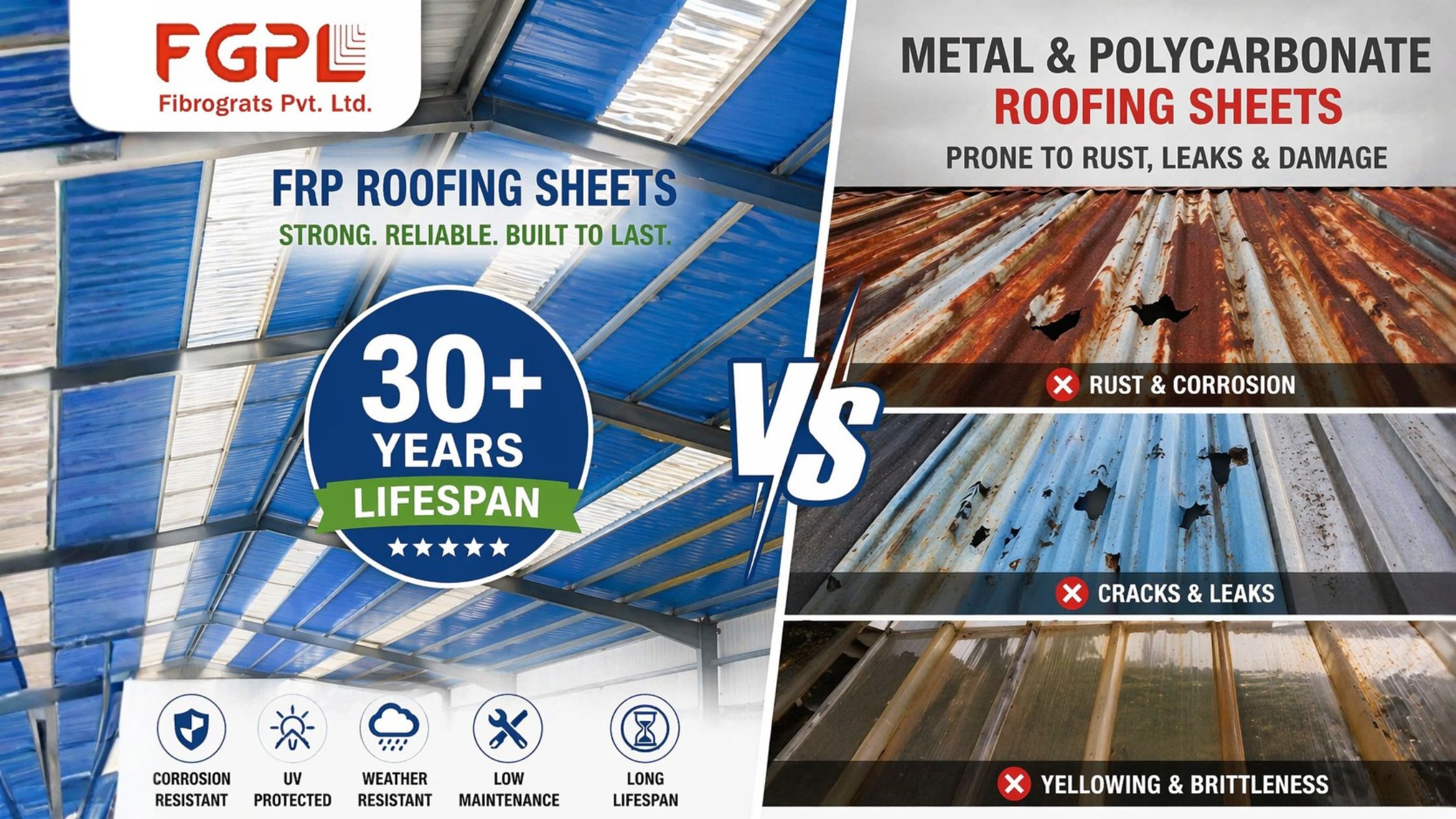
GI trays rely on a thin zinc coating to protect the steel beneath. In a dry, indoor environment with no chemical exposure, this coating can last many years. But in the environments where most Indian heavy industries operate — chemical fumes, acid mists, coastal salt air, high humidity, or constant washdowns — the zinc coating fails relatively quickly. Once it fails, the underlying steel corrodes rapidly, weakening the tray structure and potentially damaging the cables it carries.
MS trays without galvanising are even more vulnerable. Paint coatings on MS trays in aggressive environments typically begin failing within 2–3 years, requiring periodic repainting to extend service life.
Real-world example: In a coastal chemical plant in Gujarat, GI cable trays installed in a chlorine-handling area showed visible rust and structural degradation within 18 months. Replacement with FRP cable trays from FGPL eliminated the problem — the FRP trays showed zero degradation after 7 years in the same environment.
FRP cable trays, by contrast, have inherent corrosion resistance — not a coating that can be scratched off or wear away. The polymer resin matrix itself is chemically inert to most industrial chemicals, acids, alkalis, salt water, and fumes. This resistance is not surface-deep; it extends throughout the material.
Different resin systems offer varying levels of chemical resistance:
FGPL offers all three resin systems, allowing engineers to specify the right grade for their specific environment rather than accepting a one-size-fits-all solution.
3. Electrical Safety — The Hidden Cost of Metallic Trays
GI and MS cable trays are electrically conductive. This creates two important obligations that many project teams underestimate at the planning stage.
First, all metallic cable trays must be properly earthed in accordance with IS:3043 and other applicable Indian standards. This requires dedicated earthing conductors running the entire length of the tray, bonding connections at every joint, and periodic testing of earthing continuity. On a large facility, this can add significantly to both material and labour costs.
Second, a fault in an inadequately earthed metallic tray system creates a genuine electrocution risk for maintenance personnel. This is a liability that facility operators and EPC contractors take very seriously.
FRP advantage: FRP cable trays are fully non-conductive. They require no earthing, eliminating the associated material cost, installation time, and ongoing compliance obligation entirely. In large facilities, the earthing cost savings alone can offset a significant portion of the price difference between FRP and GI trays.
The non-magnetic properties of FRP also offer a secondary benefit: no electromagnetic interference (EMI) with sensitive instrumentation and control cables running in nearby trays. In process industries where instrumentation accuracy is critical, this matters.
4. Fire Safety — FRP’s Counterintuitive Advantage
Many engineers instinctively assume that a plastic material would be a fire hazard compared to metal. The reality for quality FRP cable trays is the opposite.
GI and steel trays are excellent conductors of heat. In a cable fire, metallic trays actively spread heat along their length, potentially igniting cables in adjacent sections and accelerating the spread of fire through a facility. Steel trays also warp and deform under intense heat, compromising the structural support for cables at a critical moment.
Fire-retardant grade FRP cable trays — such as those manufactured by FGPL — are formulated to be self-extinguishing. When the flame source is removed, the material stops burning. It does not propagate the fire, and it does not conduct heat along the tray length. This is a critical distinction in facilities where a cable fire must be contained rather than allowed to spread.
FGPL’s FRP cable trays meet stringent fire-retardant requirements, tested to applicable standards for self-extinguishing behaviour.
5. Cost Analysis — Initial Price vs Total Cost of Ownership
The most common objection to FRP cable trays is upfront cost. It is true that FRP trays typically cost more per metre than basic GI trays at the point of purchase. However, this comparison is dangerously incomplete when applied to real industrial projects with 20–30 year lifespans.
A proper cost analysis must include:
| Cost Component | FRP Cable Tray | GI Cable Tray |
| Purchase price per metre | Moderate | Low |
| Earthing system (conductor + bonding) | ₹0 — not required | Significant — mandatory |
| Support structure size | Smaller — lighter tray | Larger — heavier tray |
| Installation labour | Lower — no hot-work permit, lighter material | Higher — cutting, welding, earthing connections |
| Painting / maintenance (Year 1–5) | Nil | Moderate — first repaint cycle |
| Painting / maintenance (Year 5–15) | Nil | Significant — 2–3 repaint cycles |
| Partial replacement (Year 8–12) | Nil (if FRP) | High — sections replaced due to corrosion |
| Full replacement (Year 15–20) | Unlikely | Very likely in aggressive environments |
| Production downtime for maintenance | Near zero | Periodic — painting requires access shutdown |
| Estimated 20-year total cost | Lower overall | Often 2–3x FRP lifecycle cost |
When all costs are accounted for — earthing, painting, maintenance, replacement, and production downtime — FRP cable trays consistently deliver a lower total cost of ownership over the operational life of an Indian industrial facility, particularly in aggressive environments.
The initial price premium typically pays back within 3–5 years in most industrial applications, after which FRP delivers cost-free service for decades.
When Might GI Trays Still Make Sense?
To be fair and balanced: there are scenarios where GI cable trays remain a reasonable choice.
In all other scenarios — particularly in Indian heavy industry, process plants, outdoor installations, coastal environments, and any facility with chemical exposure — FRP is the technically superior and lifecycle-cost-superior choice.
The Verdict: A Quick Summary
Why Choose FGPL for FRP Cable Trays?
If you have decided that FRP is the right choice for your project, choosing the right manufacturer is the next critical step. Not all FRP cable trays are manufactured to the same standard — glass content, resin quality, pultrusion process control, and fire-retardant formulation vary widely between manufacturers.
Fibrograts Pvt. Ltd. (FGPL), based in Indore, Madhya Pradesh, is one of India’s most established FRP cable tray manufacturers with over 30 years of experience in fibre reinforced plastics. Key reasons engineers and procurement teams across India trust FGPL:
Ready to switch to FRP? Contact FGPL’s team at +91 70241-30082 or fill the enquiry form at fibrograts.com/contact-us to get a project-specific quote within 24 hours.
Conclusion
The comparison between FRP and GI/Steel cable trays is not really close when evaluated on the full set of parameters that matter to Indian industrial facilities — corrosion resistance, total cost of ownership, fire safety, electrical safety, weight, and maintenance burden.
GI trays win only on initial purchase price, and even that advantage narrows significantly when earthing, installation labour, and support structure costs are included in the upfront calculation.
For any facility in a corrosive, coastal, chemical, outdoor, or high-humidity environment — which describes the majority of Indian heavy industrial installations — FRP cable trays are not just better, they are the professionally correct choice.
The engineers and plant managers who switched to FRP ten years ago are not repainting, not replacing, and not dealing with cable faults caused by corroded tray structures. That peace of mind, multiplied across the operational life of a large facility, is worth considerably more than the initial price difference.
Ready to Switch to FRP Cable Trays?
Get a customised quote from Fibrograts — India’s trusted FRP cable tray manufacturer since 2009.