1
The Problem
Challenges in Chemical and Industrial Environments
Process industries operate in some of the most materials-hostile environments on earth. Chemical spills, submerged platforms, salt-laden air, high-temperature vapours, and electrical hazards combine to destroy conventional steel and wooden gratings far faster than project planners anticipate.
Plant engineers and safety managers across chemical, wastewater, oil & gas, and power sectors face a common set of structural flooring challenges that conventional materials simply are not equipped to handle reliably over the long term.
🧪
Chemical Corrosion
Acids, alkalis, solvents, and chlorinated compounds attack mild steel grating, causing rapid section loss and structural failure within 2–5 years in active chemical zones.
💧
Constant Moisture
Wastewater plants, cooling systems, and offshore platforms maintain near-permanent moisture saturation — accelerating rust formation in carbon steel and biological degradation in timber.
⚡
Electrical Hazard
Conductive metal grating near live electrical equipment, substations, and control rooms creates electrocution risk — a critical HSE liability in process plant environments.
💸
High Maintenance Cost
Repainting, re-coating, and replacing corroded steel grating every 3–7 years creates recurring CAPEX and forces plant shutdowns for safety-critical access replacement work.
🏗️
Heavy Structural Load
Dense steel grating adds significant dead load to elevated platforms, mezzanines, and offshore structures — increasing structural engineering requirements and material cost.
🔥
Fire & Explosion Risk
In refineries and gas processing facilities, sparking from metal-on-metal contact at grating level creates ignition risk in areas with flammable vapour accumulation.
🔄
The FRP Answer to All Six Challenges
FRP grating is inherently corrosion-proof, non-conductive, non-sparking, fire-retardant capable, and 70% lighter than steel — addressing every challenge listed above through material science rather than coatings or maintenance regimes.
2
Performance
Why FRP Grating Performs Better Than Metal Grating
The performance advantage of FRP over metallic gratings in aggressive industrial environments is not marginal — it is categorical. The comparison below reflects real-world field performance data from process industry installations across India and internationally.
| Performance Factor |
FRP Grating |
MS / GI Steel |
SS 316 |
| Acid Resistance (H₂SO₄, HCl) |
✔ Excellent |
✘ Fails rapidly |
~ Limited |
| Alkali Resistance |
✔ Excellent |
✘ Poor |
✔ Good |
| Chlorine & Hypochlorite |
✔ Excellent |
✘ Rapid corrosion |
~ Moderate |
| Saltwater / Marine |
✔ Unaffected |
✘ Rapid rust |
~ Moderate |
| H₂S (Hydrogen Sulphide) |
✔ Resistant |
✘ Severe attack |
~ Variable |
| Electrical Conductivity |
✔ Non-conductive |
✘ Conductive |
✘ Conductive |
| Spark Generation |
✔ Non-sparking |
✘ Sparking risk |
✘ Sparking risk |
| Weight vs Steel |
✔ ~70% lighter |
✘ Baseline heavy |
✘ Heavier |
| Maintenance Cycle |
✔ None required |
✘ 3–5 yr recoat |
~ Periodic |
| Typical Field Life |
✔ 25–30 years |
✘ 4–8 years |
~ 12–18 years |
Resin Grade Selection for Chemical Environments
The key to FRP grating’s chemical resistance lies in resin selection. FGPL offers three primary resin systems matched to specific environmental severity:
🟦
Isophthalic Polyester
General industrial use. Suitable for mild acids, alkalis, and humid environments. Most cost-effective grade.
RECOMMENDED
🟠
Vinyl Ester
Superior resistance to concentrated acids, solvents, and chlorinated compounds. Preferred for chemical and wastewater plants.
🔴
Phenolic Resin
Maximum fire resistance. BS 476 Class 1 compliant. For refineries, offshore platforms, and high fire-risk zones.
🟢
Fire-Retardant Polyester
Balanced fire resistance and chemical performance. Suitable for power plants and general process industry.
3
Application
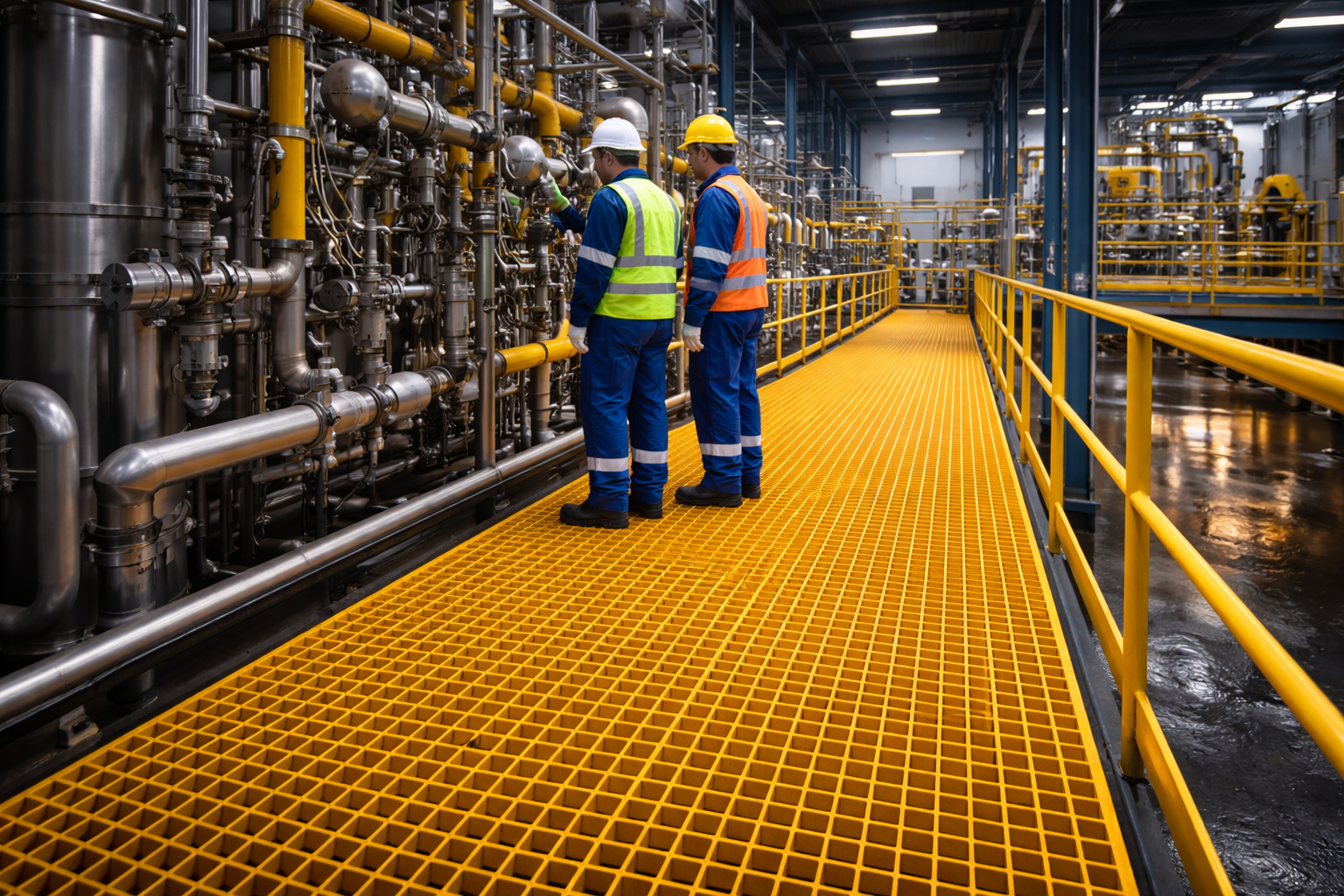
FRP Grating for Chemical Plants
Chemical manufacturing plants represent the most demanding test for any flooring material. Sulphuric acid, hydrochloric acid, caustic soda, ammonia, chlorine gas, and dozens of organic solvents are handled daily at temperatures ranging from sub-zero to above 100°C. FRP grating manufactured with vinyl ester or high-performance polyester resin is the material of choice across this sector globally.
🧪
Chemical Plant FRP Applications
Acid bays · Reactor platforms · Tank farm walkways · Mixing areas · Chemical storage
In chemical plants, FRP grating is deployed in the most chemically aggressive zones where any metallic material would require complete replacement within a few years of service.
- ▸Sulphuric acid (H₂SO₄) storage and dilution areas
- ▸Hydrochloric acid (HCl) handling platforms
- ▸Caustic soda (NaOH) production walkways
- ▸Chlorine gas processing areas
- ▸Ammonia plant access platforms
- ▸Solvent storage tank surrounds
- ▸Electroplating and pickling line grating
- ▸Battery room and acid charging areas
- ▸Fertilizer plant ammonium nitrate zones
- ▸Pharmaceutical API production platforms
Chemical Resistance Reference — FGPL Vinyl Ester FRP
| Chemical / Medium |
Conc. |
Temp |
Rating |
| Sulphuric Acid (H₂SO₄) |
Up to 70% |
60°C |
EXCELLENT |
| Hydrochloric Acid (HCl) |
Up to 35% |
50°C |
EXCELLENT |
| Sodium Hydroxide (NaOH) |
Up to 50% |
60°C |
EXCELLENT |
| Sodium Hypochlorite |
Up to 15% |
40°C |
EXCELLENT |
| Chlorine (aqueous) |
Saturated |
35°C |
GOOD |
| Acetic Acid |
Up to 50% |
50°C |
EXCELLENT |
| Phosphoric Acid |
Up to 85% |
60°C |
EXCELLENT |
| Ammonia (aqueous) |
Up to 30% |
50°C |
GOOD |
| Seawater / Brine |
Saturated |
80°C |
EXCELLENT |
| Diesel / Fuel Oil |
Neat |
40°C |
GOOD |
Note: EXCELLENT = no degradation, GOOD = minor surface effect. Full chemical resistance charts available from FGPL technical team.
📋
Specification Note
For chemical plant applications, FGPL recommends vinyl ester resin moulded grating, 38mm depth, with silicon carbide anti-slip surface and secondary veil layer for maximum chemical barrier performance. Custom mesh sizes (25×25mm mini-mesh) available for areas where chemical containment and minimal spill-through is required.
4
Application
FRP Grating for Wastewater Treatment Plants
Wastewater treatment plants (WWTPs) operate in perpetually humid, chemically complex, and biologically active environments. Hydrogen sulphide (H₂S) generated during anaerobic digestion is particularly destructive — corroding steel at accelerated rates that shock maintenance teams unfamiliar with the phenomenon. FRP grating is now the de-facto standard for new WWTP construction globally.
💧
Wastewater Treatment FRP Applications
Aeration tanks · Clarifiers · Sludge handling · Chlorination · Pump rooms
Every functional zone within a wastewater plant benefits from FRP grating’s combination of chemical inertness, slip resistance, and open-mesh drainage properties.
- ▸Primary and secondary clarifier walkways
- ▸Aeration tank perimeter platforms
- ▸Screenhouse and grit chamber grating
- ▸Sludge thickener access platforms
- ▸Digestor dome and roof walkways
- ▸Chlorination and dosing area platforms
- ▸Pump room and MCC room flooring
- ▸Filter bed and biofilm reactor covers
- ▸Effluent channel bridge decking
- ▸UV disinfection unit access grating
The H₂S Problem — Solved by FRP
Hydrogen sulphide (H₂S) produced in septic and anaerobic zones dissolves in condensation water to form sulphuric acid at pH levels as low as 1–2. This concentrated acid attacks steel grating at a rate of 0.1–1.0mm section loss per year, making structural failure a real risk within 3–5 years in unprotected installations.
✅
FRP Solution
Vinyl ester FRP grating is completely unaffected by H₂S and biogenic sulphuric acid at the concentrations typically found in wastewater treatment environments. FGPL-supplied FRP grating installed in WWTP projects across Maharashtra and Gujarat has been in continuous service for over 12 years with no structural degradation or maintenance intervention.
Additionally, FRP’s open mesh design (65–75% open area) provides unobstructed drainage, preventing the liquid pooling that accelerates corrosion and creates slip hazards on conventional solid-top or closely-spaced steel grating.
5
Application
FRP Grating for Oil & Gas Industry Platforms
The oil and gas sector demands that every structural material meet the dual requirement of extreme chemical resistance and fire safety — a combination that historically drove the entire offshore and onshore process industry towards stainless steel at enormous cost. FRP grating — particularly phenolic grade — now offers a credible, compliant, and significantly more cost-effective alternative.
🛢️ Upstream Oil Fields
🏭 Refineries
🌊 Offshore Platforms
⛽ LNG Terminals
🔧 Pipeline Stations
🧯 Gas Processing Plants
🚢 FPSO Vessels
🏗️ Petrochemical Plants
Key FRP Properties for Oil & Gas Environments
- ▸Non-sparking surface: Critical in areas where hydrocarbon vapour accumulation creates explosive atmospheres (ATEX/HAZLOC zones)
- ▸Phenolic fire rating: Phenolic FRP meets IMO FTP Code Annex 1 Part 2 — mandatory for passenger and cargo vessels and recommended for offshore installations
- ▸Hydrocarbon resistance: FRP resists crude oil, diesel, kerosene, LPG condensate, and most refined products without swelling or structural degradation
- ▸Offshore corrosion resistance: Completely unaffected by salt spray, seawater immersion, and the combined marine-chemical environment of offshore platforms
- ▸Lightweight for offshore weight budgets: Weight savings of 70% vs steel gratings directly reduce topside structural steel requirements and platform jacket cost
🛢️
Oil & Gas Platform FRP Applications
Wellhead decks · Separator platforms · Pipe racks · Escape routes · Helidecks surrounds
- ▸Wellhead and Christmas tree access platforms
- ▸Separator and vessel maintenance decking
- ▸Crude oil and gas pipeline walkways
- ▸Pump and compressor station platforms
- ▸Tank farm bund wall access grating
- ▸Loading arm and jetty access walkways
- ▸Offshore module primary and secondary decking
- ▸Emergency evacuation route grating
- ▸Flare stack base access platforms
- ▸Storage tank roof access walkways
🔥
Fire Safety Compliance
FGPL phenolic FRP grating achieves a flame spread index below 25 (ASTM E84 Class A), smoke density rating below 450, and meets IMO FTP Code requirements. Fire test certificates issued by accredited NABL laboratories are available for project submissions and safety audits.
6
Application
FRP Grating for Power Plants and Refineries
Power generation and refinery operations combine the corrosive chemistry of process industries with high temperatures, continuous vibration, and stringent electrical safety requirements. FRP grating addresses all three simultaneously — making it a natural specification choice for plant engineers in these sectors.
⚡
Power Plant FRP Applications
Boiler areas · Switchyards · Cooling towers · Ash handling · Switchgear rooms
In thermal, hydro, solar, and nuclear power plants, FRP grating serves multiple critical functions from electrical insulation to corrosion resistance in wet flue gas scrubbing systems.
- ▸Switchyard and substation walkways
- ▸Cable tray and conduit access platforms
- ▸Battery room and UPS area flooring
- ▸Cooling tower access and basin grating
- ▸Wet FGD (flue gas desulphurisation) platforms
- ▸Ash slurry pump station grating
- ▸Turbine hall mezzanine flooring
- ▸Boiler feed pump access platforms
- ▸Demineralised water plant walkways
- ▸Coal/biomass handling conveyor walkways
Electrical Safety in Switchyards & Substations
FRP grating’s dielectric strength of 35 kV/mm makes it the preferred passive insulation solution in switchyards, substations, and battery rooms. Unlike rubber matting which cracks, hardens, and disintegrates over time, FRP grating provides permanent structural flooring with maintained insulation properties across its entire 25+ year service life.
| Dielectric Strength |
> 35 kV (per mm thickness) |
| Volume Resistivity |
> 10¹⁰ Ω·cm |
| Surface Resistivity |
> 10⁹ Ω/square |
| Applicable Standard |
ASTM D-149 / IEC 60243 |
| ESD Grade (optional) |
10⁶–10⁸ Ω range for static-sensitive zones |
⚡
Refinery Application Note
In petroleum refineries, FGPL FRP grating is routinely specified for crude distillation unit (CDU) platforms, hydrocracker area access, and desalter unit walkways — where combined exposure to H₂S, chloride-containing brine, hydrocarbons, and high-pressure steam would destroy mild steel grating within 3–4 years at replacement costs exceeding ₹15–20 lakh per major walkway zone.
7
Safety
Safety Benefits of FRP Grating in Hazardous Areas
Safety is not a secondary consideration in process industries — it is the primary specification driver. FRP grating delivers a multi-layered safety profile that no metallic grating system can match without elaborate and maintenance-intensive add-on systems.
🦶
Integral Anti-Slip Surface
Silicon carbide or quartz grit moulded permanently into the surface provides R12–R13 slip resistance — exceeding regulatory requirements for industrial walkways even when wet, oily, or contaminated with process chemicals.
⚡
Electrical Non-Conductivity
Passive electrical insulation at 35+ kV eliminates electrocution risk in switchyards, battery rooms, and cable distribution areas. No maintenance required to maintain insulation effectiveness.
🔥
Fire-Retardant Grades
Phenolic FRP achieves self-extinguishing behaviour, low smoke density, and near-zero flame spread index — critical for process industries where fire events can escalate rapidly.
💥
Non-Sparking Properties
FRP grating generates no metal-on-metal sparks during installation, maintenance, or impact — eliminating ignition risk in ATEX Zone 1 and Zone 2 classified areas near flammable vapour sources.
🌊
Drainage & Visibility
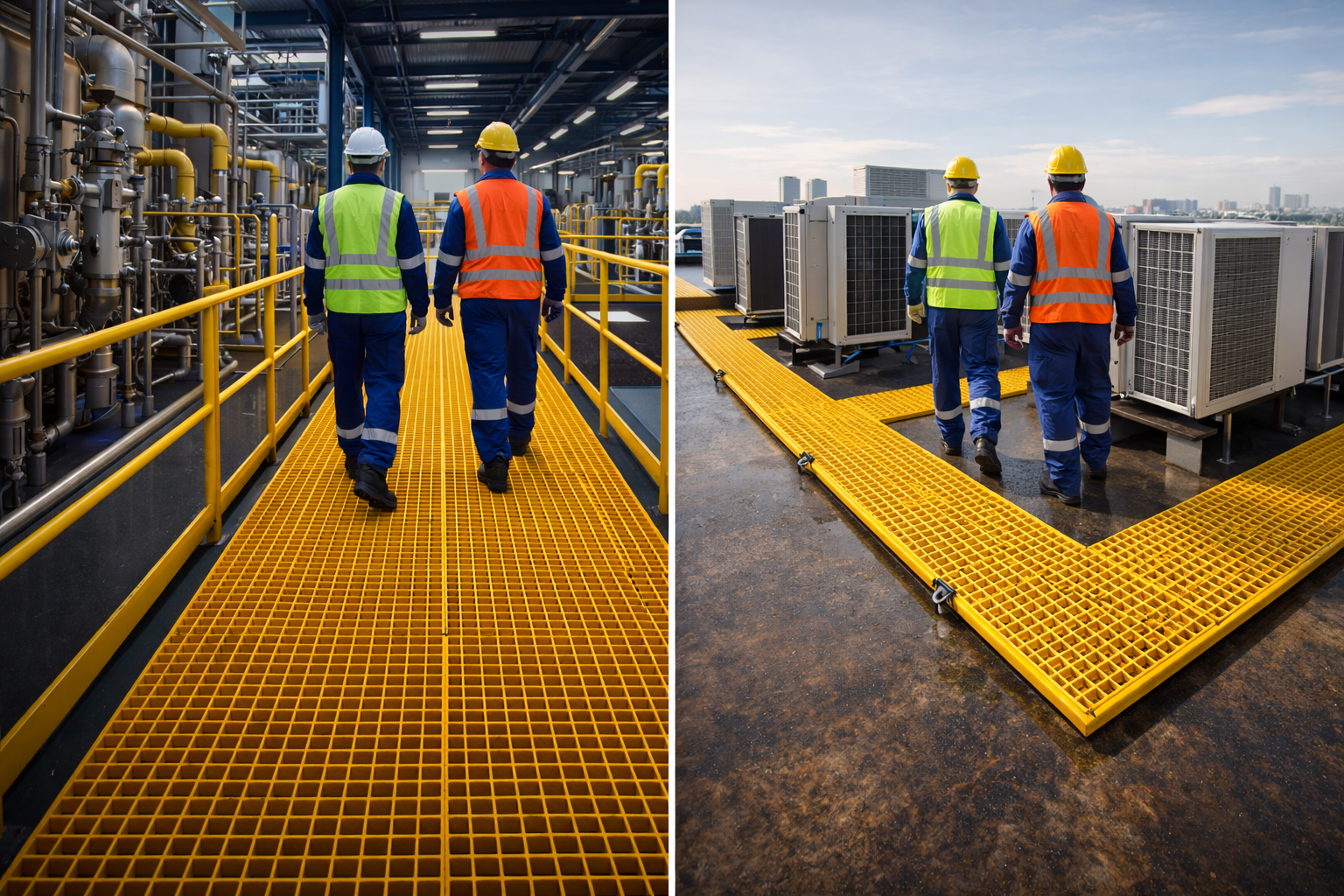
Open mesh design (65–75%) provides unobstructed liquid drainage, preventing pooling that creates slip hazards. Available in high-visibility safety yellow for hazardous zone demarcation.
🏗️
Structural Integrity Over Life
Unlike corroded steel that fails catastrophically, FRP degradation is gradual and visually detectable. There are no hidden section losses, no rust-concealed structural failures, and no sudden platform collapses from corrosion-induced weakening.
☣️
Chemical Containment
Mini-mesh FRP grating (25×25mm apertures) limits chemical spill-through, providing a level of secondary containment at platform level that is impossible with open-bar or widely spaced steel grating.
⚖️
Reduced Manual Handling Risk
At 70% lighter than equivalent steel panels, FRP grating significantly reduces installation-phase manual handling injuries — a major HSE benefit during plant construction, turnarounds, and panel replacement.
📜
Regulatory & Standards Compliance
FGPL FRP grating products comply with IS 14570, BS 4592 (Part 4 — GRP grating), ASTM D-790, ASTM D-638, ASTM E84, IMO FTP Code, and OSHA walkway surface requirements. Documentation for all standards available on request for project QA submissions.
8
Our Expertise
Why FGPL is a Trusted FRP Grating Manufacturer in India
Fibrograts Pvt Ltd (FGPL) has built its reputation by supplying high-performance FRP grating to some of India’s most demanding process industry projects — including chemical complexes, municipal wastewater plants, power generation facilities, and offshore support installations.
🔬
Resin Engineering Expertise
We formulate and select resin systems specifically matched to your plant’s chemical inventory — not generic catalogue specifications.
📐
Project-Specific Fabrication
All panels cut to your exact BOM dimensions with notches, cutouts, and shaped sections. Zero-waste site installation.
🏆
Certified Quality
ISO-certified manufacturing with NABL-accredited test reports covering mechanical, fire, and chemical resistance performance.
🧠
Technical Application Support
Our engineers provide chemical compatibility assessments, load calculations, and platform layout drawings at no charge for project orders.
⚡
Fast Project Delivery
Standard sizes from stock. Custom fabricated panels dispatched within 7–14 working days to any location across India.
🌍
Export Capability
FGPL supplies FRP grating for export projects in the Middle East, Southeast Asia, and Africa with full export documentation support.
Whether you are specifying for a new greenfield plant, upgrading an existing facility, or responding to a safety-critical corrosion failure, FGPL’s technical team is ready to support your project from specification to installation.
✦
FAQ
Frequently Asked Questions
Questions most frequently asked by plant engineers, safety managers, and procurement teams evaluating FRP grating for chemical and process industry applications.
+
What is the lifespan of FRP grating in a chemical plant environment?
In well-specified FRP grating installations using vinyl ester or high-performance polyester resin, field experience consistently demonstrates design lives of 25–30 years even in aggressive chemical environments. The key variable is resin selection — FGPL’s technical team will review your chemical inventory and recommend the optimal resin grade at no charge.
+
Does FRP grating meet fire safety standards for refineries and oil & gas plants?
Yes. FGPL supplies phenolic resin FRP grating that meets ASTM E84 Class A (flame spread index below 25, smoke density below 450), BS 476 Part 7 Class 1, and IMO FTP Code requirements. These grades are suitable for offshore platforms, refineries, LNG terminals, and any installation governed by fire safety codes. NABL-accredited fire test certificates are available for all phenolic grade products.
+
Can FRP grating be used in areas classified as ATEX / HAZLOC explosive atmospheres?
FRP grating is non-sparking and non-conductive — two properties that make it suitable for use in ATEX Zone 1 and Zone 2 / HAZLOC Class I Div 1 and Div 2 classified areas. For areas with specific static electricity accumulation concerns (such as certain solvent handling zones), FGPL also supplies ESD-grade FRP grating with controlled surface resistivity in the 10⁶–10⁸ Ω range.
+
What safety standards govern FRP grating for wastewater treatment plant installations in India?
FRP grating for wastewater treatment applications in India is typically specified under IS 14570, which covers GRP/FRP gratings for industrial applications. Additionally, ASTM D-790 (flexural properties), ASTM D-638 (tensile properties), and ASTM E84 (fire spread) are referenced in project specifications. FGPL products carry test certificates for all these standards from NABL-accredited laboratories.
+
Can FRP grating panels be customised in size, mesh opening, and colour?
Comprehensive customisation is a core strength of FGPL. Panels are available in any cut size, mesh opening (25×25mm mini-mesh through to 50×50mm standard), thickness (25mm, 38mm, 50mm), resin type, colour (grey, yellow, green, red, or custom RAL), and surface finish (grit top, smooth top, or concave profile). Shaped panels with notches, holes, or compound cutouts are fabricated from BOM drawings with no additional lead time for standard orders.
+
How is FRP grating installed in an operating chemical plant where hot work is prohibited?
This is one of FRP grating’s most significant practical advantages in operating plant environments. FRP panels are fixed using GRP clip fasteners, stainless steel saddle clamps, or bolted angle retainers — all cold-work operations requiring no welding, grinding, or flame cutting. Panels are trimmed on-site with standard circular saw blades fitted with a fine-tooth carbide blade. Hot work permits are not required, making installation viable during plant operation or restricted maintenance windows.
+
What maintenance does FRP grating require in a wastewater treatment plant?
FRP grating in wastewater treatment plants requires essentially no scheduled maintenance. Periodic visual inspection as part of routine HSE walkdowns is recommended to check for mechanical impact damage or loose fixings. Cleaning, if required, can be performed with water jets or standard industrial detergents — no specialist chemicals or surface treatments are needed. Individual damaged panels can be replaced without disturbing adjacent panels or the supporting structure.
+
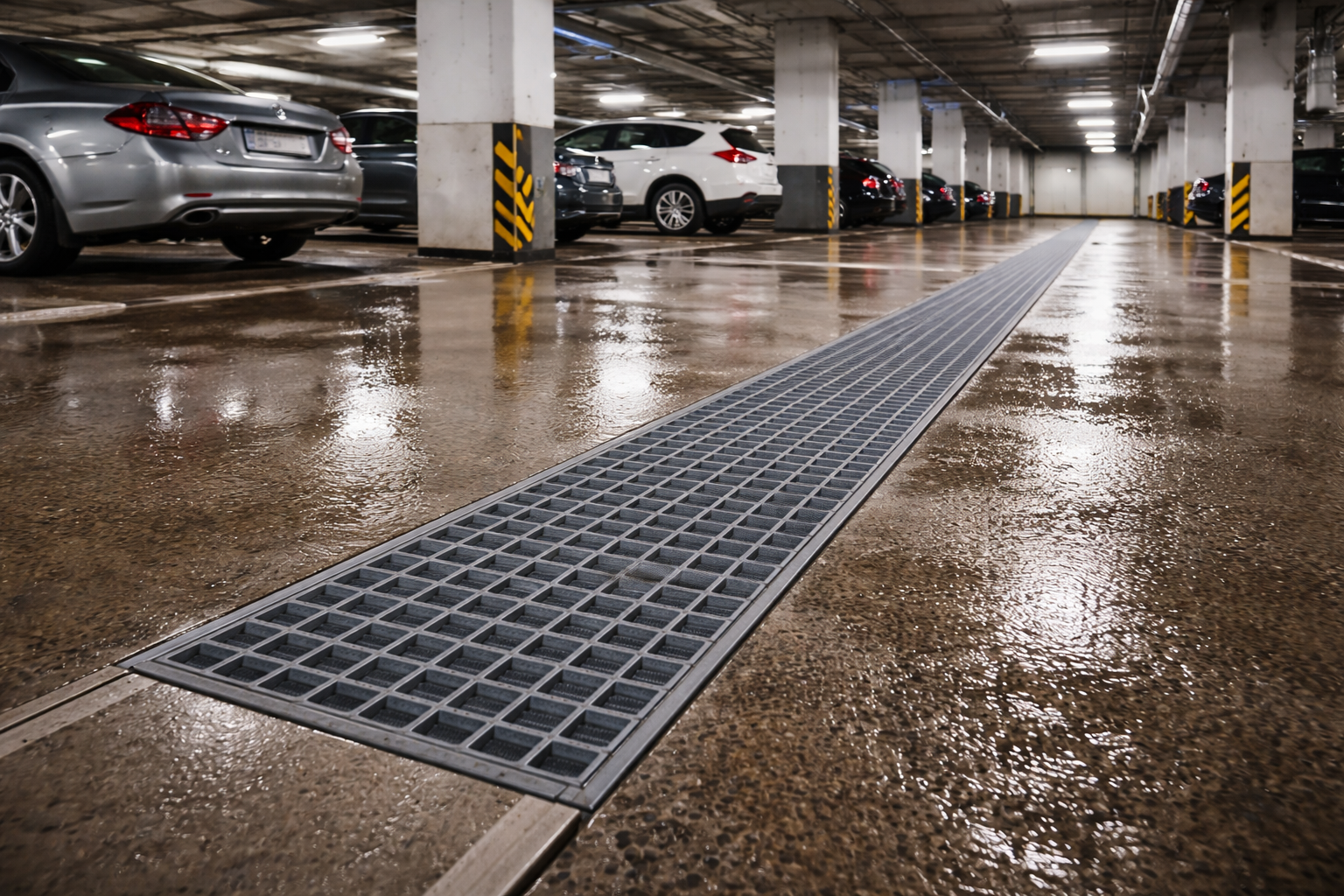
Is FRP grating suitable for sump covers and trench covers in chemical plants?
Yes. FRP grating is widely used as sump covers, drain trench covers, and bund floor grating in chemical plant environments. Mini-mesh grade (25×25mm apertures) is recommended for sump and trench covers to comply with fall-protection requirements under IS and international safety codes. FGPL fabricates covers with integral aluminium or GRP frame sections and lifting handles as required by your HSE specification.