Choosing the right overhead covering for a factory, warehouse, chemical facility, or logistics hub is rarely straightforward. Two materials consistently come up in specifications and procurement discussions: fiberglass reinforced plastic (FRP) sheets and polycarbonate panels. Both offer significant advantages over conventional metal or cement options — yet they differ in ways that matter greatly depending on the environment, span, and operational priorities of a given project.
This article breaks down the FRP vs polycarbonate roofing sheets debate across every dimension that influences real-world performance — structural integrity, light transmission, chemical resistance, thermal behavior, service life, and total cost of ownership.
Understanding the Materials
What are FRP Roofing Sheets?
Fiberglass reinforced plastic panels are composite materials formed by embedding continuous glass fiber mats or woven rovings into a thermosetting resin matrix — typically unsaturated polyester, vinyl ester, or phenolic resin depending on the application. The resulting sheet combines the tensile strength of glass with the chemical inertness and moldability of polymers. A UV-resistant surface veil is typically applied during manufacturing to protect the fiber reinforcement from photodegradation. The outcome is a panel that is simultaneously strong, lightweight, and highly resistant to the corrosive, humid, and thermally variable environments common in heavy industry.
What are Polycarbonate Sheets?
Polycarbonate is a pure thermoplastic material derived from bisphenol-A polycarbonate resin. Unlike FRP, it contains no fiber reinforcement — its mechanical properties rely entirely on the polymer chain structure. Polycarbonate panels are available in two primary formats: solid flat or corrugated sheets, and multi-wall (twin-wall or triple-wall) structured panels with internal air channels. The multi-wall variants offer improved thermal insulation alongside their signature clarity. A co-extruded UV coating on the outer surface is standard practice, as unprotected polycarbonate degrades rapidly under direct sunlight.
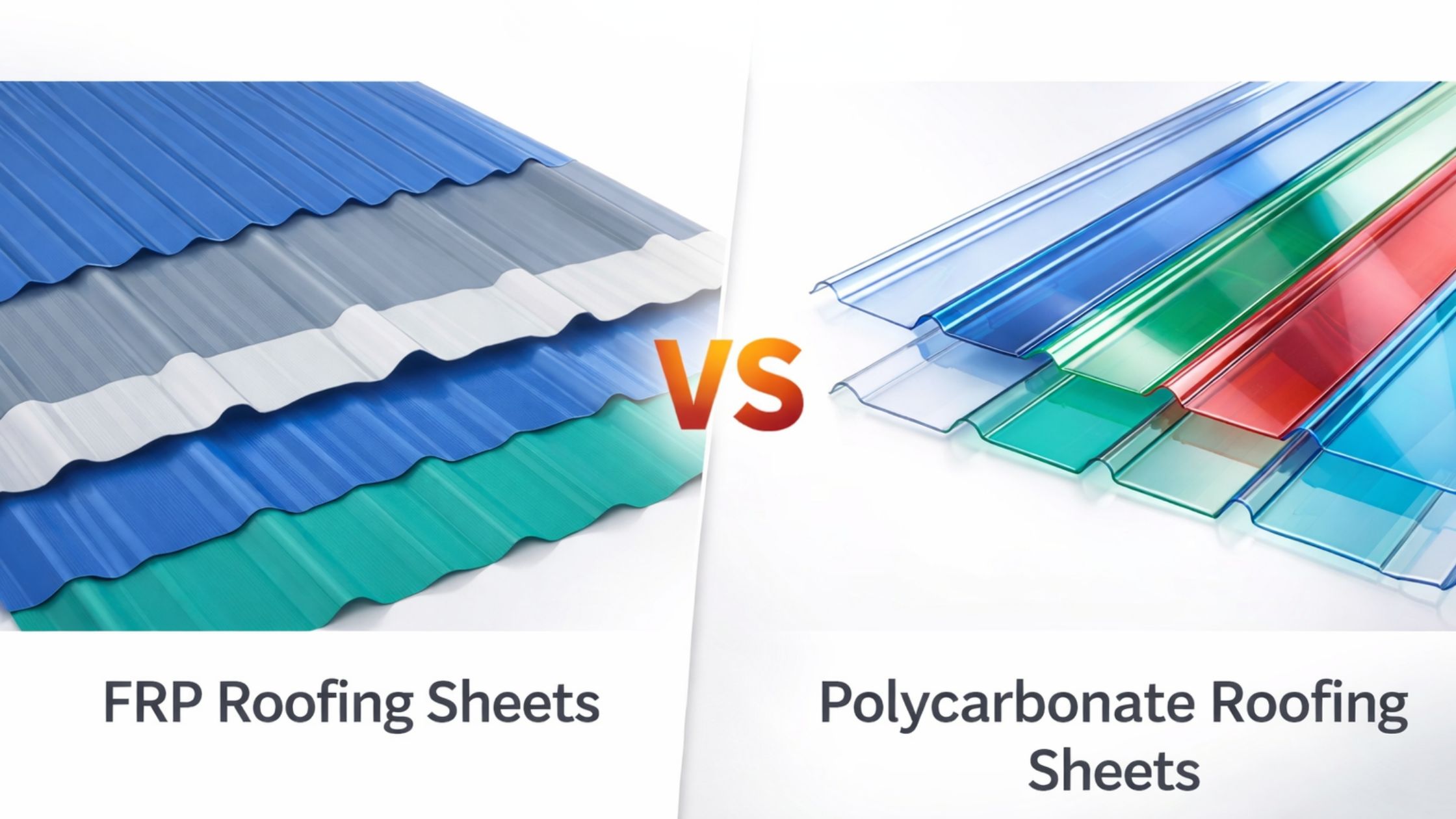
FRP vs Polycarbonate Roofing Sheets: Head-to-Head Comparison
The table below captures the core performance parameters for this industrial roofing sheets comparison. Note that performance values can shift based on resin formulation, panel thickness, and installation quality — these represent typical industrial-grade specifications.
| Parameter | FRP Sheets | Polycarbonate Sheets |
|---|---|---|
| Structural Strength | Very high — glass fiber reinforcement provides excellent flexural and tensile strength Advantage | Moderate — relies on polymer structure alone; can flex under point loads |
| Light Transmission | Diffused natural light (70–85%) — no harsh glare | High optical clarity (up to 88–90%) — near-glass transparency Advantage |
| Chemical Resistance | Exceptional — resin matrix resists acids, alkalis, solvents, and industrial vapors Advantage | Limited — susceptible to aromatic solvents, strong acids, and certain industrial chemicals |
| Thermal Insulation | Moderate — single-skin panels offer basic insulation | Good — multi-wall construction provides effective thermal buffering Advantage |
| UV Durability | High — UV-stabilized surface veil protects fiber integrity long-term Advantage | Moderate — co-extruded UV layer degrades over 10–15 years; yellowing common |
| Impact Resistance | High — fiber reinforcement absorbs and distributes impact energy Advantage | Very high at point of impact — but can craze or crack under repeated stress |
| Weight | Low — typically 3–6 kg/m² depending on thickness | Very low — multi-wall panels often 1.5–3 kg/m² Advantage |
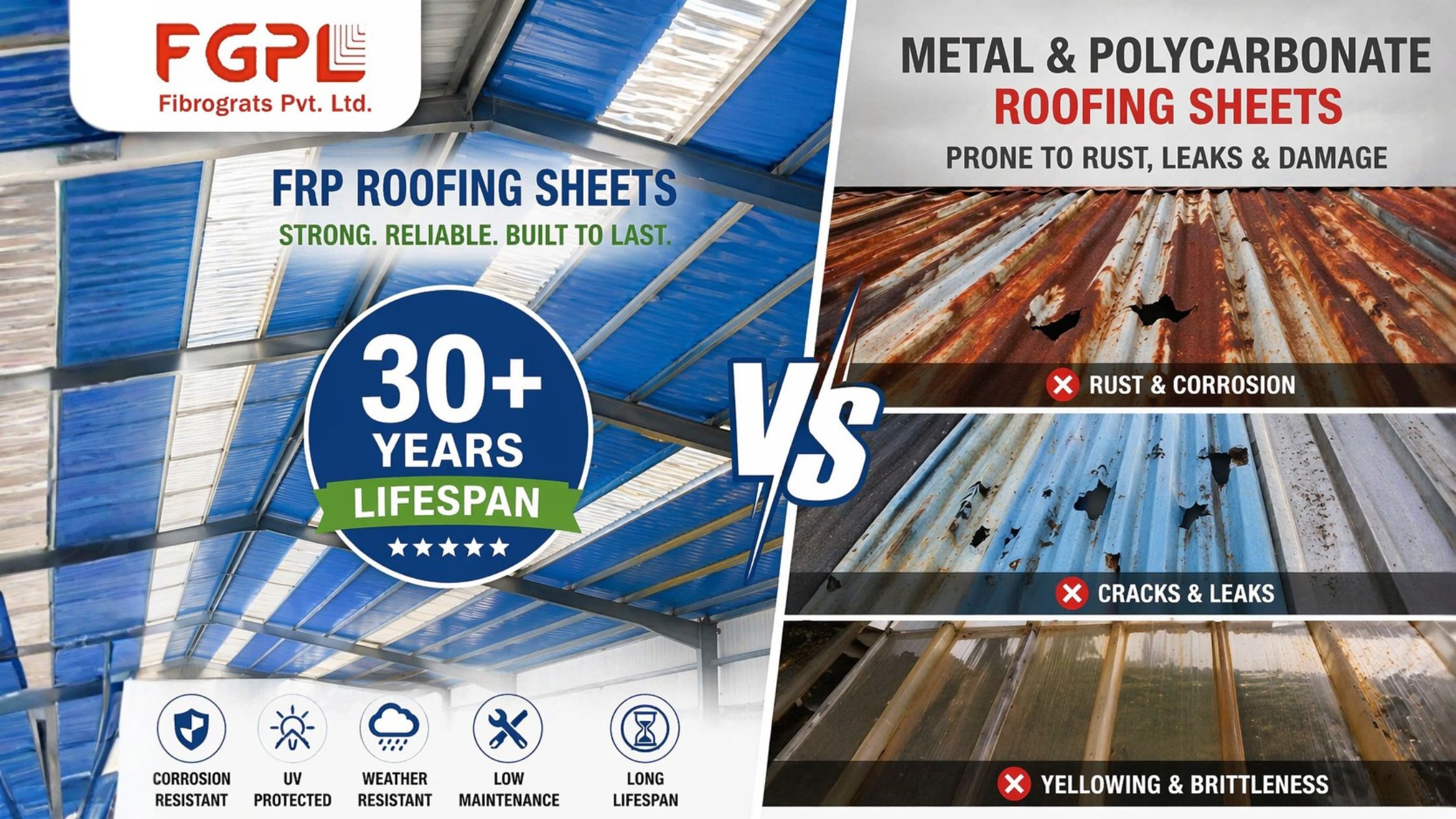
| Service Life | 25–35+ years with minimal maintenance Advantage | 12–20 years before significant UV yellowing or embrittlement |
| Fire Performance | Fire-retardant grades available (FR-grade resin) Advantage | Combustible unless halogenated grades specified; melts under sustained heat |
| Initial Cost | Moderate — higher than basic polycarbonate flat sheets | Lower initial cost for basic solid sheets Advantage |
| Long-term Cost | Favorable — minimal replacement and maintenance cycles Advantage | Higher lifecycle cost due to earlier degradation and replacement |
Structural Performance in Demanding Conditions
When evaluating FRP roofing sheets vs polycarbonate sheets from a purely structural perspective, the fiber reinforcement in FRP creates a meaningful gap in load-bearing capacity. Industrial facilities — particularly those with long-span roof structures, heavy equipment overhead, or significant snow and wind load requirements — benefit from the higher modulus of rupture that glass fiber provides.
Polycarbonate panels perform well in lightly loaded applications such as covered walkways, small skylights, and decorative canopies. However, in wide-span industrial bays where purlin spacing exceeds 1.5–2 metres, thicker FRP sheets maintain deflection within acceptable limits more reliably than equivalent polycarbonate.
For factories and processing plants where the roofing must withstand chemical vapor environments, vibration from heavy machinery, and decades of operational load — the composite architecture of FRP is difficult to substitute with a pure thermoplastic.
Chemical Resistance: A Critical Industrial Parameter
No category better illustrates why this industrial roofing sheets comparison matters more in heavy industry than it does in commercial construction. Polycarbonate’s Achilles’ heel is its vulnerability to chemical attack — aromatic hydrocarbons, ketones, esters, and many strong acids can cause stress crazing, discoloration, and structural failure within months of exposure.
FRP sheets, by contrast, can be engineered specifically for chemical resistance by selecting the appropriate resin system. Vinyl ester resins offer superior performance against oxidizing acids and chlorinated solvents. Isophthalic polyester resins provide a solid baseline against milder chemical environments. This configurability means FRP solutions can be specified for fertilizer plants, metal processing facilities, acid storage areas, and marine chemical terminals — environments where polycarbonate would fail prematurely.
Light Transmission and Daylighting
This is the one area where polycarbonate holds a clear and legitimate advantage for applications where visual clarity is important. Facilities like showrooms, greenhouses, sports halls, and retail canopies benefit from polycarbonate’s near-glass transparency. The material lets occupants see through the roof, maintains color rendering, and can give interiors a bright, open feel.
FRP panels transmit light diffusely — eliminating hotspots and harsh direct glare while still allowing substantial natural illumination into industrial interiors. For production floors, warehouses, and logistics hubs where workers require consistent, even lighting rather than visual transparency, FRP’s diffused transmission is often preferable. Glare from direct solar penetration can cause safety issues and visual fatigue in working environments.
FRP vs Polycarbonate Sheets for Roofing: Best-Fit Applications
Rather than declaring a universal winner in the FRP vs polycarbonate sheets for roofing debate, a more useful lens is matching material capabilities to application requirements.
- Chemical and fertilizer plants
- Metal processing and electroplating facilities
- Wastewater treatment infrastructure
- Long-span industrial warehouses
- Marine and coastal industrial buildings
- Facilities with strict fire-resistance requirements
- High-humidity manufacturing environments
- Commercial greenhouses and nurseries
- Sports hall skylights and canopies
- Covered walkways and retail atria
- Cold-storage facilities (thermal panels)
- Car parks and transit shelters
- Architectural feature glazing
- Residential conservatories
Lifecycle Cost: The Long View
Initial material cost comparisons frequently mislead procurement decisions. Polycarbonate panels — particularly standard flat or corrugated solid sheets — carry a lower per-square-metre purchase price. However, the replacement cycle changes the economics substantially. Where FRP installations commonly achieve 25–35 year service lives with minimal intervention, polycarbonate panels in harsh UV or chemically active environments may require replacement within 12–15 years.
When total lifecycle cost is calculated — including replacement material, labor, operational disruption, and waste disposal — FRP roofing sheets vs polycarbonate sheets in industrial settings typically favors FRP on a 20-year or 30-year cost basis. The higher initial investment in FRP is amortized across a significantly longer service horizon.
Fire Safety Considerations
Industrial buildings often fall under stringent fire safety codes, and roofing material selection directly affects compliance. Standard polycarbonate is a combustible thermoplastic that melts and flows when exposed to sustained heat — creating a risk of fire spread along the roofline. While flame-retardant grades exist, they add to cost and may still not meet the most demanding fire classifications.
FRP sheets manufactured with fire-retardant (FR) resin systems — incorporating alumina trihydrate or halogenated additives — can meet BS476, IS:12866, and other international fire performance standards. For chemical storage areas, power generation facilities, and other high-risk industrial environments, FR-grade FRP provides a level of confidence that standard polycarbonate cannot.
FRP vs Polycarbonate Roofing Sheets: Installation and Maintenance
Both materials are lightweight relative to metal or concrete, and both can be cut with standard circular-saw blades on-site. FRP panels can be drilled, trimmed, and fastened without specialist tooling — making installation accessible to general construction teams. Polycarbonate’s flexibility can complicate handling on large spans, as panels require careful support to avoid permanent distortion during installation.
Maintenance requirements for both are low compared to steel. Neither requires painting or anti-corrosion coatings. Routine cleaning with mild detergents and water is sufficient for most environments. FRP’s textured or smooth surface finishes resist algae accumulation in humid climates, while polycarbonate’s smooth surface can accumulate organic growth in multi-wall channel cavities, requiring more attention in tropical or coastal settings.
The comparison between FRP vs polycarbonate roofing sheets ultimately comes down to operational environment and performance priorities. For industrial applications — where chemical exposure, structural loading, fire compliance, and long service life converge as requirements — fiberglass reinforced plastic panels deliver a more dependable and cost-effective solution across the board.
Polycarbonate remains the preferred option for projects where optical clarity is central, chemical exposure is minimal, and lighter structural loading is the norm. In commercial, architectural, and horticultural settings, its advantages in transparency and low weight are genuinely compelling.
For procurement teams evaluating roofing for factories, processing plants, or large logistics facilities, FRP’s combination of chemical resistance, fire performance, structural strength, and long service life positions it as the material of choice — particularly where the environment is aggressive and maintenance access is limited.
Need help specifying the right roofing sheet for your facility?
Our engineering team can assess your site conditions and recommend the optimal panel specification.