
Quick Answer
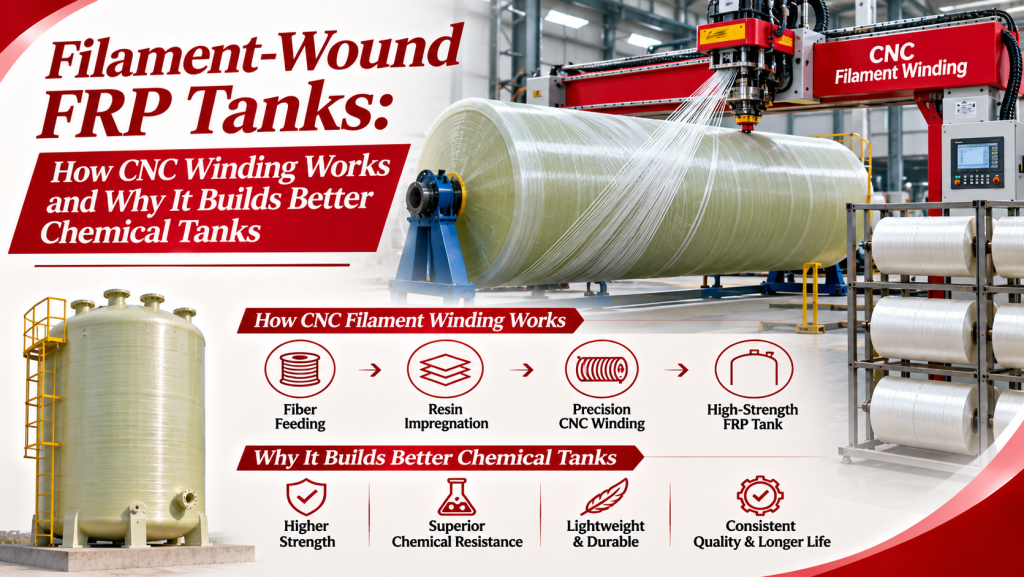
In filament winding, continuous glass rovings soaked in resin are wound under tension onto a rotating mandrel along a computer-controlled path. Hoop windings near 90° carry the hydrostatic hoop load; helical windings at lower angles carry axial and bending loads. The result is a tank shell with high, consistent glass content (often 60–75% by weight in the structural layers), precisely placed fibres and repeatable thickness, which is why filament winding is the preferred process for cylindrical FRP chemical tanks.
Most of the strength in an FRP tank comes from glass fibre, and the way that fibre is placed decides how well the tank performs. In hand lay-up, workers apply glass mat and woven roving by hand and roll resin into them. It works, and it remains essential for ends, nozzles and special shapes. But for the main cylindrical shell, which carries most of the load, filament winding places fibres exactly where the loads are, at a controlled tension and angle, and with far more glass per kilogram of laminate.
This article explains how filament winding works, why winding angle matters, how the corrosion barrier is built, what can go wrong, and what to check when you buy a filament-wound tank. It is based on how FGPL winds tanks on its fully automated 4-axis CNC filament winding machine with Siemens controllers, which handles tanks up to 150 KL.
How filament winding works
The machine
A filament winding machine rotates a mandrel (a precisely made cylinder the shape of the tank’s inside) while a carriage moves the fibre delivery eye back and forth along it. On a 4-axis CNC machine, the axes typically include mandrel rotation, carriage traverse, cross-feed (moving the eye towards or away from the mandrel) and rotation of the delivery eye. Coordinated by the controller, they lay bands of fibre along programmed paths.
The process step by step
-
Mandrel preparation. The mandrel is cleaned and coated with a release agent or film so the finished tank can be removed.
-
Corrosion barrier. A resin-rich surface veil and chopped strand mat layers are applied to the mandrel and allowed to gel. This becomes the inner chemical-resistant surface.
-
Structural winding. Glass rovings pass through a resin bath, through tensioning devices and the delivery eye, and are wound onto the mandrel in hoop and helical patterns to the designed thickness.
-
Cure. The resin cures at ambient temperature or with heat. Some services call for post-curing to improve chemical and thermal performance.
-
Extraction. The cured shell is removed from the mandrel.
-
Fabrication. Bottom, roof, nozzles, manways, lifting lugs and hold-down lugs are attached and reinforced, typically by hand lay-up with the same resin system.
-
Finishing and testing. An external UV-resistant layer is applied for outdoor tanks; the tank is inspected and hydrotested.
Winding patterns and angles
Table 1. Filament winding patterns
| Pattern | Angle to tank axis | What it carries | Notes |
|---|---|---|---|
| Hoop (circumferential) | Close to 90° | Hoop stress from liquid pressure | Most efficient for hydrostatic load |
| Helical | Typically 30–70° | Axial loads, bending from wind and seismic, some hoop load | Angle chosen in the design |
| Polar | Close to 0° | Axial loads in closed vessels | Used for pressure vessels with domed ends |
Why winding angle matters: netting theory
A simple but powerful way to understand fibre angle is netting theory, which assumes the fibres carry all the load. For a helical winding at angle α to the axis, the ratio of hoop to axial load capacity is tan²α.

A closed cylinder under internal pressure has hoop stress twice the axial stress, so a helical winding at about 54.7° balances both. Atmospheric storage tanks are different: hydrostatic pressure creates hoop load that rises with depth, while axial loads come mainly from self-weight, roof loads, wind and seismic. Tank designers therefore combine near-hoop windings, which can be thickened towards the bottom where pressure is highest, with helical layers sized for axial and bending loads. Netting theory is a starting point; detailed design uses laminate analysis and the factors in standards such as BS EN 13121-3.
Glass content and why it improves the tank
Filament-wound structural layers typically contain around 60–75% glass by weight, compared with about 25–35% for hand-laid chopped strand mat. More glass, aligned with the load, means:
-
Higher strength and stiffness per millimetre, so walls can be thinner for the same load.
-
Lower weight for the same capacity.
-
Lower thermal expansion and better dimensional stability.
-
Better consistency, because the CNC path and tension are repeated layer after layer.
Table 2. Filament-wound vs hand lay-up shells
| Property | Filament-wound shell | Hand lay-up shell |
|---|---|---|
| Glass content (structural) | ~60–75% by weight | ~25–35% (CSM), higher with woven roving |
| Fibre orientation | Controlled hoop and helical angles | Random (mat) or 0/90° (roving) |
| Thickness control | Precise, programme-controlled | Operator-dependent |
| Strength per mm | High | Lower |
| Consistency tank to tank | High | Variable |
| Suitable shapes | Cylinders, vessels | Any shape, including ends and rectangular tanks |
| Typical use in a tank | Main shell | Bottoms, roofs, nozzles, special parts |
The corrosion barrier: the part that touches the chemical
Structural windings are strong but not designed to be in direct contact with aggressive chemicals; the glass fibres must be protected. That is the job of the corrosion barrier, built on the mandrel before winding starts.
-
Inner surface: a resin-rich layer reinforced by a surface veil, typically 0.25–0.5 mm thick and about 90% resin.
-
Interior layer: chopped strand mat in the same resin, bringing the total barrier commonly to at least 2.5 mm.
-
Resin: chosen for the chemical, such as bisphenol-A or novolac vinyl ester for acids, alkalis and oxidisers.
-
Thermoplastic liners: for the most demanding chemicals, a PP, PVDF or other liner can be used instead, bonded to the FRP structure.
ASTM D3299 for filament-wound corrosion-resistant tanks and ASTM D4097 for contact-moulded tanks describe this layered construction, and many Indian specifications follow the same approach.
What can go wrong in filament winding
-
Low or uneven tension, leading to loose fibres, voids and low glass content.
-
Poor resin wet-out, leaving dry fibres that wick chemicals.
-
Wrong angles or band overlaps, producing gaps or thick spots.
-
Barrier not properly gelled before winding, so the structural layer disturbs it.
-
Under-cure, leaving the laminate soft and chemically vulnerable.
-
Damage during extraction from an inadequately released mandrel.
A good winder controls these with machine settings, written procedures, trained operators and in-process checks.
Mandrels and the size range they set
Every filament-wound tank diameter needs a mandrel, which is why manufacturers usually offer standard diameters. A well-equipped winder keeps mandrels for the common sizes and can make new ones for large projects. The machine’s swing (the largest diameter it can rotate) and bed length (the longest shell it can wind) set the maximum tank size. FGPL’s machine and mandrel set cover tanks up to 150 KL. Ask early whether your preferred diameter uses an existing mandrel; choosing a standard diameter can shorten delivery and reduce cost.
Post-cure: why it matters in chemical service
Thermoset resins continue to cure for some time after they gel. A post-cure, in which the finished laminate is heated in a controlled way, drives the cure further. Fully cured laminates generally show better chemical resistance, higher heat distortion temperature and more stable properties. Design standards reflect this: BS EN 13121-3 treats the degree of cure as one of its influence factors. For aggressive chemicals, elevated temperatures or food-contact applications, ask whether post-curing is included.
Quality checks on filament-wound tanks
-
Visual inspection of the inner surface for cracks, pits, dry spots and inclusions.
-
Thickness measurement at specified points against the laminate schedule.
-
Barcol hardness to confirm cure (ASTM D2583), and acetone sensitivity tests on resin-rich surfaces.
-
Glass content by ignition loss on cut-outs (ASTM D2584).
-
Dimensional checks of diameter, height, nozzle positions and orientation.
-
Hydrostatic test with water, held for a defined period and inspected for leaks and deflection.
Beyond storage tanks: what filament winding enables
The same process builds FRP pipes, ducts, scrubber shells, absorption towers, chimney sections and pressure vessels. FGPL’s engineering team has also designed filament winding layer sequences for high-pressure composite vessels, where fibre angle and layer order are critical. The discipline of precise fibre placement carries across all of these products.
Worked example: why winding matters for a 50 KL acid tank
Consider a 50 KL vertical tank, Ø3.3 m with a 6 m shell, for dilute acid.
-
Hydrostatic hoop load at the bottom is about ρgh × D/2. With SG 1.15 and 6 m depth, that is roughly 1,150 × 9.81 × 6 × 1.65 ÷ 1,000 ≈ 112 N per mm of height.
-
A filament-wound structural laminate carries this hoop load efficiently with hoop-dominated windings, thickened towards the base.
-
A hand-laid laminate with lower glass content would need a noticeably thicker wall for the same strength, adding weight and resin.
-
The corrosion barrier is identical in both cases, because it is sized for the chemical, not the load.
What to ask a filament-wound tank manufacturer
-
What machine do you use, how many axes, and what is the maximum size?
-
What winding angles and glass content does the laminate schedule specify?
-
How is the corrosion barrier built and how thick is it?
-
How do you verify cure and thickness?
-
How are nozzles and the bottom joint reinforced?
-
Can we witness winding and hydrotesting?
Filament winding vs contact moulding at a glance
Most FRP tanks combine both processes: filament winding for the cylindrical shell and contact moulding for the heads, nozzles, manways and the corrosion barrier. Knowing what each does well helps buyers read a laminate schedule.
Table 3. Filament winding and contact moulding compared
| Feature | Filament winding | Contact (hand) moulding |
|---|---|---|
| Typical glass content | 60–75% by weight | 25–40% by weight |
| Strength direction | Tuned by winding angle; strongest in hoop | Broadly equal in plane (mat and woven roving) |
| Best for | Cylindrical shells, pipes, stacks | Heads, nozzles, rectangular tanks, fittings |
| Thickness for the same hoop load | Thinner | Thicker |
| Consistency | Machine-controlled tension and angle | Depends on operator skill |
| Surface | Inner surface from mandrel is smooth | Mould side smooth, back side rougher |
Because the wound shell is thinner for the same load, a well-designed filament-wound tank is usually lighter than a fully hand-laid tank. The hand-laid parts remain important: most nozzle failures start at poorly built contact-moulded joints, not in the wound shell.
FGPL’s filament winding capability
-
Fully automated 4-axis CNC filament winding machine with Siemens controllers.
-
Tanks up to 150 KL, vertical and horizontal, plus scrubber and process shells.
-
BS EN 13121-3 laminate design with hoop and helical layers sized to load.
-
Vinyl ester, isophthalic and dual-laminate corrosion barriers.
-
In-house lab with pressure testing and a universal testing machine; hydrotest before dispatch.
-
Engineering team with backgrounds at TÜV, EPP Composites and Arvind Composites.
Frequently asked questions
What is a filament-wound FRP tank?
A tank whose shell is made by winding resin-impregnated continuous glass rovings onto a rotating mandrel along a controlled path, giving high, consistent glass content and precise fibre orientation.
Why is 54.7° called the ideal winding angle?
By netting theory, a helical winding at 54.7° carries hoop and axial loads in the ratio 2:1, matching a closed cylinder under internal pressure. Atmospheric tanks use combinations of hoop and helical layers instead.
What glass content do filament-wound tanks have?
Structural filament-wound layers typically contain around 60–75% glass by weight, far more than hand-laid mat laminates.
Is the corrosion barrier also filament wound?
No. The corrosion barrier is a resin-rich veil and chopped strand mat layer applied to the mandrel first. Structural winding is placed over it.
Can rectangular tanks be filament wound?
Not practically. Rectangular tanks are made by hand lay-up or panel construction with stiffeners. Filament winding suits cylinders and vessels.
Does filament winding make the tank more expensive?
Not usually. Filament winding uses material more efficiently and is faster for cylindrical shells, so it often reduces cost for medium and large tanks while improving quality.
What is the largest tank FGPL can filament wind?
FGPL’s 4-axis CNC filament winding machine handles tanks up to 150 KL.
Why are nozzles on filament-wound tanks hand laid?
Nozzles, flanges and reinforcing pads have complex shapes that cannot be wound on a mandrel, so they are contact moulded and bonded to the shell with secondary bond laminates.
References and standards cited
-
BS EN 13121-3 — GRP tanks and vessels: design and workmanship.
-
ASTM D3299 — Filament-wound glass-fibre-reinforced thermoset resin corrosion-resistant tanks.
-
ASTM D4097 — Contact-moulded glass-fibre-reinforced thermoset resin corrosion-resistant tanks.
-
ASTM D2583 (Barcol hardness); ASTM D2584 (glass content).
-
Netting analysis of filament-wound structures (composite mechanics literature).
Want to see filament winding in action? Arrange a visit to FGPL’s Indore works or request a laminate proposal via the contact page or products@fgpl.in.
About The Author
This article was prepared by the engineering team at Fibro Grats Pvt. Ltd. (FGPL), Indore — designers and manufacturers of filament-wound FRP tanks and vessels, pultruded and moulded FRP products and FRP process equipment, with an in-house quality lab (UTM and pressure testing) and ISO-certified management systems. Data in this article comes from the standards cited, published resin and industry data, and FGPL’s own engineering practice. Where figures are illustrative, the text says so; for project-specific calculations, drawings and test reports, contact FGPL’s engineering desk.