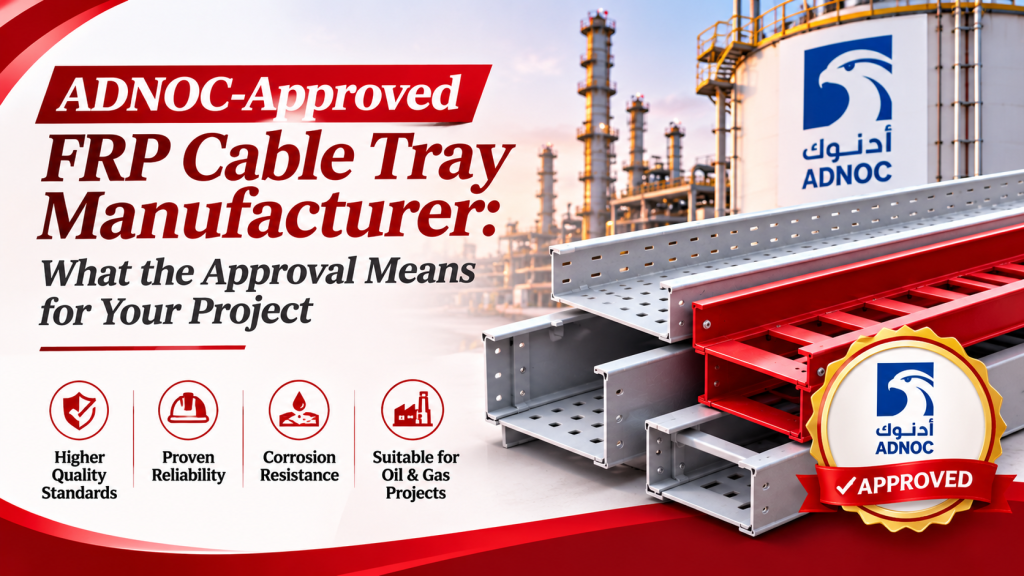
An ADNOC-approved FRP cable tray manufacturer has passed ADNOC’s supplier registration and technical pre-qualification for that product. For an EPC contractor or end user, this means the vendor’s company records, quality and HSE systems, manufacturing capability and product data have already been reviewed by one of the world’s most demanding energy companies. FGPL is an ADNOC-approved vendor for FRP cable trays.
Electrical packages on ADNOC projects carry thousands of metres of cable tray across process units, pipe racks, jetties and offshore modules. The environment is harsh: summer shade temperatures above 40 °C, sun-exposed surfaces far hotter, intense UV, airborne chlorides from the Gulf, and in many units hydrocarbon or sour gas. Steel trays corrode, aluminium suffers in chlorides and alkalis, and stainless steel is expensive and can still pit. That is why fibre-reinforced plastic (FRP, also called GRP in the Gulf) trays are widely specified.
But a material choice is only half the decision. The vendor must also be acceptable to ADNOC. This article explains what ADNOC approval involves, why it is hard to earn, what it does and does not tell you, and how to specify FRP cable trays that will perform on an ADNOC site.
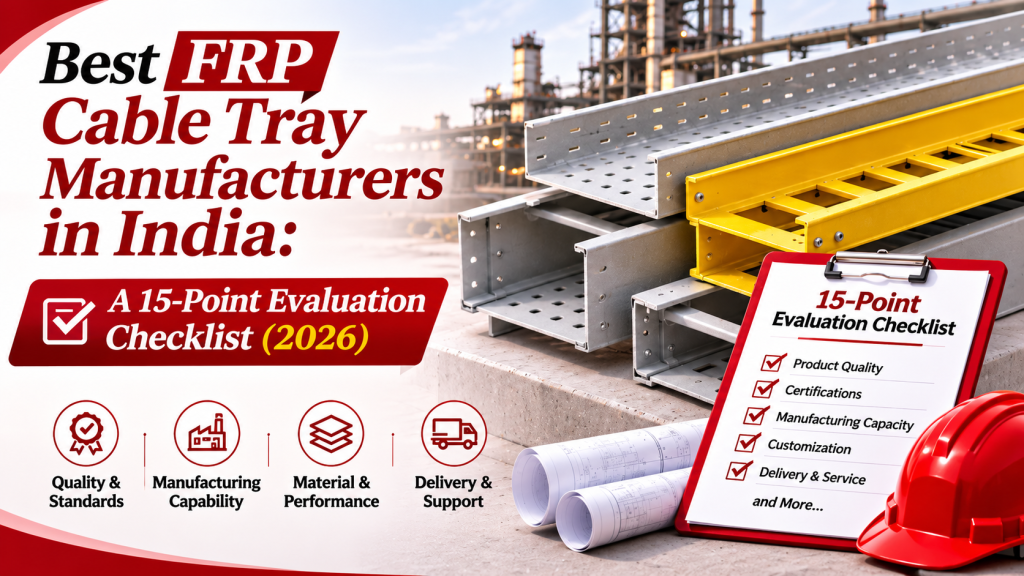
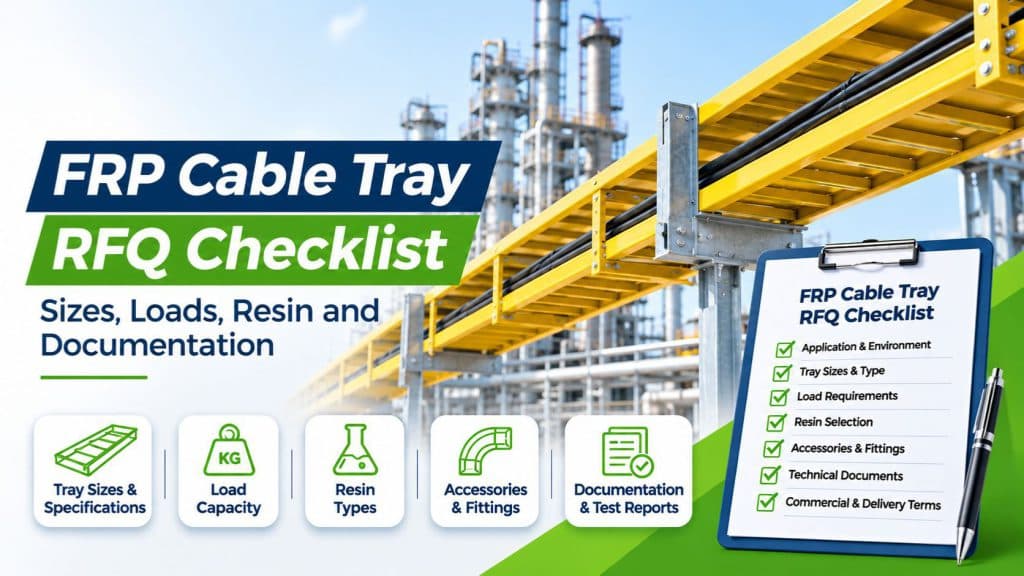
FGPL supplies pultruded ladder, perforated and trough FRP cable trays with fittings and supports.
01How ADNOC qualifies suppliers
ADNOC manages supplier registration centrally for the ADNOC Group through its Supplier Hub, which runs on the SAP Ariba platform. The published journey has two broad parts: registration, then pre-qualification for specific products or services.
| Stage | What happens | What the supplier must show |
|---|---|---|
| 1. Account set-up | Supplier creates an ADNOC Ariba account or links an existing Ariba Network ID | Legal entity details |
| 2. Registration request | Profile questionnaire, business location, supplier category | Commercial licence, ownership, tax and financial information |
| 3. Integrity Due Diligence (IDD) | Compliance review of ownership and company information | Transparent ownership and compliance records |
| 4. ADNOC review | ADNOC team reviews and may request clarifications | Prompt, complete responses |
| 5. Registration approval | Supplier profile becomes active | — |
| 6. Technical pre-qualification | Assessment for the specific product category, e.g. FRP cable trays | Past supply, quality and HSE systems, certifications, manpower, equipment, facilities, product specifications |
Registration creates a supplier profile. Pre-qualification is the harder step because it links that profile to a specific product category and tests whether the supplier can actually deliver it. For a manufactured product like FRP cable tray, reviewers look for technical evidence: datasheets, test reports, a working quality management system, manufacturing facilities and a track record of comparable supply.
Why ADNOC approval is hard to get
-
It is product-specific. Approval for one category does not carry over to another, so a manufacturer must prove capability for cable trays specifically.
-
It looks at systems, not just samples. Quality, health, safety and environmental management systems are reviewed, not only the product.
-
It checks history. Past supply experience and references count, which favours established manufacturers.
-
It includes integrity due diligence. Ownership and compliance must be transparent.
-
It must be maintained. Approved suppliers are expected to keep documents current and perform on orders.
02What ADNOC sites demand from a cable tray
Approval opens the door; the site environment decides whether the tray lasts. The Gulf coast is among the most corrosive atmospheres in the world for metals because it combines heat, humidity swings and airborne salt. ISO 9223 classifies atmospheric corrosivity from C1 (very low) to CX (extreme) using first-year corrosion rates of standard metals.

For zinc, the C5 band runs from 4.2 to 8.4 µm per year and the CX band up to 25 µm per year. Hot-dip galvanised cable tray made from 1.5–3 mm steel carries a minimum mean zinc coating of only 55 µm under ISO 1461. In a C5 atmosphere that coating can be consumed in roughly 6.5–13 years; in CX, in as little as 2–7 years. Cut ends, bolt holes and site modifications fail sooner.
FRP does not corrode electrochemically, so these rates do not apply to it. Its design concerns are different: UV ageing of the surface, strength reduction at high temperature, and chemical attack if the wrong resin is chosen. A competent manufacturer designs for those.
| Site condition | Risk to cable trays | FRP design response |
|---|---|---|
| Airborne chlorides (C4–CX) | Rapid corrosion of steel and zinc; pitting of stainless steel | Non-metallic tray; SS316 or FRP fasteners; vinyl ester resin near splash zones |
| Summer heat, sun-exposed surfaces | FRP strength reduction at high temperature | Vinyl ester resin; derate polyester; add covers to shade cables and trays |
| Intense UV | Surface erosion and fibre bloom on unprotected FRP | Synthetic surface veil, UV inhibitors, light colours, covers |
| Hydrocarbon and sour gas areas | Sparks, static, H₂S attack on metals | Non-sparking material; anti-static grades where the hazardous-area study requires |
| Sand and dust | Abrasion and dust build-up | Resin-rich surface, covers or solid bottoms on critical runs |
| Long straight runs | Thermal movement | Expansion splices sized for the site temperature range |
Temperature: the factor most often missed
FRP keeps most of its strength at normal ambient temperatures but loses some as it gets hotter. NEMA FG 1 guidance for polyester trays shows roughly 90% of rated strength at about 38 °C and 78% at about 52 °C. Vinyl ester retains noticeably more. On a sun-exposed rack in Abu Dhabi in August, tray surface temperatures can run well above the air temperature. Specify vinyl ester for exposed runs, or apply a derating factor to polyester load tables. Covers help too: they shade both the tray and the cables, which also helps cable ampacity.
03How EPC contractors use ADNOC vendor approval
On ADNOC projects, the project specification and approved vendor list typically define which manufacturers the EPC contractor can buy from. Using an approved manufacturer simplifies the procurement chain:
-
Faster technical bid evaluation. The vendor’s credentials are already on record with the company.
-
Fewer vendor-addition requests. Proposing a non-listed vendor usually requires a formal request and company review, which costs schedule time.
-
Predictable document approval. An approved manufacturer is already familiar with company expectations for datasheets, quality plans and inspection records.
-
Lower audit risk. Quality and HSE systems have already been reviewed.
In-Country Value (ICV) — the other half of a UAE bid
ADNOC’s In-Country Value programme, launched in 2018, scores suppliers on their contribution to the UAE economy. ADNOC states that suppliers without an ICV certificate are treated as having 0% ICV in bid evaluation. ICV does not replace technical approval, but EPC contractors weigh it alongside price. If ICV is part of your evaluation, discuss the supply structure with the vendor’s UAE team early. FGPL has an office in Abu Dhabi for this kind of coordination.
04What ADNOC approval does not tell you
Approval is a strong filter, not a substitute for engineering. Before placing an order, still confirm:
-
Scope. Is the approval for the exact product category you need (FRP cable trays and fittings)?
-
Currency. Ask for the approval reference and confirm it is active.
-
Grade. Is the resin, fire grade and UV protection quoted the right one for your area?
-
Load capacity. Does the tray size meet your cable load at your support span after temperature derating?
-
Hazardous-area requirements. Does your area classification require an anti-static grade?
Check the FRP cable tray range, sizes and resin grades before you finalise your specification.
05Specifying FRP cable trays for an ADNOC project
| Item | Typical requirement to state | Notes |
|---|---|---|
| Material and process | Pultruded GRP, glass content stated (e.g. ~60–65% by weight) | Ask for burn-off results |
| Resin | Vinyl ester for exposed, splash or chemical areas; FR polyester elsewhere | Confirm temperature derating data |
| Fire performance | ASTM E84 flame spread ≤ 25 and self-extinguishing per ASTM D635 / UL 94 | Certificate must match resin grade |
| UV protection | Surface veil plus UV inhibitors | Covers on long exposed runs |
| Load rating | Safe working load at stated span to NEMA FG 1 or IEC 61537 | Include concentrated load and wind on covers |
| Fasteners | SS316 or FRP hardware | Avoid carbon steel and zinc-plated bolts |
| Earthing | Separate earth continuity conductor | FRP trays are non-conductive |
| Static | Anti-static grade where required by area classification | See our hazardous-area guide |
| Documents | Datasheets, QAP, ITP, test certificates, installation manual | Submitted before production |
| Vendor status | ADNOC-approved manufacturer for FRP cable trays | Provide approval reference in bid |
06Worked example: a coastal pipe-rack run in Abu Dhabi
Consider a 600 mm wide ladder run on an open pipe rack about 1 km from the shoreline. The cable schedule gives a total cable weight of 70 kg/m, supports are at 3 m, and the rack is fully sun-exposed. Here is how an engineer would approach the selection.
-
Classify the environment. A coastal process area of this kind is commonly treated as ISO 9223 C5. Galvanised steel would need early maintenance; FRP is a sound choice.
-
Choose the resin. Sun exposure plus salt air points to vinyl ester. If polyester were used, its rated load would need derating for tray temperature, roughly to 78% at about 52 °C under NEMA FG 1 guidance.
-
Add other loads. Allow for a concentrated maintenance load. NEMA practice converts a mid-span point load P to an equivalent uniform load of 2P/L, so a 90 kg load on a 3 m span adds 60 kg/m. Add wind uplift on covers if they are fitted.
-
Select the load class. With 70 kg/m of cable plus 60 kg/m equivalent concentrated load, the tray needs a rated safe working load of at least about 130 kg/m at 3 m, after any temperature derating. That points to a heavy side rail, typically 150 mm, rather than a light 100 mm section.
-
Detail the system. Use SS316 or FRP hardware, expansion splices sized for the site temperature swing, covers clamped against wind, and a separate earth continuity conductor.
This is the kind of calculation an approved manufacturer should be able to show you, with its own tested load tables behind it.
07Common reasons GRP tray submittals are rejected on Gulf projects
From our experience on approved-vendor projects, document reviewers most often return submittals for the same handful of reasons. Avoid these and approval moves faster.
-
Load tables without a named test standard or span. Reviewers want to see NEMA FG 1 or IEC 61537 and the span tested.
-
Fire certificates that do not match the offered resin. A polyester certificate does not cover a vinyl ester tray.
-
No temperature derating data. For sun-exposed Gulf sites this is a frequent comment.
-
Carbon steel or zinc-plated hardware on a GRP system.
-
Missing cut-edge sealing instructions in the installation manual.
-
No hazardous-area statement where runs pass through classified zones.
-
Approval references not supplied with the bid, which forces the reviewer to ask.
08FGPL: an ADNOC-approved FRP cable tray manufacturer
Fibro Grats Pvt. Ltd. (FGPL) manufactures pultruded FRP cable trays at its Indore facility in India and supports Gulf customers through its Abu Dhabi office. Our cable tray range is approved by ADNOC and by Engineers India Limited (EIL), and our management systems are ISO-certified.
-
Ladder trays from 150 mm to 1500 mm wide; perforated instrumentation trays from 50 mm to 300 mm; 3 m and 6 m standard lengths.
-
Polyester, vinyl ester and epoxy systems, in fire-retardant and UV-stabilised grades.
-
Approximately 60–65% glass content from continuous, automated pultrusion.
-
Complete systems: bends, tees, reducers, risers, covers, splice and expansion plates, and fasteners.
-
In-house quality lab with UTM testing; documentation prepared for client and third-party inspection.
Read more on our ADNOC-approved FRP cable tray manufacturer page, and see our guides to GRP cable tray supply in the UAE and anti-static FRP cable trays for hazardous areas.
Review the full range, then send us your cable schedule for a load check and compliant offer.
09Frequently asked questions
Is FGPL an ADNOC-approved vendor for FRP cable trays?
Yes. FGPL is approved by ADNOC as a vendor for FRP cable trays, and also by Engineers India Limited (EIL). Approval documents can be shared with EPC contractors for bid and vendor-list purposes.
How does a manufacturer get ADNOC approval?
Through ADNOC’s Supplier Hub on SAP Ariba: account set-up, a registration request with a profile questionnaire, Integrity Due Diligence, ADNOC review, registration approval and then technical pre-qualification for the specific product category.
Are GRP and FRP cable trays the same thing?
Yes. GRP (glass-reinforced plastic) is the term more common in the Gulf and the UK; FRP (fibre-reinforced plastic) is common in India. Both describe glass-fibre-reinforced thermoset resin trays.
Which resin is best for ADNOC coastal and offshore sites?
Vinyl ester is generally preferred for sun-exposed, splash and chemical areas because it retains more strength at elevated temperature and resists a wider range of chemicals. Fire-retardant polyester can suit sheltered areas with suitable derating.
Does ADNOC approval replace a project technical evaluation?
No. Approval confirms the supplier’s capability and systems. Each project should still check load capacity, resin grade, fire and UV performance, and hazardous-area requirements against its own specification.
10References and standards cited
-
ADNOC Supplier Hub — supplier registration and pre-qualification guidance (SAP Ariba).
-
ADNOC In-Country Value (ICV) programme information.
-
ISO 9223 — Corrosion of metals and alloys: corrosivity of atmospheres.
-
ISO 1461 — Hot-dip galvanised coatings on fabricated iron and steel articles.
-
NEMA FG 1 — Fiberglass Cable Tray Systems (temperature strength reduction guidance).
-
IEC 61537:2023; ASTM E84; ASTM D635; UL 94.
Bidding on an ADNOC package?
Our Abu Dhabi and Indore teams can provide approval references, datasheets, load checks and a compliant offer. Reach us through the FGPL contact page or at products@fgpl.in.
This article was prepared by the Applications Engineering team at Fibro Grats Pvt. Ltd. (FGPL), Indore — the team that designs, pultrudes and tests FGPL’s FRP cable tray systems, which are approved by ADNOC and Engineers India Limited (EIL). Data in this article comes from the international standards cited, published resin and industry data, and FGPL’s own engineering practice. Where figures are illustrative, the text says so; for project-specific load tables, test reports and drawings, contact FGPL’s engineering desk.