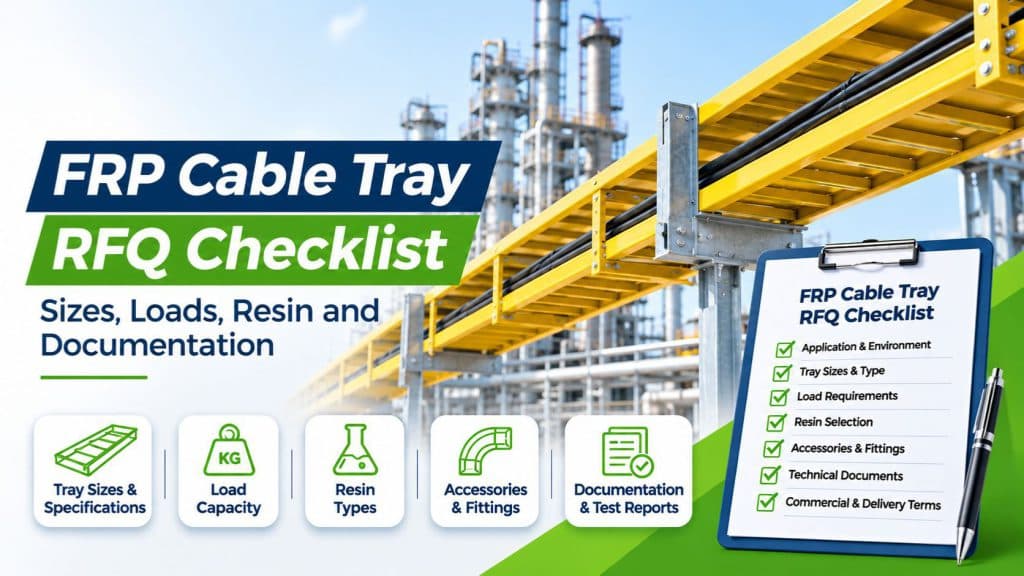
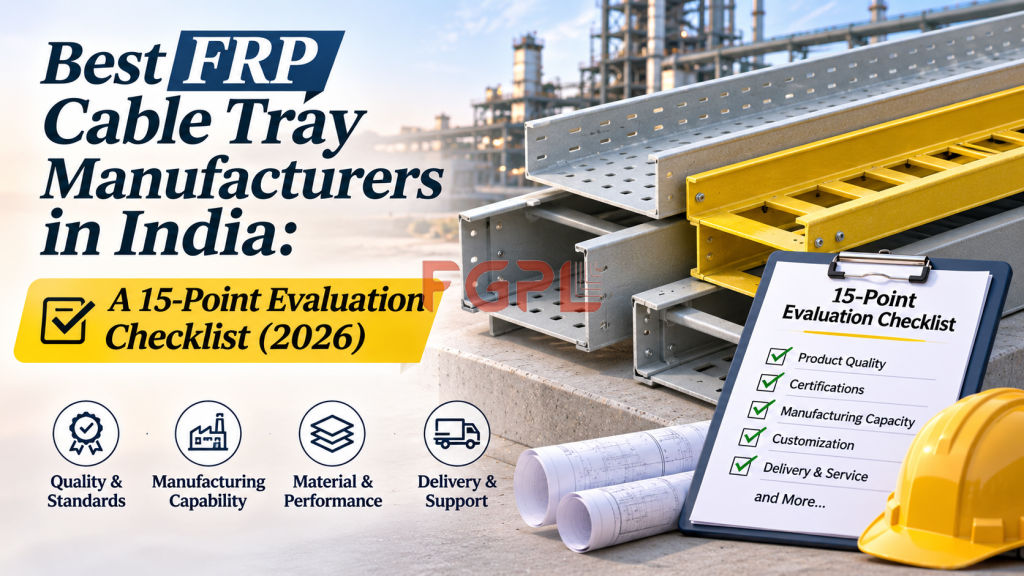
The best FRP cable tray manufacturers in India can prove three things: tested load capacity (to NEMA FG 1 or IEC 61537), documented fire and UV performance for the grade they supply, and acceptance by demanding owners and consultants such as ADNOC and Engineers India Limited (EIL). Price only matters once those three are in place. This checklist shows how to score each vendor.
Search for “best FRP cable tray manufacturer in India” and you will find dozens of companies that claim corrosion resistance, light weight and long life. Those claims apply to every FRP tray, good or bad. What separates a reliable manufacturer from a trader with a catalogue is whether they can show evidence: a tested load table, a glass-content report, a fire test certificate for the actual resin grade, and approval by an owner whose vendor list is hard to get onto.
This guide is written for electrical engineers, EPC procurement teams and plant owners who must shortlist an FRP (fibre-reinforced plastic, also called GRP) cable tray supplier for refineries, chemical plants, power stations, solar farms and offshore or coastal projects. It is based on what our own engineering team at Fibro Grats Pvt. Ltd. (FGPL) is asked to demonstrate in vendor audits, technical bid evaluations and third-party inspections.
-
Ask for evidence, not adjectives: load-test reports, fire-test reports and a glass-content (burn-off) result for the grade quoted.
-
Owner and consultant approvals such as ADNOC and EIL are a strong filter because they involve document review, capability assessment and supply-record checks.
-
Check the process: continuous pultrusion with controlled glass content (typically 60–65% by weight) gives consistent section properties.
-
Score vendors on a weighted sheet. Price should carry less weight than technical proof for corrosive or critical service.
Explore FGPL’s pultruded ladder, perforated and trough trays with fittings and supports.
01Why choosing the right FRP cable tray manufacturer matters
A cable tray is a structural element. It carries power and control cables for decades, often above process equipment, in sun, salt air or chemical fumes. When an FRP tray is under-designed or poorly made, the failure modes are slow and expensive: excessive sag between supports, cracked rungs, fibre blooming from UV exposure, and splice plates that loosen. Replacing a cable tray in a running plant means a shutdown window, cable rerouting and hot-work permits for the surrounding steel.
FRP is chosen precisely because metal trays fail in these environments. Hot-dip galvanised steel in a C5 (very high) corrosivity atmosphere can lose its 55 µm zinc coating in roughly 6.5 to 13 years, based on ISO 9223 corrosion rates and ISO 1461 coating thickness. A good FRP tray should outlast that by a wide margin. But a bad one can fail earlier than the steel it replaced. That is why the manufacturer, not the material, is the real decision.
02The 15-point checklist for evaluating FRP cable tray manufacturers
Use the following checks in order. The first eight are technical “must-haves”; the remaining seven separate good suppliers from excellent ones.
A. Product performance evidence
-
Tested load capacity. Ask for the load/deflection test report and the standard used. NEMA FG 1 tests a single simply supported span with a 1.5 safety factor on failure load. IEC 61537 tests a multi-span arrangement with a splice in the span and a 1.7 safety factor, with deflection limited to span/100 at the safe working load. A manufacturer who quotes a load class without a test report is quoting a guess.
-
Glass content and process control. Pultruded trays should state glass content by weight, verified by a burn-off test (ASTM D2584 or ISO 1172). FGPL trays are pultruded at approximately 60–65% glass by weight. Lower glass content usually means lower stiffness, which shows up as sag.
-
Fire performance for the exact grade. Fire-retardant grades are typically specified to ASTM E84 Class 1 (flame spread index 25 or less) and self-extinguishing behaviour to ASTM D635 or UL 94. The certificate should name the resin system you are buying, not a different product.
-
UV stabilisation and surface veil. Outdoor trays need UV inhibitors and a synthetic surface veil so the resin-rich surface protects the glass fibres. Ask how the surface is made and request accelerated weathering data if the project is in the Gulf or a high-UV location.
-
Resin range. A capable manufacturer offers at least isophthalic polyester and vinyl ester, and can explain when each is needed. Vinyl ester is the safer choice for strong acids, alkalis, chlorine and elevated temperatures.
-
Complete system, not just straight lengths. Bends, tees, risers, reducers, covers, splice plates, expansion splices and fasteners must come from the same system and be load-rated together.
B. Manufacturer capability and quality
-
Manufacturing process. Continuous pultrusion with controlled pull speed, die temperature and resin impregnation produces consistent profiles. Hand-laid or moulded trays can be suitable for small fittings but rarely match pultruded straight lengths for stiffness consistency.
-
In-house testing. Look for a quality lab that can run Barcol hardness, dimensional checks, glass content and load tests. FGPL operates an in-house lab with a universal testing machine (UTM).
-
Quality management certification. ISO 9001 for quality, with ISO 14001 and ISO 45001 for environment and safety, signals a system that will survive a client audit.
-
Owner and consultant approvals. This is the hardest item to fake. Approvals from bodies such as ADNOC and EIL require document review, capability assessment and a supply record. We explain why below.
C. Commercial and execution strength
-
Engineering support. Can the vendor check your cable loads, recommend support spans, and produce layout drawings and a bill of materials?
-
Documentation package. Datasheets, quality assurance plan (QAP), inspection and test plan (ITP), material test certificates and installation manual should be ready before production, not after.
-
Capacity and lead time. Ask for monthly pultrusion capacity in running metres and current order book. Large EPC packages can run into many kilometres.
-
Logistics and export readiness. For Middle East and Southeast Asian projects, check export packing, documentation and regional presence. FGPL has offices in Abu Dhabi and Singapore in addition to its Indore headquarters.
-
Reference projects and after-sales. Ask for references in a similar environment and for how site queries are handled.
| # | Check | Evidence to request | Red flag |
|---|---|---|---|
| 1 | Load capacity | NEMA FG 1 or IEC 61537 test report with span, load, deflection | Load class quoted with no report |
| 2 | Glass content | Burn-off result (ASTM D2584 / ISO 1172) | “High glass content” with no number |
| 3 | Fire grade | ASTM E84 / D635 or UL 94 certificate for the quoted resin | Certificate for a different product |
| 4 | UV resistance | Surface veil detail, UV inhibitor, weathering data | Bare-glass surface on outdoor trays |
| 5 | Resin range | Datasheets for polyester and vinyl ester grades | One resin offered for every service |
| 6 | Full system | Fittings and splice load data | Fittings sourced from third parties |
| 7 | Process | Pultrusion line details and capacity | Unclear process or outsourced profiles |
| 8 | Testing | In-house lab equipment list | All tests “available on request” externally |
| 9 | QMS | ISO 9001 / 14001 / 45001 certificates | Expired or withdrawn standard versions |
| 10 | Approvals | Owner/consultant approval letters (e.g. ADNOC, EIL) | Claims without letters |
| 11 | Engineering | Load calculation and layout support | Sales-only contact |
| 12 | Documents | Sample QAP, ITP, datasheet, installation manual | Documents created after the PO |
| 13 | Capacity | Running metres per month | No figure given |
| 14 | Logistics | Export packing and regional presence | No export experience |
| 15 | References | Similar-environment references | References in mild service only |
03How to score and compare vendors
A checklist becomes useful when it turns into a number. We recommend a weighted 100-point score, where technical proof and approvals carry most of the weight. The weighting below reflects FGPL’s view for corrosive or critical industrial service. For a light-duty indoor application you might shift weight towards price and lead time.

To use it, score each vendor from 0 to 10 on every criterion, multiply by the weight, and divide by 10. A vendor with excellent prices but no test evidence will rarely reach 60 points, which is the right outcome for a structural product that must last 25 years.
| Criterion (weight) | Vendor X | Vendor Y | Vendor Z |
|---|---|---|---|
| Product test evidence (20) | 9 → 18.0 | 5 → 10.0 | 3 → 6.0 |
| Owner/consultant approvals (18) | 10 → 18.0 | 4 → 7.2 | 0 → 0.0 |
| QA/QC and in-house lab (14) | 8 → 11.2 | 6 → 8.4 | 4 → 5.6 |
| Process and capacity (13) | 8 → 10.4 | 7 → 9.1 | 5 → 6.5 |
| Engineering and documents (11) | 8 → 8.8 | 6 → 6.6 | 4 → 4.4 |
| Resin/grade range (9) | 9 → 8.1 | 6 → 5.4 | 5 → 4.5 |
| Delivery record (8) | 7 → 5.6 | 7 → 5.6 | 6 → 4.8 |
| Price (7) | 6 → 4.2 | 8 → 5.6 | 10 → 7.0 |
| Total (100) | 84.3 | 57.9 | 38.8 |
Vendor Z is the cheapest but scores lowest. Vendor X costs more but carries the lowest risk. On a refinery or offshore project, that difference in risk is worth far more than the price gap.
See tested load data, resin grades and sizes for FGPL FRP cable trays.
04Why ADNOC and EIL approvals are a strong filter
Many suppliers say their products are “approved”. It helps to know what a real approval involves.
Engineers India Limited (EIL), established in 1965, is one of South Asia’s leading engineering consultancy and EPC companies for hydrocarbons and petrochemicals. Its published supplier enlistment process has three stages. Stage 1 is a document review covering company documents, ISO certificates, three years of audited financials, the organisation chart, a ten-year supply record, end-user performance feedback, type test reports and an internal quality plan. Stage 2 is a shop survey of the manufacturing facility, design capability, quality system, testing arrangements and after-sales service. Stage 3 is final approval by EIL’s competent authority before an enlistment letter is issued. A manufacturer cannot pass this on marketing material alone.
ADNOC (Abu Dhabi National Oil Company) manages supplier registration centrally through its Supplier Hub on SAP Ariba. Registration includes a profile questionnaire and Integrity Due Diligence, followed by technical pre-qualification. Pre-qualification can cover past supply experience, quality and HSE management systems, certifications, manpower, equipment, facilities and product specifications. ADNOC projects are built in some of the most demanding conditions anywhere: high heat, intense UV, saline coastal and offshore atmospheres.
FGPL is an approved vendor for FRP cable trays with both ADNOC and EIL. For a buyer, this means another demanding organisation has already reviewed our documents, processes and track record for this exact product. It does not replace your own technical evaluation, but it narrows the field quickly.
| Approval | Who sets the bar | What is typically examined | What it tells you |
|---|---|---|---|
| EIL enlistment | India’s leading hydrocarbon consultant and EPC company | Documents, financials, supply record, type tests, shop survey, QA | Supplier fits Indian refinery and petrochemical project requirements |
| ADNOC approval | Abu Dhabi’s national energy company | Registration, integrity due diligence, technical pre-qualification, HSE | Supplier meets Gulf oil-and-gas expectations for quality and compliance |
| ISO 9001 / 14001 / 45001 | Accredited certification bodies | Management systems | A working quality, environment and safety system exists |
05Questions to ask in the technical bid meeting
Use these questions to test a manufacturer’s depth. Strong vendors answer them on the spot.
-
What is the safe working load of your 300 mm ladder tray at a 3 m support span, and which test standard does that figure come from?
-
How much does capacity reduce at 50 °C for polyester and for vinyl ester? (NEMA FG 1 guidance for polyester shows roughly 78% of rated strength at about 52 °C.)
-
What glass content do you guarantee, and how is it verified per batch?
-
Which resin do you recommend for our chlorine or caustic area, and why?
-
How do you seal cut edges on site, and what do you supply for it?
-
What expansion splice spacing do you recommend for our temperature range?
-
Can you share the approval letters and the last third-party inspection report?
06Common mistakes buyers make
-
Comparing price per metre without comparing load class. A cheaper tray with thinner side rails may need supports every 1.5 m instead of 3 m, roughly doubling the support count and erasing the saving.
-
Accepting one resin for every area. General-purpose polyester in a caustic area will degrade. Specify vinyl ester where the chemistry demands it.
-
Ignoring temperature derating. In Indian summers and Gulf climates, sun-exposed trays run far hotter than the air.
-
Forgetting the earth conductor. FRP trays are non-conductive and cannot act as an earth path, so a separate earth continuity conductor must be designed in.
-
Buying fittings from a different source. Mixed systems create weak points at splices and bends.
07How FGPL meets this checklist
We built this checklist because it is the one our customers and their consultants apply to us. In summary:
-
Continuous, fully automated pultrusion at our Indore facility with approximately 60–65% glass content.
-
Ladder trays from 150 mm to 1500 mm wide and perforated instrumentation trays from 50 mm to 300 mm wide, in 3 m and 6 m standard lengths, with custom widths and depths on request.
-
Polyester, vinyl ester and epoxy resin systems, with fire-retardant and UV-stabilised grades.
-
In-house quality lab with a UTM for mechanical testing.
-
Approved vendor for FRP cable trays with ADNOC and EIL, alongside ISO-certified management systems.
-
Engineering support for load checks, layouts and documentation, with offices in Indore, Abu Dhabi and Singapore.
See the full range on our FRP cable tray manufacturer in India page, or download the FRP cable tray brochure.
Check the full FRP cable tray range, then send us your cable schedule for a load check and quote.
08Frequently asked questions
Who are the best FRP cable tray manufacturers in India?
The best manufacturers are those that can show tested load data, grade-specific fire certificates, controlled glass content and approvals from demanding owners and consultants. FGPL is an ADNOC- and EIL-approved FRP cable tray manufacturer based in Indore. Use the 15-point checklist above to compare any shortlist objectively.
Why does ADNOC or EIL approval matter for an FRP cable tray supplier?
Both organisations review documents, quality systems, supply history and manufacturing capability before approving a vendor. Approval shows the manufacturer has already passed a structured, independent evaluation for that product category.
What glass content should a pultruded FRP cable tray have?
Pultruded FRP trays typically contain about 60–65% glass by weight. Ask for a burn-off test result to ASTM D2584 or ISO 1172 rather than a general claim.
Which standard should I specify for FRP cable tray load testing?
NEMA FG 1 and IEC 61537 are the two widely used references. IEC 61537 uses a multi-span test with a splice and a 1.7 safety factor; NEMA FG 1 uses a single span and a 1.5 safety factor. Specify one and ask for the test report.
Is the cheapest FRP cable tray a false economy?
Often, yes. Thinner sections need closer supports, lower-grade resins degrade faster in chemical areas, and poor UV protection shortens outdoor life. Compare total installed cost and expected service life, not price per metre.
09References and standards cited
-
NEMA FG 1 — Fiberglass Cable Tray Systems.
-
IEC 61537:2023 — Cable management: cable tray systems and cable ladder systems.
-
ISO 9223 — Corrosivity of atmospheres; ISO 1461 — Hot-dip galvanised coatings.
-
ASTM E84 (surface burning), ASTM D635 (rate of burning), UL 94 (flammability), ASTM D2584 (ignition loss of cured reinforced resins).
-
Engineers India Limited — Enlistment of Suppliers & Contractors brochure (2023).
-
ADNOC Supplier Hub — supplier registration and pre-qualification guidance.
Shortlisting vendors for a live project?
Send your cable schedule, support spacing and environment details to FGPL’s engineering desk through our contact page or at products@fgpl.in. We will return a load check, a recommended tray size and resin grade, and our ADNOC and EIL approval documents for your bid file.
This article was prepared by the Applications Engineering team at Fibro Grats Pvt. Ltd. (FGPL), Indore — the team that designs, pultrudes and tests FGPL’s FRP cable tray systems, which are approved by ADNOC and Engineers India Limited (EIL). Data in this article comes from the international standards cited, published resin and industry data, and FGPL’s own engineering practice. Where figures are illustrative, the text says so; for project-specific load tables, test reports and drawings, contact FGPL’s engineering desk.