When FRP cable tray quotations come back with significantly different prices, the reason is often not the supplier but the enquiry itself. One supplier may quote a light-duty perforated tray, another may offer a heavy-duty ladder tray with fire-retardant resin, while a third may exclude essential accessories. As a result, the quotations are based on different technical assumptions and cannot be compared fairly.
A properly prepared FRP Cable Tray RFQ Checklist helps procurement teams communicate their requirements clearly, reduce unnecessary clarification rounds and obtain comparable technical and commercial quotations. It also ensures that important details such as tray dimensions, load requirements, resin selection, accessories and documentation are addressed before placing an order.
This guide explains the essential information to include when preparing an FRP cable tray enquiry for industrial projects.
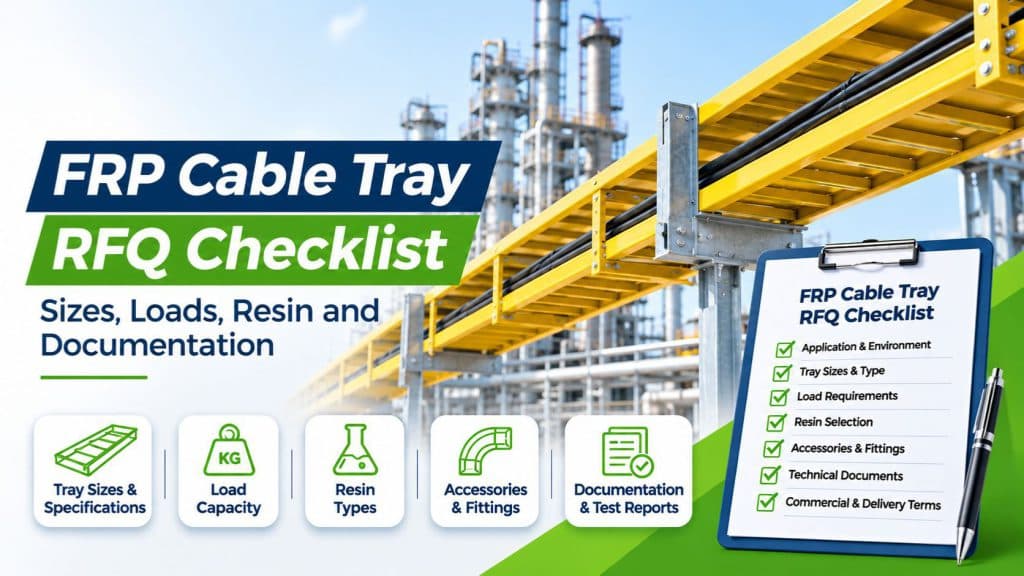
A properly prepared FRP Cable Tray RFQ Checklist helps procurement teams communicate their requirements clearly, reduce unnecessary clarification rounds and obtain comparable technical and commercial quotations — covering application details, dimensions, load, resin, accessories, documentation and commercial terms.
FRP Cable Tray RFQ Checklist: What Information Should You Include?
Step 1: Share the Application and Environmental Details
Start by explaining where and how the cable trays will be used. The operating environment plays an important role in selecting the appropriate resin system, tray profile and accessories.
Include the following information in your enquiry:
- Industry and application area: Mention whether the installation is for a chemical plant, fertiliser unit, effluent treatment plant, power plant, coastal facility or metro tunnel.
- Installation location: Specify whether the trays will be installed indoors, outdoors, on rooftops, pipe racks, trenches or underground.
- Chemical exposure: Provide the names and concentrations of chemicals present in the form of fumes, splashes or accidental spillages.
- Operating temperature: Mention the normal and maximum temperatures around the proposed cable tray route.
- UV exposure: Clarify whether the trays will be exposed to direct sunlight.
- Special environmental conditions: Mention high humidity, salt air, regular washdown, abrasion or other operating conditions.
These details help suppliers understand the application before recommending suitable materials and construction options.
Step 2: Specify Tray Width, Depth, Length and Support Span
Dimensions directly influence cable arrangement, installation planning and structural performance. Therefore, buyers should provide clear FRP cable tray sizes instead of relying on general descriptions such as standard or heavy-duty trays.
The following parameters should be included:
| Parameter | What to specify | Why it matters |
|---|---|---|
| Tray type | Ladder, perforated or solid bottom | Determines the appropriate cable arrangement |
| Width | Internal usable width in mm | Helps determine cable capacity and future expansion |
| Side height/depth | Side rail height in mm | Influences cable accommodation and stiffness |
| Length | Total running metres for each type and size | Helps calculate the required quantity |
| Support span | Distance between supports in metres | Important for load calculations and deflection |
| Covers | Whether covers are required and their type | Protects against debris and external exposure |
If a project requires multiple tray dimensions, list each size separately rather than combining everything into one quantity.
For a better understanding of available configurations and dimensional considerations, refer to our guide on FRP cable tray sizes and specifications.
Step 3: Define the Cable Load and Structural Requirements
One of the most common gaps in cable tray enquiries is an unclear load requirement. Terms such as heavy-duty or high-capacity can mean different things to different manufacturers.
Instead of using general descriptions, provide measurable requirements.
Include:
- Cable load per metre: Specify the expected cable weight in kg/m based on the cable schedule.
- Future expansion allowance: Mention the additional loading allowance required for future cable installations.
- Concentrated loads: Identify additional loads from junction boxes, equipment or occasional maintenance activities, where applicable.
- Allowable deflection: Specify the maximum permitted deflection if the project has a defined limit.
- Support span: Clearly state the distance between supports at which the specified load must be carried.
These details help the supplier evaluate the FRP cable tray load capacity and select a suitable structural profile.
The manufacturer should refer to relevant tested load tables and explain the basis of the proposed load rating. Buyers should also confirm whether the quoted performance applies to the actual support span and installation conditions.
A well-prepared FRP Cable Tray RFQ Checklist should always include the load requirement and its corresponding support arrangement. Without these details, comparing two technically different products becomes difficult.
Step 4: Select the Appropriate Resin System and Environmental Protection
The resin system is an important factor in determining the chemical resistance, temperature performance and overall suitability of an FRP cable tray.
Different FRP cable tray resin types are considered depending on the operating environment and project specifications.
| Resin system | Typical application | Important consideration |
|---|---|---|
| General-purpose polyester | Relatively mild environments | Cost-effective option with application-dependent chemical resistance |
| Isophthalic polyester | Moderate chemical exposure | Offers improved resistance compared with general-purpose polyester |
| Vinyl ester | More aggressive chemical environments | Generally offers higher chemical and temperature resistance |
| Fire-retardant formulations | Projects requiring specified fire performance | Requires appropriate supporting test documentation |
The final selection should be based on actual operating conditions, chemical exposure and the manufacturer’s technical recommendations. Buyers should confirm the availability of the required resin system before finalising the enquiry.
Also specify:
- Fire performance: Mention the applicable fire-performance requirements from the project specification.
- UV protection: Include UV protection requirements for outdoor installations.
- Colour: Specify any colour requirements for identification or project standards.
If you are unsure which resin system is appropriate, share the chemical list, operating temperature and environmental conditions with the supplier. Request a written recommendation explaining the basis of material selection.
Step 5: Include All Required FRP Cable Tray Accessories
Accessories are an important part of the overall cable management system. Leaving them out of the initial enquiry can lead to additional costs, separate purchase orders and longer project timelines.
Your enquiry should clearly identify the required FRP cable tray accessories, including:
- Horizontal bends (30°, 45° and 90°), including the required radius.
- Vertical bends, both inside and outside.
- Tees, crosses and reducers.
- Straight couplers and expansion couplers.
- Dropouts and cable exits.
- Support brackets, cantilever arms and hangers.
- Hold-down clamps and cover clamps.
- Fasteners in FRP, stainless steel or other specified materials.
- Cut-edge sealant for site modifications.
Whenever possible, attach a layout drawing showing the cable tray route and marking the required fittings.
This makes it easier for the supplier to prepare a complete quotation rather than making assumptions about accessories.
Step 6: Request Technical Documents and Test Reports
Technical documentation helps buyers evaluate whether the proposed product meets the project’s requirements.
When requesting an FRP cable tray quotation, ask the supplier to provide or confirm the availability of the following documents:
- Product technical data sheet.
- Load and span tables with the deflection basis.
- Fire test reports from a recognised laboratory, wherever fire performance is specified.
- Chemical resistance information for the proposed resin system.
- UV resistance information for outdoor applications.
- Dimensional drawings for trays and fittings.
- Material test certificates for the supplied batch, where applicable.
- Installation and handling guidelines.
- Inspection and test plan, if required by the project.
An important point is to ensure that the test reports correspond to the actual product construction and resin system being offered.
Documentation should not be treated as an optional formality, particularly in industrial projects where technical approvals are required before procurement.
Step 7: Specify Commercial and Delivery Requirements
Technical specifications alone are not sufficient to finalise a purchase. Commercial details should also be included in the enquiry to avoid misunderstandings during order processing.
Mention:
- Project delivery location.
- Required delivery date.
- Packaging and transportation requirements.
- Inspection requirements, including third-party inspection if applicable.
- Payment terms.
- GST and applicable commercial details.
- Warranty expectations.
Providing these details at the beginning allows suppliers to prepare more complete commercial proposals.
How to Compare FRP Cable Tray Quotations Fairly
Even when buyers provide detailed specifications, suppliers may present their quotations in different formats. Therefore, procurement teams should compare every quotation against the same technical and commercial requirements.
Use the following comparison points:
| Comparison parameter | Why it matters |
|---|---|
| Resin system offered | Different resin systems have different performance characteristics and costs |
| Fire-retardant formulation | Check whether the specified fire performance is included and supported by test reports |
| Profile dimensions and wall thickness | Differences can affect structural performance |
| Load rating at the specified support span | Confirms whether the proposed tray meets project requirements |
| UV protection | Important for outdoor installations |
| Accessories included | Bends, couplers and fasteners can significantly affect the total cost |
| Covers | Confirm whether covers are included or quoted separately |
| Technical documentation | Check whether required reports and drawings are provided |
| Delivery and packaging | Different freight and packaging terms can affect the final price |
| Lead time | Important for project planning and execution |
A comparison sheet based on these parameters makes it easier to identify differences between suppliers.
The lowest-priced quotation may not necessarily represent the best value if it excludes required accessories, offers different structural specifications or does not meet the project’s technical requirements.
Illustrative Example: Converting a Vague Enquiry Into a Detailed RFQ
The following example illustrates how a basic enquiry can be improved.
A vague enquiry
“Please quote FRP cable tray 300 mm, 500 metres, heavy duty, with accessories.”
This enquiry does not explain the tray type, side height, load requirement, support span, resin selection or accessory quantities.
A more detailed enquiry
- Application: Effluent treatment plant, outdoor pipe rack, with exposure to moisture and mild acidic fumes.
- Tray requirements: Ladder type, 300 mm wide with 100 mm side height, 420 metres; perforated type, 150 mm wide, 80 metres.
- Load requirement: Cable load per metre based on the attached cable schedule, including a future expansion allowance, at a 2-metre support span.
- Resin selection: Supplier to recommend a suitable resin system based on the attached chemical list, with fire-retardant formulation as specified in the project requirements.
- UV protection: Required for all outdoor installations.
- Covers: Required on ladder trays in outdoor sections.
- Accessories: As per the attached layout drawing, with fittings clearly marked.
- Documentation: Load tables, fire test reports, chemical resistance information, dimensional drawings and material certificates.
- Delivery: Project site address and required delivery date.
The second enquiry provides much clearer information and allows suppliers to prepare quotations against a common set of requirements.
This reduces clarification rounds and helps procurement teams evaluate the technical and commercial suitability of each offer.
Plan Lead Time, Drawing Approval and Inspection Early
FRP cable trays may be manufactured to order, particularly when projects require non-standard dimensions, specific resin systems or large quantities.
Procurement teams should account for the following stages when preparing project schedules:
-
1
Technical clarification
The supplier reviews the application, resin selection, tray profile and loading requirements.
-
2
Drawing approval
Tray and fitting drawings are submitted for review and approval.
-
3
Manufacturing
Production begins after technical and commercial requirements are finalised.
-
4
Inspection
The client or an appointed third party may inspect the products at the manufacturing facility before dispatch.
-
5
Dispatch and delivery
Products are properly packed and transported to the project location.
Delays can occur during technical clarification and drawing approval if the original enquiry is incomplete.
Providing accurate specifications and responding promptly to supplier queries can help keep the procurement schedule on track.
Common RFQ Mistakes to Avoid
Even experienced procurement teams can overlook important details when preparing an enquiry.
Avoid these common mistakes:
- ✕Requesting a standard FRP tray without describing the application or operating environment.
- ✕Providing the total running length without separating quantities by tray type and size.
- ✕Leaving out the support span, which is essential for structural evaluation.
- ✕Forgetting accessories and ordering them separately later.
- ✕Requesting fire test reports only after placing the order.
- ✕Failing to mention outdoor installations and UV exposure.
- ✕Sharing only a layout drawing without written technical specifications.
- ✕Providing specifications without the corresponding installation layout.
- ✕Not defining the expected cable load and future expansion allowance.
Avoiding these mistakes improves communication between procurement teams, project engineers and manufacturers.
Simple FRP Cable Tray RFQ Template
Use the following format when sending an enquiry to a manufacturer. You can copy this structure into your procurement email.
| RFQ section | Details to provide |
|---|---|
| Project name and location | Project details and site address |
| Application and environment | Industry and operating conditions |
| Chemical exposure | Chemical names and concentrations |
| Temperature range | Normal and maximum operating temperatures |
| Installation conditions | Indoor, outdoor and UV exposure |
| Tray specifications | Type, width, side height and total length |
| Load requirements | Cable load per metre and support span |
| Fire performance | Applicable project requirements |
| Covers | Required or not, including cover type |
| Accessories | Fittings list or layout drawing |
| Technical documents | Required reports, drawings and certificates |
| Delivery | Site location and required delivery date |
| Contact details | Name, designation, email and phone number |
A well-organised RFQ helps manufacturers understand the project requirements and respond with a more accurate technical and commercial proposal.
Frequently Asked Questions
What if I do not know the exact cable tray load?+
Can FRP cable trays be supplied in custom sizes?+
Should I request samples before placing a bulk order?+
Which documents should be checked before approving an FRP cable tray quotation?+
Request an FRP Cable Tray Quotation from Fibrograts
Preparing a complete enquiry is an important step towards selecting the right FRP cable tray solution for an industrial project.
Fibrograts manufactures FRP cable trays and accessories for corrosive and demanding industrial environments. Buyers can share their application details, required dimensions, loading information and project drawings to help the team understand their technical and commercial requirements. Use this FRP Cable Tray RFQ Checklist to organise your requirements before contacting the manufacturer.