
Quick Answer
An acid dilution system turns concentrated acid, most often 98% sulphuric acid, into the concentration a process needs by metering acid and water in a controlled ratio, mixing them in a device designed for the heat released, cooling the diluted acid, and verifying concentration with temperature-compensated measurements. Each zone needs materials suited to its concentration and temperature: carbon steel or lined systems for strong acid, special materials at the hot mixing point, and FRP, PP or PVDF for the cooled dilute acid. Interlocks, venting and containment make it safe.
Many plants buy acid in concentrated form because it is cheaper to transport and store, then dilute it for use: sulphuric acid for pH control, effluent neutralisation, ion-exchange regeneration, fertiliser and chemical processes; hydrochloric acid for regeneration and pickling; caustic soda for neutralisation and cleaning. Dilution sounds simple. With sulphuric acid in particular, it is one of the more hazardous routine operations in a plant, because of the heat released and the way corrosivity changes with concentration and temperature.
This guide explains how acid dilution systems work, why sulphuric acid needs special care, how to choose materials for each zone, how to control concentration and how to build safety into the system. It reflects the engineering approach behind FGPL’s acid dilution systems.
Why dilute on site?
-
Lower purchase and transport cost per tonne of active acid.
-
Smaller storage volumes for the same amount of acid.
-
Process flexibility: produce the exact concentration needed, on demand.
-
Safety in handling: downstream users handle dilute acid rather than concentrated acid.
The physics: heat of dilution
When concentrated sulphuric acid mixes with water, it releases a large amount of heat. The temperature of the mixture can rise sharply enough to boil locally and spatter if the mixing is uncontrolled. That is the origin of the long-standing rule: always add acid to water, never water to acid. In a continuous dilution system, the same principle appears as controlled metering of acid into a larger flow of water within a mixing device designed to absorb and remove the heat.
Hydrochloric acid releases much less heat on dilution, and caustic soda releases a moderate amount. Their dilution systems are simpler, but still need controlled mixing.
Corrosivity changes with concentration
Sulphuric acid’s behaviour towards materials changes dramatically with concentration and temperature:
-
Concentrated acid (around 93–98%) at ambient temperature is commonly stored in carbon steel, which forms a protective iron sulphate film at low velocities.
-
Intermediate concentrations, especially when hot, are very corrosive to carbon steel and many alloys.
-
Dilute acid at moderate temperature can be handled in suitable polymers and composites, including vinyl ester FRP within the resin manufacturer’s limits, PP and PVDF.
That is why a dilution system is a chain of zones, each with its own material.
Material selection by zone
Table 1. Typical material considerations by zone (sulphuric acid dilution)
| Zone | Conditions | Materials commonly considered | Notes |
|---|---|---|---|
| Concentrated acid storage | ~98%, ambient | Carbon steel tank, designed for acid service | Keep velocities low; avoid water ingress |
| Concentrated acid transfer | ~98%, ambient | Lined or alloy piping; pumps with PTFE/PVDF wetted parts | Select per supplier data |
| Water supply | Process or DM water | Standard materials | Quality affects final acid |
| Mixing point | Heat release; intermediate concentrations | PTFE-lined steel or suitable special materials | The most demanding zone |
| Cooler | Hot dilute acid | Graphite, PTFE or suitable alloy exchangers | Size for full heat load |
| Dilute acid storage | Cooled, dilute acid | Vinyl ester FRP (within resin limits), PP, PP-FRP | Check concentration and temperature against data |
| Dilute acid distribution | Cooled, dilute acid | PP, PVDF, FRP | Plastic valves and fittings |
| Vents | Acid mist | FRP or PP to scrubber | Mist control |
Material choices must be confirmed against corrosion data for the actual concentrations and temperatures, including upset conditions. FRP is excellent for the dilute side of many systems but is not used for concentrated sulphuric acid or at an uncooled mixing point.
Concentration measurement and control
Ratio control
The simplest robust approach meters acid and water with flowmeters and controls their ratio, often trimmed by a downstream concentration measurement. Flowmeter types are selected for each fluid; Coriolis meters, for example, measure mass flow and density directly.
Measuring concentration
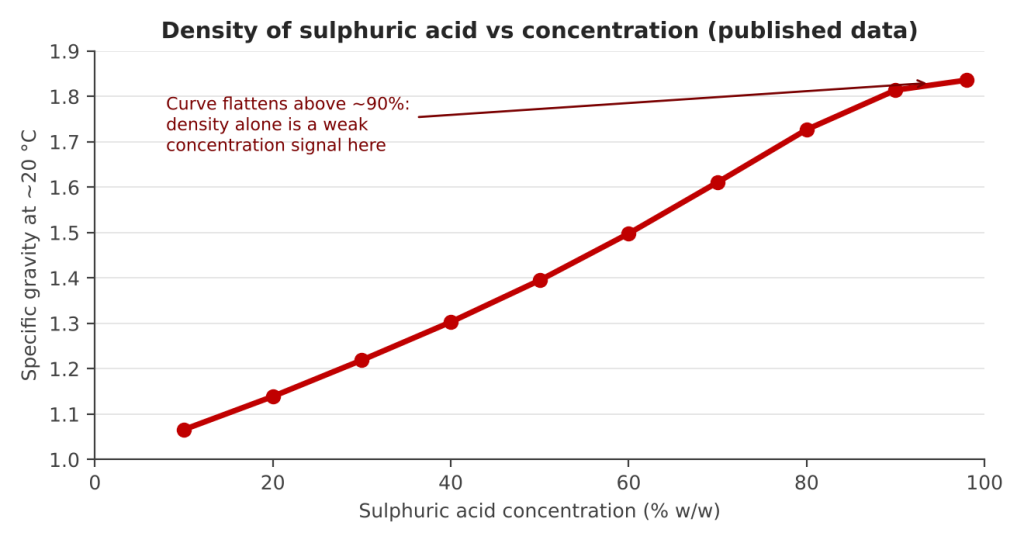
Density and conductivity are common indicators of acid concentration, with temperature compensation.

For typical dilute targets, such as 10–70%, density changes clearly with concentration and makes a reliable control signal once temperature is compensated. At high concentrations the curve flattens, so density alone is a weak signal there; conductivity or other methods may be combined with it.
Cooling
The heat released must be removed so that downstream materials stay within their temperature limits. Cooling options include plate or block exchangers in materials suited to hot dilute acid, and designs that mix into a large recirculating cooled stream. Size the cooler for the maximum dilution rate and the highest cooling water temperature, and interlock acid flow with cooling water flow and outlet temperature.
Safety systems
-
Interlocks: stop acid flow on low water flow, high outlet temperature, loss of cooling, high tank level or out-of-range concentration.
-
Order of start-up and shutdown: water first on start-up, acid last; acid stopped first on shutdown.
-
Venting and mist control: route vents to a scrubber to capture acid mist.
-
Containment: bunds sized for spills, with acid-resistant linings.
-
Segregation: keep acids away from incompatible chemicals such as hypochlorite.
-
Personnel protection: acid-resistant PPE, safety showers and eyewash stations at the skid and unloading point.
-
Pressure protection: relief for blocked or isolated sections where heating or gas generation could raise pressure.
Worked example: diluting 98% sulphuric acid to 30%
A plant needs 1,000 kg/h of 30% sulphuric acid for effluent pH control.
-
Mass balance: acid needed = 1,000 × 0.30 ÷ 0.98 ≈ 306 kg/h of 98% acid; water needed ≈ 694 kg/h.
-
Heat: the dilution releases substantial heat, so a cooler is sized for the full dilution rate, keeping the product within the temperature limit of the dilute-side materials.
-
Mixing: acid metered into the water stream at a mixing device in suitable lined construction.
-
Control: ratio control on Coriolis meters, trimmed by temperature-compensated density on the product line; interlocks on water flow, cooling and outlet temperature.
-
Storage: a vinyl ester FRP day tank for 30% acid, checked against resin data at the maximum product temperature, vented to a small scrubber.
-
Distribution: PP or PVDF piping and valves to dosing points.
HCl and caustic dilution
-
HCl dilution (for example 33% to a few per cent for regeneration) releases little heat. The whole system, including mixing and storage, can usually be built in vinyl ester FRP, PP or PVDF, with fume control on the concentrated acid tank.
-
Caustic dilution (for example 48% to 32% or lower) releases moderate heat and may need cooling for large rates. Vinyl ester FRP suits caustic; polyester does not. Concentrated caustic can crystallise in cold weather, so heat tracing may be needed upstream.
Skid-mounted systems
Many acid dilution systems are supplied as skids: a frame carrying pumps, flowmeters, mixer, cooler, instruments, valves and a control panel, connected to storage tanks on site. Skids are factory-tested, quicker to install and easier to validate than site-built systems.
Key terms
-
Heat of dilution: heat released when a concentrated acid mixes with water.
-
Ratio control: controlling two flows so their ratio stays constant.
-
Specific gravity: density relative to water, used to infer concentration.
-
Coriolis flowmeter: a meter measuring mass flow and density directly.
Model specification clause
-
The acid dilution system shall produce acid of the specified concentration and tolerance at the specified flow, from concentrated acid and process water.
-
Acid shall be metered into water in a mixing device designed for the heat of dilution; the system shall include cooling to keep the product within downstream material limits.
-
Materials shall be selected for each zone from corrosion data at the actual concentration and temperature, including upsets.
-
Concentration shall be controlled by ratio control with temperature-compensated verification; interlocks shall stop acid flow on loss of water, loss of cooling, high temperature and high level.
-
Vents shall be routed to a scrubber; the skid shall sit in a lined bund with safety showers nearby.
Common mistakes
-
Using one material for the whole system regardless of concentration and temperature.
-
Undersized coolers that let hot acid reach plastic or FRP components.
-
Starting acid flow before water flow.
-
No temperature compensation on density or conductivity measurements.
-
Venting acid mist to atmosphere.
Commissioning an acid dilution skid
Commissioning is when design assumptions meet real flows and temperatures. A careful sequence reduces risk:
-
Water trials: run the system on water only to check pumps, valves, flow meters, instruments and interlocks.
-
Instrument calibration: confirm density, conductivity and temperature measurements against laboratory samples.
-
Interlock testing: simulate high temperature, low water flow and high concentration to confirm trips work.
-
Low-rate acid introduction: start acid flow at a low rate with full water flow, checking temperature rise and concentration.
-
Ramp to design: increase flow in steps while monitoring temperature, concentration and cooler performance.
-
Sample and verify: laboratory analysis of product concentration at each step.
-
Train operators on normal operation, upsets and emergency shutdown.
Operating checks
-
Daily: check product concentration, temperatures and alarms.
-
Weekly: inspect for leaks at joints and flanges.
-
Periodically: recalibrate instruments and test interlocks.
-
During shutdowns: inspect mixing point, cooler and dilute tanks for corrosion or wear.
Batch or continuous dilution?
Table 2. Batch and continuous acid dilution compared
| Feature | Batch dilution | Continuous in-line dilution |
|---|---|---|
| Method | Acid added to water in a stirred tank | Acid and water mixed in-line at controlled ratio |
| Typical use | Small, intermittent demand | Steady, larger demand |
| Heat removal | Tank cooling, slow addition | In-line coolers |
| Control | Simpler, slower | Ratio control with concentration feedback |
| Footprint | Larger tank volume | Compact skid |
| Product consistency | Varies batch to batch unless controlled | Consistent if well controlled |
For small users, batch dilution with controlled acid addition to water, good cooling and strict procedures may be enough. For steady demand, continuous dilution skids with ratio control, cooling and interlocks give better consistency and safety.
FGPL acid dilution systems
FGPL designs and supplies acid dilution systems, together with the FRP and dual-laminate storage tanks, scrubbers and piping that surround them. We select materials zone by zone, build skids with metering, mixing, cooling and control, and coordinate them with our tank and scrubber packages.
See our acid dilution systems page and our guides to FRP scrubbers and dual-laminate tanks.
Frequently asked questions
What is an acid dilution system?
A system that meters concentrated acid and water in a controlled ratio, mixes them safely, removes the heat released, verifies concentration and delivers dilute acid to a process.
Why is diluting sulphuric acid dangerous?
It releases a large amount of heat that can cause local boiling and spattering if not controlled. Acid is always added to water, never the reverse.
Can FRP be used in acid dilution systems?
Yes, on the cooled dilute side within the resin manufacturer’s limits, for tanks, piping and vents. It is not used for concentrated sulphuric acid or at an uncooled mixing point.
How is acid concentration measured in a dilution system?
Usually by temperature-compensated density or conductivity, often combined with ratio control on flowmeters.
Is HCl dilution simpler than sulphuric acid dilution?
Yes. HCl releases much less heat on dilution, so systems can often be built entirely in FRP, PP or PVDF, with fume control on the concentrated acid.
Do acid dilution systems need scrubbers?
Vents from acid tanks and mixing points can release acid mist or fumes, so venting to a scrubber is good practice.
How is an acid dilution system commissioned?
By water trials, instrument calibration, interlock testing, then gradual acid introduction while checking temperature and concentration, followed by operator training.
How often should dilution interlocks be tested?
Periodically, according to the plant’s safety procedures, and always after maintenance on instruments or control systems.
Should acid dilution be batch or continuous?
Batch suits small, intermittent demand; continuous in-line dilution with ratio control suits steady, larger demand and gives more consistent concentration.
What happens if water is added to concentrated sulphuric acid?
The heat released can boil the water locally and spatter acid violently. The rule is always to add acid to water under controlled conditions, never water to acid.
Can a dilution skid handle different target concentrations?
Yes, if instruments, coolers and materials are designed for the full range; the ratio controller setpoint is changed for each target.
References and standards cited
-
Published density data for sulphuric acid solutions.
-
Corrosion data for materials in sulphuric, hydrochloric acid and caustic service (material and resin manufacturers).
-
BS EN 13121 — GRP tanks and vessels (for dilute acid storage).
Planning an acid dilution system? Send FGPL the acid, concentrations, flow rates and site details via the contact page or products@fgpl.in.
About The Author
This article was prepared by the engineering team at Fibro Grats Pvt. Ltd. (FGPL), Indore — designers and manufacturers of filament-wound FRP tanks and vessels, pultruded and moulded FRP products and FRP process equipment, with an in-house quality lab (UTM and pressure testing) and ISO-certified management systems. Data in this article comes from the standards cited, published resin and industry data, and FGPL’s own engineering practice. Where figures are illustrative, the text says so; for project-specific calculations, drawings and test reports, contact FGPL’s engineering desk.