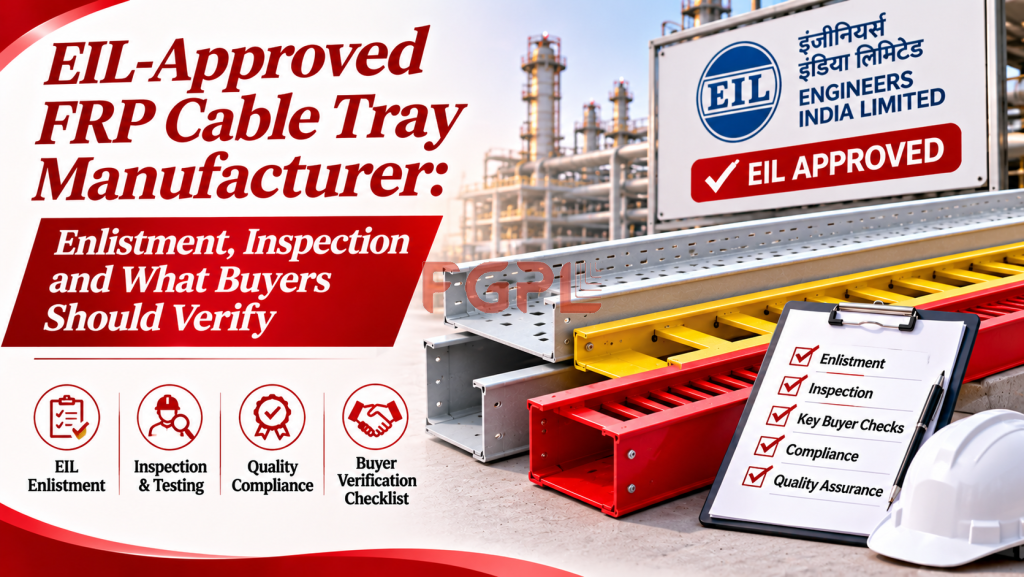
An EIL-approved FRP cable tray manufacturer has been enlisted by Engineers India Limited after a three-stage process: document review, a shop survey of the factory by EIL’s procurement office, and final approval by EIL’s competent authority. For refinery, petrochemical and fertiliser projects engineered by EIL, it means the vendor’s facility, quality system, type tests and supply record have already been examined. FGPL is an EIL-approved manufacturer of FRP cable trays.
Engineers India Limited (EIL) sits behind a large share of India’s hydrocarbon infrastructure. Established in 1965, it is one of South Asia’s leading engineering consultancy and EPC companies in hydrocarbons and petrochemicals, and has diversified into fertilisers, LNG, infrastructure and green hydrogen. When EIL is the consultant or EPCM contractor, its specifications, vendor lists and inspection practices shape what gets bought.
For electrical packages, that includes cable trays. In corrosive process units, cooling tower areas, effluent plants and coastal sites, fibre-reinforced plastic (FRP) trays are often specified in place of galvanised steel. This article explains what EIL enlistment involves, what inspection and testing to expect on an EIL-engineered project, and how to verify that an FRP cable tray vendor is genuinely approved.
FGPL supplies pultruded ladder, perforated and trough FRP cable trays with fittings and supports for EIL-engineered projects.
01The EIL supplier enlistment process
EIL’s published guidance for supplier enlistment describes three stages. Only suppliers that clear each stage move to the next.
| Stage | Who acts | What is examined |
|---|---|---|
| Stage 1 — Document review | EIL reviewers | Company profile and major clients; incorporation documents; ISO 9001 and ISO 45001; factory licence; MSME (Udyam) registration; audited financials for three years; organogram covering design, QA/QC, production and after-sales; ten-year supply record; end-user performance feedback; type test reports; statutory approvals where applicable; internal QA plan; compliance with EIL specifications and ITP |
| Stage 2 — Shop survey | EIL Regional or Foreign Procurement Office (RPO/FPO) | Works visit covering manufacturing facility layout and machinery, design facility, planning and scheduling, quality management and ISO compliance, testing arrangements, after-sales service and document verification |
| Stage 3 — Final approval | EIL competent authority or committee | Recommendation reviewed; enlistment letter issued if approved |
Why EIL enlistment is demanding
Three things make it a meaningful filter for FRP cable tray buyers.
-
Evidence over claims. Stage 1 asks for type test reports, a ten-year supply record and end-user feedback. A new entrant or a trader without manufacturing cannot produce these.
-
Physical verification. The shop survey confirms that the factory, machinery and lab described on paper actually exist and operate.
-
Specification discipline. Suppliers must comply with EIL specifications and inspection and test plans (ITPs), so the vendor is already used to working to defined acceptance criteria.
02What EIL-engineered projects expect from FRP cable trays
Project specifications vary, but they generally cover the same technical areas. The table below summarises what a buyer should expect to see in a compliant offer.
| Area | What is usually specified | How a good vendor demonstrates it |
|---|---|---|
| Manufacturing | Pultruded profiles with defined glass content and resin system | Process description; burn-off test results |
| Mechanical | Safe working load at stated span; deflection limit | Load test report to NEMA FG 1 or IEC 61537 |
| Fire | Fire-retardant, self-extinguishing grade | ASTM E84 / ASTM D635 / UL 94 test reports for the offered grade |
| Weathering | UV-stabilised, resin-rich surface | Surface veil detail and UV inhibitor confirmation |
| Chemical | Resin suited to the unit’s chemicals | Resin selection rationale; resin maker’s resistance data |
| Dimensions | Width, height, thickness, rung spacing, tolerances | Dimensional inspection records |
| Accessories | Fittings, covers, splices, fasteners from the same system | Drawings and datasheets for each item |
| Quality | QAP and ITP with stage inspections | Approved QAP before production |
A useful benchmark: EN 13706 profile grades
Indian projects normally reference product-level load tests rather than material grades. Still, the European standard for pultruded profiles, EN 13706, is a useful benchmark for the quality of the profiles a tray is made from. It defines two grades, E23 and E17, by minimum stiffness and strength.

E23 requires a minimum full-section flexural modulus and axial tensile modulus of 23 GPa, axial tensile and flexural strength of 240 MPa, and axial pin-bearing strength of 150 MPa. Profiles thinner than about 5 mm are often classed against E17. Because FRP trays are usually limited by deflection rather than strength, stiffness (modulus) is the property that matters most. Higher, well-controlled glass content is the main way to get it.
03Inspection and testing on an EIL-type project
Expect stage-wise inspection under an approved ITP, with hold and witness points for the client or its third-party inspection agency. The table shows a typical structure; the exact tests and frequencies are agreed in the QAP for each order.
| Stage | Check | Typical method / reference | Typical frequency |
|---|---|---|---|
| Raw material | Resin and glass test certificates | Supplier certificates reviewed against specification | Every batch |
| In-process | Pull speed, die temperature, cure | Production records | Continuous / per shift |
| Finished profile | Visual (cracks, dry fibre, voids, surface veil) | Visual inspection | 100% |
| Finished profile | Dimensions and straightness | Calibrated gauges | Sampling plan per lot |
| Finished profile | Degree of cure | Barcol hardness, ASTM D2583 | Sampling per lot |
| Finished profile | Glass content | Ignition loss, ASTM D2584 / ISO 1172 | Per lot or per resin batch |
| Type test | Load and deflection | NEMA FG 1 or IEC 61537 | Per design / as agreed |
| Type test | Fire performance | ASTM E84, ASTM D635 or UL 94 | Per resin grade |
| Final | Marking, packing, documentation | Visual and document review | Every dispatch |
Sampling for dimensional checks is usually drawn from ISO 2859-1 or its Indian equivalent IS 2500 (Part 1). For a lot of 1,201–3,200 tray lengths at general inspection level II, the normal sample size is 125 pieces.
04Documents to expect from an EIL-enlisted vendor
-
Technical datasheets for each tray type, fitting and accessory.
-
General arrangement and fabrication drawings, including splice details.
-
Load and deflection tables with the test standard and span stated.
-
Fire and UV test reports for the offered resin grade.
-
Quality assurance plan (QAP) and inspection and test plan (ITP).
-
Raw material test certificates and in-house test records.
-
Packing, handling, storage and installation instructions.
-
Copy of the EIL enlistment letter covering the product category.
05How to verify that a vendor is genuinely EIL-approved
Approval claims are easy to make and easy to check. Before you rely on one:
-
Ask for the enlistment letter. It should name the company and the item category.
-
Check the category. Enlistment for one item does not cover another. Make sure it includes FRP cable trays.
-
Check currency. Enlistment is subject to EIL’s terms for revalidation; confirm the status is current.
-
Match the manufacturing location. The shop survey covers a specific works. Confirm your supply will come from that facility.
-
Cross-check with the project. Where the project has its own vendor list, confirm the vendor appears on it for this item.
Check the FRP cable tray range, sizes and resin grades before you finalise your specification and datasheets.
06Specification points that are often missed on refinery projects
Even with an approved vendor, a few details decide whether an FRP tray system performs for its full life. These come up repeatedly in our technical clarifications with EPC teams.
-
Earth continuity. FRP trays are non-conductive and cannot serve as an earth path. The electrical design must include a separate earth continuity conductor run along the tray, sized and bonded to the plant earthing system.
-
Temperature derating near hot equipment. Trays routed near furnaces, heaters, hot lines or under sun-exposed roofs see higher temperatures. Polyester retains about 78% of rated strength at roughly 52 °C under NEMA FG 1 guidance; vinyl ester retains more.
-
Cut-edge sealing. Every site cut must be sealed with compatible resin, or moisture and chemicals can wick along the fibres.
-
Hardware material. Specify SS316 or FRP bolts. Carbon steel hardware on an FRP tray in a corrosive unit is a common and avoidable weak point.
-
Expansion splices. FRP expands less than steel (about 9 × 10⁻⁶ per °C against about 11.7 × 10⁻⁶ per °C), but long straight runs on racks still need expansion splices.
-
Covers and wind. Covers on open racks must be clamped for the design wind pressure from IS 875 (Part 3).
-
Hazardous areas. Where the area classification calls for static control, specify an anti-static grade.
07Why EIL approval matters commercially
For an EPC contractor working on an EIL-engineered project, an enlisted vendor removes a procurement risk. The contractor avoids the time and uncertainty of proposing a new vendor, inspection agencies know the vendor’s systems, and document approval tends to move faster. For a plant owner, it adds confidence that the tray installed on a critical unit came from a manufacturer that passed an independent capability check.
It also signals breadth. EIL’s work spans refineries, petrochemicals, fertilisers, LNG terminals and new energy projects. A vendor approved by EIL has typically been assessed against the expectations of these sectors, not just a single client.
08Where FRP trays are typically specified on Indian hydrocarbon projects
Not every area of a refinery or petrochemical complex needs FRP. Galvanised steel remains common in dry, sheltered locations. FRP earns its place where corrosion, chemicals or electrical considerations make metal trays a maintenance burden.
| Area | Why metal trays struggle | FRP grade usually considered |
|---|---|---|
| Cooling tower and cooling water areas | Constant wetting, treatment chemicals, biocides | FR polyester or vinyl ester, UV-stabilised |
| Effluent treatment plant | Acidic and alkaline effluents, H₂S, humidity | Vinyl ester |
| Sulphur recovery and amine units | SO₂, H₂S, sulphuric acid mist | Vinyl ester |
| DM water and chemical dosing | Acid and caustic regenerants | Vinyl ester |
| Coastal jetties and marine terminals | Salt spray, splash, high UV | Vinyl ester, UV-stabilised, with covers |
| Battery rooms and substations near process | Acid fumes; preference for non-conductive supports | FR polyester or vinyl ester |
| Fertiliser and ammonia units | Ammonia, nitrate and urea dust, humidity | Vinyl ester |
09Preparing for third-party inspection
On EIL-engineered projects, inspection is usually carried out by EIL or an appointed third-party agency against the approved ITP. A well-prepared manufacturer makes inspection quick and uneventful. At FGPL, preparation includes:
-
Lot segregation. Material offered for inspection is stacked by item code and batch so samples can be drawn at random from every bundle.
-
Calibrated instruments. Vernier callipers, tapes, Barcol impressors and the UTM have current calibration certificates on file.
-
Record traceability. Raw material certificates, production logs and in-house test results are linked to each batch.
-
Witness-ready tests. Glass content and hardness tests can be run in front of the inspector on request.
-
Document dossier. Approved drawings, QAP, ITP and previous test reports are ready for review.
The result is fewer re-inspections and faster release notes, which matters when cable pulling on site is waiting for trays.
10FGPL: EIL- and ADNOC-approved FRP cable trays
Fibro Grats Pvt. Ltd. (FGPL) is an EIL-approved and ADNOC-approved manufacturer of FRP cable trays, with ISO-certified quality, environmental and occupational safety management systems.
-
Continuous, fully automated pultrusion at our Indore facility, with approximately 60–65% glass content.
-
Ladder trays from 150 mm to 1500 mm wide and perforated trays from 50 mm to 300 mm wide, in 3 m and 6 m standard lengths.
-
Polyester, vinyl ester and epoxy resin systems with fire-retardant and UV-stabilised grades.
-
In-house quality lab with a universal testing machine for mechanical testing.
-
QAP, ITP and documentation prepared for client and third-party inspection.
Review the full range, then send us your cable schedule for a load check and technical offer.
11Frequently asked questions
What does EIL approval mean for an FRP cable tray manufacturer?
It means Engineers India Limited has enlisted the manufacturer after reviewing its documents, surveying its works and approving it through EIL’s competent authority. The approval applies to the item category and works assessed.
Is FGPL EIL-approved for FRP cable trays?
Yes. FGPL is an EIL-approved manufacturer of FRP cable trays and is also approved by ADNOC. Approval letters are available to EPC contractors and owners on request.
What tests are carried out on FRP cable trays during inspection?
Typical tests include visual and dimensional checks, Barcol hardness for cure (ASTM D2583), glass content by ignition loss (ASTM D2584), and review of type test reports for load and fire performance. The exact list comes from the approved QAP and ITP.
Does EIL publish a cable tray specification?
EIL prepares project specifications for the projects it engineers. Requirements differ from project to project, so always work from the specification issued for your job.
How long does EIL enlistment take?
EIL does not publish a fixed duration. The process depends on document completeness, scheduling of the shop survey and committee review.
12References and standards cited
-
Engineers India Limited — Enlistment of Suppliers & Contractors in EIL (2023 brochure).
-
EN 13706-3 — Reinforced plastics composites: specifications for pultruded profiles.
-
ISO 2859-1 / IS 2500 (Part 1) — Sampling procedures for inspection by attributes.
-
ASTM D2583 (Barcol hardness); ASTM D2584 / ISO 1172 (glass content).
-
NEMA FG 1; IEC 61537:2023; ASTM E84; ASTM D635; UL 94.
Working on an EIL-engineered project?
Send your tray schedule and specification to FGPL through the contact page or products@fgpl.in. We will respond with a compliant offer, QAP, datasheets and our EIL enlistment documents.
This article was prepared by the Applications Engineering team at Fibro Grats Pvt. Ltd. (FGPL), Indore — the team that designs, pultrudes and tests FGPL’s FRP cable tray systems, which are approved by ADNOC and Engineers India Limited (EIL). Data in this article comes from the international standards cited, published resin and industry data, and FGPL’s own engineering practice. Where figures are illustrative, the text says so; for project-specific load tables, test reports and drawings, contact FGPL’s engineering desk.