Quick Answer
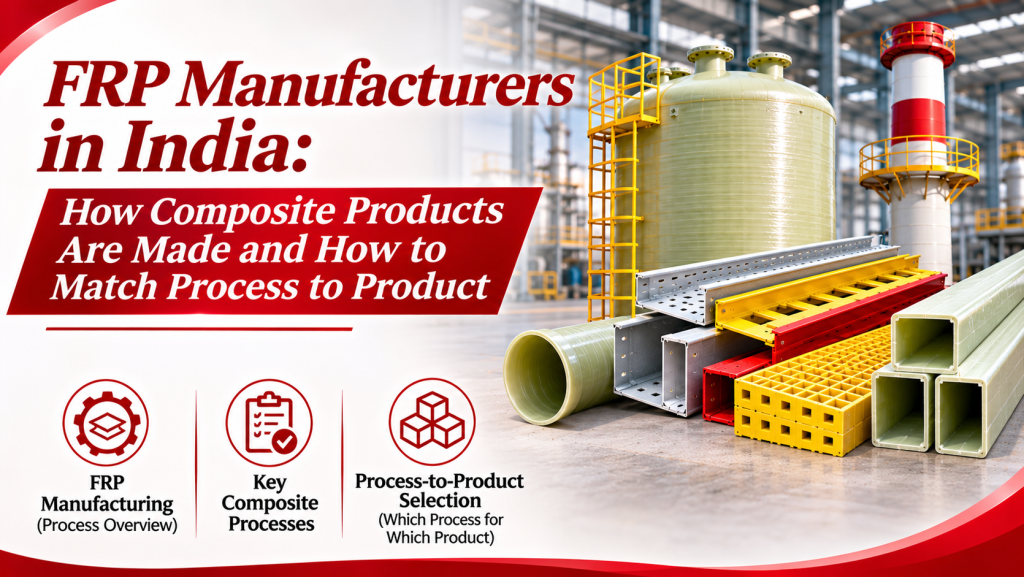
FRP (fibre reinforced plastic, also called GRP) products are made by combining glass or other fibres with a thermoset resin, using processes such as hand lay-up, spray-up, filament winding, pultrusion, compression moulding and resin transfer moulding. Each process gives a different glass content, strength, surface finish and cost. Good FRP manufacturers match the process to the product: filament winding for tanks and pipes, pultrusion for profiles and cable trays, moulding for gratings and covers, and contact moulding for complex fabricated equipment. Buyers should check process capability, resin systems, standards, testing and approvals.
India has a large and varied FRP industry, from small workshops making sheets and simple mouldings to engineering-led manufacturers producing chemical tanks, process equipment and approved electrical support systems for oil and gas projects. For buyers, the word “FRP manufacturer” covers a wide range of capabilities. Understanding how FRP products are made helps buyers ask the right questions and compare suppliers fairly.
This guide explains the main FRP manufacturing processes, the products each suits, and how to evaluate an FRP manufacturer. It draws on FGPL’s experience running multiple processes across tanks, vessels, pultruded products, moulded gratings and covers, and process equipment.
What FRP is made of
-
Reinforcement: usually E-glass fibres in forms such as rovings, chopped strand mat, woven roving, stitched fabrics and surfacing veils. Synthetic veils (polyester or similar) are used in corrosion barriers.
-
Resin: thermosets such as orthophthalic polyester, isophthalic polyester, vinyl ester, novolac vinyl ester, epoxy and fire-retardant variants, chosen for chemical, temperature and fire requirements.
-
Additives: fillers, pigments, UV stabilisers, fire retardants, conductive additives.
-
Thermoplastic liners (PP, PVDF, HDPE and others) in dual-laminate equipment.
The main FRP processes

Hand lay-up (contact moulding)
Layers of mat and woven roving are laid on an open mould and wetted out with resin by roller. It suits large, complex and one-off parts, and fabricated equipment such as rectangular tanks, ducts, hoods, scrubber internals and fittings. Quality depends heavily on workmanship.
Spray-up
Chopped glass and resin are sprayed together onto a mould. It is faster than hand lay-up for large surfaces such as covers and enclosures, with similar glass content.
Filament winding
Continuous rovings soaked in resin are wound onto a rotating mandrel at controlled angles. It gives high glass content and strength in the hoop direction, ideal for cylindrical tanks, vessels, pipes and stacks. Winding angle can be tuned for the loads. A resin-rich corrosion barrier is usually laid up first.
Pultrusion
Fibres are pulled through a resin bath and a heated die, producing continuous profiles with constant cross-section and high glass content. Pultrusion makes cable trays, ladders, channels, angles, I-beams, gratings, handrails and structural profiles.
Compression moulding (including SMC/BMC)
Moulding compound or reinforcement and resin are pressed in heated matched dies. It suits high-volume parts with consistent dimensions, such as manhole covers, gratings and electrical enclosures.
Moulded grating
Continuous rovings and resin are laid into an open grid mould, giving a one-piece bi-directional grating with high resin content and good corrosion resistance.
Resin transfer moulding (RTM) and infusion
Dry reinforcement is placed in a closed mould and resin is injected or drawn in by vacuum. It gives good surface finish on both sides and controlled glass content, for medium-volume parts.
Matching process to product
Table 1. Process selection by product
| Product | Typical process | Why |
|---|---|---|
| Vertical and horizontal storage tanks | Filament winding + contact-moulded ends and nozzles | High hoop strength, efficient laminate |
| Rectangular tanks and fabricated vessels | Hand lay-up | Complex shapes and stiffeners |
| Pipes and ducts | Filament winding or hand lay-up | Diameter and pressure dependent |
| Stacks and chimneys | Filament winding or hand lay-up | Cylindrical shells with joints |
| Cable trays and ladders | Pultrusion | Constant profiles, high glass content |
| Structural profiles, handrails | Pultrusion | Strength-to-weight, consistency |
| Moulded gratings | Open-grid moulding | Bi-directional strength, corrosion resistance |
| Pultruded gratings | Pultrusion + assembly | High one-way span capacity |
| Manhole and drain covers | Compression moulding | Consistent dimensions, high volume |
| Conveyor hoods, sheets | Moulding, continuous sheet lines | Large areas, profiles |
| Dual-laminate equipment | Thermoplastic lining + FRP overwrap | Extreme chemical resistance |
How to evaluate an FRP manufacturer
Engineering capability
-
Design to recognised standards: BS EN 13121, ASME RTP-1, ASTM D3299/D4097 for tanks; NEMA FG1 and IEC 61537 for cable trays; EN 124 for covers; ASTM and other standards for gratings.
-
Structural calculations including wind and seismic loads to IS 875 and IS 1893.
-
Drawings and quality plans before fabrication.
Process and materials
-
Range of processes suited to the products needed.
-
Resin systems available, including vinyl ester, novolac and fire-retardant grades, with documented chemical resistance.
-
Material traceability for resin and glass batches.
Quality and testing
-
In-house testing: Barcol hardness, glass content (burn-off), laminate thickness, mechanical testing on a universal testing machine, hydrostatic and pressure testing.
-
Third-party inspection acceptance.
-
ISO-certified quality management systems.
Approvals and track record
-
Client and consultant approvals relevant to the product: for example, approvals from major oil and gas operators and engineering consultants are hard to obtain because they involve detailed technical, quality and facility assessments.
-
References for similar products and services.
Commercial and service
-
Delivery capability and logistics for large items.
-
Site installation and repair support.
-
Documentation: test certificates, material certificates, manuals.
Worked example: choosing suppliers for a chemical plant package
A chemical plant project needs storage tanks, a scrubber, FRP gratings, cable trays and drain covers.
-
Tanks: filament-wound vinyl ester tanks designed to BS EN 13121-3, with wind and seismic checks.
-
Scrubber and stack: contact-moulded and filament-wound FRP with process sizing.
-
Gratings: moulded grating for chemical splash areas; pultruded grating where longer spans are needed.
-
Cable trays: pultruded FRP cable trays tested to NEMA FG1 or IEC 61537, from an approved manufacturer.
-
Covers: compression-moulded FRP covers classified to EN 124.
-
Supplier check: process capability, standards, testing, approvals and references for each item, and whether one manufacturer can supply several items with consistent quality.
Common mistakes when buying FRP
-
Comparing prices without comparing laminate thickness, resin type and glass content.
-
Accepting general-purpose polyester for chemical service.
-
Ignoring corrosion barrier specifications.
-
Skipping structural calculations for tanks and stacks.
-
No third-party or in-house testing evidence.
-
Choosing a supplier without relevant approvals for regulated projects.
Key terms
-
FRP / GRP: fibre (glass) reinforced plastic.
-
Corrosion barrier: the resin-rich inner layer that resists chemical attack.
-
Glass content: proportion of glass by weight, affecting strength and stiffness.
-
Barcol hardness: a measure of resin cure.
-
Pultrusion: continuous production of constant-section profiles.
-
Filament winding: winding resin-wetted fibres onto a rotating mandrel.
Resin systems at a glance
Table 2. Common FRP resin systems
| Resin | Typical use | Strengths | Limitations |
|---|---|---|---|
| Orthophthalic polyester | General-purpose, non-corrosive products | Low cost | Limited chemical and heat resistance |
| Isophthalic polyester | Water tanks, mild chemicals, gratings, sheets | Better chemical resistance than ortho | Not for strong acids, alkalis or oxidisers at high temperature |
| Bisphenol / vinyl ester | Chemical tanks, scrubbers, ducts, gratings | Broad chemical resistance, toughness | Higher cost |
| Novolac vinyl ester | High temperature, solvents, aggressive chemicals | Higher temperature and solvent resistance | Higher cost, more brittle |
| Epoxy | Pipes, high-performance parts | Strength, adhesion | Cost, cure requirements |
| Phenolic | Offshore, tunnels, fire-critical areas | Low flame spread and smoke | Processing complexity |
| Fire-retardant polyester or vinyl ester | Cable trays, ducts, buildings | Reduced flame spread | Some loss of other properties |
Quality checks by process
Table 3. Typical quality checks for FRP products
| Check | Filament winding | Pultrusion | Moulding | Hand lay-up |
|---|---|---|---|---|
| Barcol hardness (cure) | Yes | Yes | Yes | Yes |
| Glass content (burn-off) | Yes | Yes | Yes | Yes |
| Thickness / dimensions | Yes | Yes | Yes | Yes |
| Visual defects | Yes | Yes | Yes | Yes |
| Mechanical tests | Ring or coupon tests | Flexural, tensile, load tests | Load tests on panels or covers | Coupon tests |
| Pressure or hydro test | Tanks and pipes | Not applicable | Not applicable | Tanks and vessels |
| Product-specific tests | Tank design verification | NEMA FG1 / IEC 61537 load tests for trays | EN 124 for covers | As required |
Signs of a capable FRP manufacturer
-
Engineering team that produces calculations and drawings, not just prices.
-
Documented resin selection with chemical resistance data for your chemicals.
-
Test equipment in use, with calibration records.
-
Process control: written procedures for laminate schedules, cure and post-cure.
-
Traceability from raw materials to finished product.
-
Willingness to accept third-party inspection.
-
Approvals and references that match the product and industry.
The role of standards and approvals in procurement
Large projects in oil and gas, power, water and infrastructure often require suppliers to be on approved vendor lists. Getting on these lists involves technical document review, factory audits, product testing and track record checks. For buyers, approvals reduce the work needed to qualify a supplier; for manufacturers, they demand sustained investment in quality systems and testing.
From enquiry to delivery at an engineering-led manufacturer
-
Enquiry review: product, chemicals, temperatures, sizes, standards and site conditions.
-
Technical clarification: questions on missing data, such as specific gravity, upset temperatures or load classes.
-
Design and offer: preliminary design, laminate or product selection, drawing and price.
-
Order and approvals: detailed drawings and calculations submitted for client approval.
-
Manufacturing: material receipt and inspection, production under process control, in-process checks.
-
Testing and inspection: in-house tests, third-party or client inspection.
-
Documentation: test certificates, material certificates, manuals.
-
Dispatch and installation support: packing, transport, site guidance.
What drives lead time
-
Design approval cycles, often the longest step on project orders.
-
Raw material availability, especially special resins and liners.
-
Mould or die availability for moulded and pultruded products.
-
Size and complexity of fabricated equipment.
-
Testing and inspection scheduling with third parties.
The Indian FRP landscape
India’s FRP industry ranges from small fabricators supplying local markets to engineering-led manufacturers serving refineries, chemical plants, power, water and infrastructure projects, including export work. For buyers, the key is matching supplier capability to the product’s criticality: a decorative panel and a hydrochloric acid storage tank are both “FRP”, but they demand very different levels of engineering, testing and approval.
FGPL’s processes and credentials
FGPL manufactures across multiple processes: filament-wound and contact-moulded tanks and vessels; pultruded cable trays, profiles, handrails and gratings; moulded gratings; compression-moulded covers; FRP sheets, hoods and chimneys; and FRP process equipment and complete plants. Our FRP cable trays are approved by ADNOC and EIL, which reflects the depth of technical, quality and manufacturing assessment behind them.
Our in-house quality lab includes UTM and pressure testing, and our management systems are ISO-certified. Learn more about FGPL.
Frequently asked questions
What are the main FRP manufacturing processes?
Hand lay-up, spray-up, filament winding, pultrusion, compression moulding, open-grid moulding, and resin transfer moulding or infusion.
Which process is best for FRP tanks?
Filament winding for cylindrical shells, with contact-moulded heads, nozzles and corrosion barriers; rectangular tanks use hand lay-up.
How are FRP cable trays made?
By pultrusion, which produces constant profiles with high glass content, then fabricated into trays, fittings and accessories.
What should I check when choosing an FRP manufacturer in India?
Design standards, process capability, resin systems, in-house testing, ISO certification, approvals relevant to the product and references for similar projects.
What is the difference between FRP and GRP?
They are the same family of materials. GRP specifically refers to glass reinforcement; FRP is the broader term.
Why do approvals matter?
Approvals from major operators and consultants show that a manufacturer’s products, processes and quality systems have passed detailed assessments, reducing project risk.
Which resin is best for chemical tanks?
Vinyl ester resins are widely used for chemical tanks because of their broad chemical resistance; novolac vinyl esters suit higher temperatures and solvents. Selection depends on the specific chemical and temperature.
What quality tests should an FRP manufacturer perform?
Barcol hardness, glass content, thickness, visual inspection, mechanical tests and product-specific tests such as pressure tests for tanks or load tests for cable trays and covers.
How long does it take to manufacture FRP equipment?
It depends on design approval cycles, raw material availability, moulds or dies, size and complexity, and inspection scheduling; design approval is often the longest step.
Is FRP the same as fibreglass?
In everyday use, yes. Fibreglass usually means glass fibre reinforced plastic, which is the most common type of FRP.
Can one FRP manufacturer supply tanks, gratings and cable trays?
Some can. Manufacturers that run filament winding, moulding and pultrusion under one quality system can supply several product types with consistent documentation.
References and standards cited
-
BS EN 13121 series — GRP tanks and vessels.
-
ASME RTP-1 — reinforced thermoset plastic equipment.
-
ASTM D3299 / D4097 — filament-wound and contact-moulded tanks.
-
NEMA FG1 and IEC 61537 — cable trays.
-
EN 124 — gully tops and manhole tops.
-
ISO 9001 — quality management.
Need an FRP partner? Send FGPL your product list, specifications and project schedule via the contact page or products@fgpl.in.
About The Author
This article was prepared by the engineering team at Fibro Grats Pvt. Ltd. (FGPL), Indore — designers and manufacturers of filament-wound FRP tanks and vessels, pultruded and moulded FRP products and FRP process equipment, with an in-house quality lab (UTM and pressure testing) and ISO-certified management systems. Data in this article comes from the standards cited, published resin and industry data, and FGPL’s own engineering practice. Where figures are illustrative, the text says so; for project-specific calculations, drawings and test reports, contact FGPL’s engineering desk.