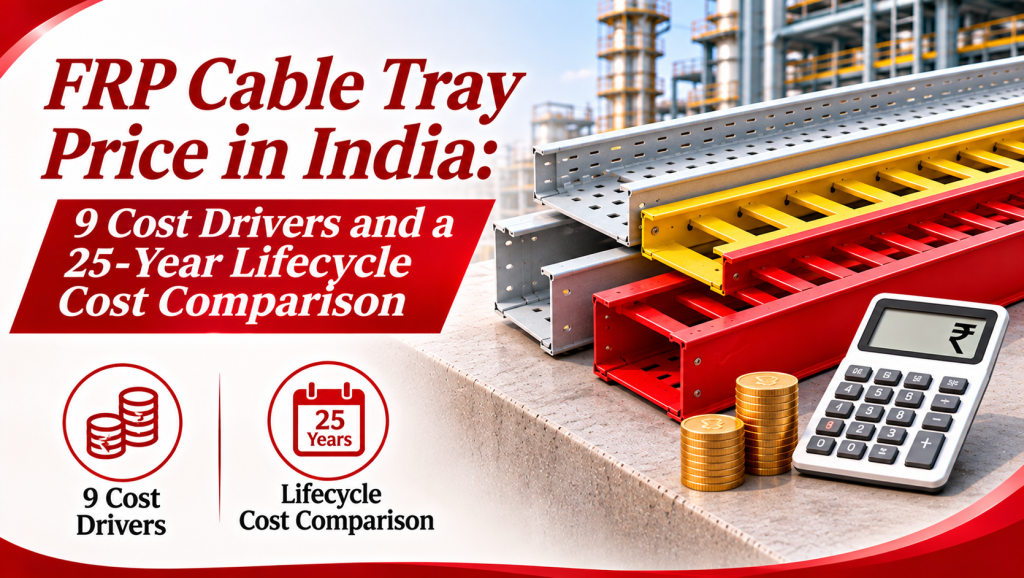
FRP cable tray price in India depends mainly on tray width and side-rail height, wall thickness (load class), resin system, fire and UV grade, the share of fittings and covers, and order size. FRP usually costs more per metre than hot-dip galvanised (GI) steel at purchase, but in corrosive or coastal plants it often costs far less over 25 years because it does not need recoating or replacement. Compare total installed and lifecycle cost, not price per metre.
“What is the price of FRP cable tray per metre?” is one of the most common questions we receive. The honest answer is that a single number is misleading. Two trays that look the same on a drawing can differ by a wide margin in cost because one has thicker side rails, a vinyl ester resin and a fire-retardant, UV-stabilised surface, while the other has none of these. The cheaper tray may also need supports twice as often, which moves the cost from the tray to the steelwork.
This guide explains the nine factors that set the price of an FRP cable tray in India, shows how to compare offers fairly, and presents an illustrative 25-year lifecycle cost model against GI and stainless steel trays.
FGPL quotes pultruded FRP cable trays with fittings, supports and documents so you can compare like for like.
01The 9 cost drivers of an FRP cable tray
1. Width and side-rail height
Material quantity rises with width (more and longer rungs, or a wider base) and with side-rail height (taller, heavier rails). A 600 mm × 150 mm ladder uses far more resin and glass per metre than a 300 mm × 100 mm ladder.
2. Wall thickness and load class
Thicker sections carry more load at longer spans. FRP trays are usually limited by deflection, and deflection falls with the cube of the span. A tray that is slightly more expensive but rated for a 3 m span can be cheaper overall than a light tray that needs supports every 1.5 m.
3. Resin system
Isophthalic polyester is the economical general-purpose resin. Vinyl ester costs more but resists strong acids, alkalis, chlorine and higher temperatures. Epoxy is used for special cases. Specifying vinyl ester only where the chemistry or temperature requires it is the best way to control cost without risking performance.
4. Fire-retardant grade
Fire-retardant additives and formulations that meet ASTM E84 Class 1 flame spread (25 or less) and self-extinguishing requirements add cost. Low-smoke and halogen-free formulations add more.
5. UV protection
A synthetic surface veil and UV inhibitors protect outdoor trays. They add a small cost per metre and save a large cost later by preventing fibre bloom and surface erosion.
6. Tray type
Ladder trays use the least material per metre of width. Perforated and solid-bottom trays need a continuous base, and trays with covers add cover material and clamps.
7. Share of fittings and accessories
Bends, tees, risers and reducers are made in lower volumes than straight lengths and include more labour, so their cost per piece is higher. A congested plant with many direction changes has a higher average cost per metre than a long straight rack.
8. Fasteners and hardware
SS316 or FRP hardware is required in corrosive areas. Carbon steel bolts would corrode and defeat the purpose of the FRP tray.
9. Order size, documentation and inspection
Large orders allow efficient production runs. Projects that need third-party inspection, extensive documentation or special packing carry those costs too, but they also reduce risk.
| Driver | Lower-cost choice | Higher-cost choice | When the higher-cost choice is worth it |
|---|---|---|---|
| Size | 300 × 100 mm | 600 × 150 mm | High cable fill or long spans |
| Load class | Light section, short spans | Heavy section, 3 m+ spans | When it reduces supports |
| Resin | Isophthalic polyester | Vinyl ester / epoxy | Acids, alkalis, chlorine, heat |
| Fire grade | Standard | FR, low-smoke, halogen-free | Indoor plants, tunnels, offshore |
| UV | None | Surface veil + inhibitors | Any outdoor run |
| Tray type | Ladder | Solid bottom with cover | Instrument cables, dust, UV |
| Fittings share | Long straight runs | Congested routing | Unavoidable in process units |
| Hardware | Zinc-plated steel | SS316 / FRP | Any corrosive area |
| Order size | Large, single drop | Small, multiple drops | Phased construction |
02How to compare FRP cable tray quotes fairly
Price per metre only compares like with like when the following are the same in every offer:
-
Tray width, side-rail height and wall thickness.
-
Safe working load at your support span, from a named test standard.
-
Resin, fire grade and UV protection.
-
Scope: straights only, or straights plus fittings, covers, splices and hardware.
-
Inspection, documentation and delivery terms.
A practical method is to normalise each quote to installed cost per metre at your support spacing. Include the tray, fittings, covers, hardware, supports and installation labour. A tray that permits a 3 m span instead of 2 m needs about 34 supports per 100 m instead of 51, which can outweigh a higher tray price.
Check the FRP cable tray range, sizes and resin grades, then send your cable schedule for a quote.
03Lifecycle cost: FRP vs GI vs SS316
Purchase price is only the first cost. In corrosive environments, the dominant costs come later: recoating, replacement, shutdown windows and cable rerouting. The figures below come from an illustrative model, not a quotation. They show how the picture changes over 25 years in a C5 (very high corrosivity) coastal or industrial atmosphere.
| Item | HDG steel | FRP (vinyl ester, UV-stabilised) | SS316 |
|---|---|---|---|
| Supply | 100 | 140 | 300 |
| Installation | 60 | 45 | 60 |
| Bonding / earthing jumpers | 8 | 0 (separate earth conductor run in all cases) | 8 |
| Annual inspection | 1.0 per year | 0.5 per year | 0.5 per year |
| Maintenance events | Touch-up year 7 (30); replacement year 12 (170); touch-up year 19 (30) | Surface refresh year 15 (15) | Cleaning years 10 and 20 (5 each) |
The HDG replacement year is not arbitrary. ISO 1461 requires a minimum mean zinc coating of 55 µm on steel 1.5–3 mm thick, and ISO 9223 gives zinc corrosion rates of 4.2–8.4 µm per year in a C5 atmosphere. That puts the end of the zinc coating at roughly 6.5–13 years, earlier at cut edges and bolt holes.

On these assumptions, FRP starts about 10% above HDG in first cost but ends the 25 years at roughly half of HDG’s cumulative cost and about 45% below SS316. The model leaves out the cost of shutdowns and cable rerouting during replacement, which on a running plant can exceed the cost of the tray itself. Including it would widen the gap.
When GI may still be the cheaper choice
In a dry, indoor, low-corrosivity area (ISO 9223 C2 or low C3), galvanised steel may last the full design life with little maintenance, and its lower first cost can win. FRP’s lifecycle advantage grows with corrosivity, humidity, chemical exposure and the cost of plant downtime. Our existing article on FRP cable tray vs GI cable tray covers the technical comparison in more depth.
04Worked example: two quotes that look different but are not
Imagine two offers for a 300 mm FRP ladder tray for a cooling tower area. Quote A is 15% cheaper per metre than Quote B. On a price-per-metre basis, A wins. Now look closer.
-
Quote A’s tray has a light side rail. Its load table shows the required cable load can only be carried at a 2 m support span.
-
Quote B’s tray has a heavier rail rated for the same load at 3 m, in vinyl ester with a surface veil. Quote A is isophthalic polyester without a veil.
-
Over 100 m, Quote A needs about 51 supports and Quote B about 34. Each support is a fabricated bracket, anchor and labour.
-
Cooling tower drift and treatment chemicals favour vinyl ester, and the area is outdoors, so the veil matters.
Once supports and installation labour are added, Quote B is often the cheaper installed option. It is also the lower-risk option over the tray’s life. This is why we recommend comparing installed cost per metre at your design span, with the resin and surface specified the same way in every offer.
| Item | Quote A (light rail, 2 m span) | Quote B (heavy rail, 3 m span) |
|---|---|---|
| Tray, fittings, covers | 85 | 100 |
| Supports (fabricated brackets and anchors) | 51 × 1.0 = 51 | 34 × 1.0 = 34 |
| Installation labour | 30 | 25 |
| Installed index | 166 | 159 |
| Resin / surface | Iso-polyester, no veil | Vinyl ester, surface veil |
The indices are illustrative. The pattern is real: supports and labour can swing the comparison.
05Hidden costs that FRP avoids
-
Hot-work permits. FRP can be cut and drilled cold on site, without welding, which simplifies permits in live plants.
-
Earthing jumpers at every splice. Metal trays used as part of the earth path need bonding at joints. FRP trays do not, although a separate earth continuity conductor is still required.
-
Repainting access. Scaffolding and shutdown windows for repainting high-level racks are expensive.
-
Heavy lifting. Lighter bundles need smaller cranes and fewer lifts.
06Hidden costs to watch with FRP
-
Under-specified load class, which leads to sag and retrofitted supports.
-
Wrong resin, for example polyester in a caustic area.
-
Unsealed site cuts, which let moisture and chemicals reach the fibres.
-
Ignoring temperature derating on sun-exposed runs.
07A budgeting checklist for FRP cable tray packages
Before you set a budget or compare tenders, make sure the estimate covers the whole system, not just straight lengths.
-
Straights by size and type: ladder, perforated or solid bottom, with side-rail height and wall thickness defined.
-
Fittings allowance: derive it from the routing; congested process units need far more fittings per metre than long racks.
-
Covers and clamps: for outdoor runs, UV-exposed cables and dusty areas.
-
Splices and expansion splices: at every joint, plus expansion splices on long runs.
-
Supports: brackets, channels and anchors at the chosen span; often a large share of installed cost.
-
Hardware: SS316 or FRP; quantity follows the number of splices and supports.
-
Site consumables: cut-edge sealing kits.
-
Earth continuity conductor: a separate line item, because FRP trays cannot carry earth.
-
Inspection and documentation: third-party inspection days and dossier preparation.
-
Freight and handling: usually lower for FRP, but include it.
-
Contingency for routing changes: typically needed on brownfield jobs.
08Why the supplier affects the price you really pay
A quote is only as good as the product behind it. A tray without a load test report might be cheaper, but if it sags at the intended span you pay for extra supports or replacement. FGPL is an approved vendor for FRP cable trays with ADNOC and Engineers India Limited (EIL). Both approvals involved independent review of our documents, systems and supply record. For you, that means the price you are quoted is backed by tested, documented performance.
09What FGPL includes in a cable tray quotation
-
Load check of your cable schedule at your support span, with temperature derating.
-
Recommended tray size, wall thickness and resin grade for each area.
-
Itemised bill of materials covering straights, fittings, covers, splices and hardware.
-
Datasheets, test reports and approval documents.
-
Delivery plan aligned to your installation sequence.
See our full range on the FRP cable tray manufacturer page.
Review the full range, then send us your cable schedule for a load check and technical offer.
10Frequently asked questions
What is the price of FRP cable tray per metre in India?
It depends on width, side-rail height, wall thickness, resin, fire and UV grade, tray type, fittings share and order size. Because these vary so much, a reliable price needs your cable load, support span and environment. FGPL quotes against these inputs.
Is FRP cable tray more expensive than GI cable tray?
Usually at purchase, yes. In corrosive, humid or coastal plants, FRP is often cheaper over 25 years because galvanised steel needs recoating and replacement once its zinc is consumed.
Does vinyl ester make FRP cable trays much more expensive?
Vinyl ester resin costs more than polyester, so trays cost more. Use it where chemicals or high temperatures require it and use fire-retardant polyester elsewhere.
How can I reduce FRP cable tray cost without reducing quality?
Choose the right load class to optimise support spacing, limit vinyl ester to areas that need it, standardise widths, minimise unnecessary fittings, and order area-wise to match installation.
Why do quotes from different FRP suppliers vary so much?
Differences in wall thickness, glass content, resin, fire and UV grade, scope of fittings and the presence or absence of test evidence explain most of the gap. Normalise quotes to installed cost per metre at your span.
11References and standards cited
-
ISO 1461 — minimum galvanised coating thickness (55 µm mean for 1.5–3 mm steel).
-
ISO 9223 — corrosivity categories and first-year corrosion rates for zinc and steel.
-
ASTM E84; ASTM D635; UL 94 — fire performance references.
-
NEMA FG 1; IEC 61537:2023 — load rating references.
Want a like-for-like price?
Share your cable schedule, spans and environment with FGPL through the contact page or products@fgpl.in, and we will return an itemised, load-checked quotation.
This article was prepared by the Applications Engineering team at Fibro Grats Pvt. Ltd. (FGPL), Indore — the team that designs, pultrudes and tests FGPL’s FRP cable tray systems, which are approved by ADNOC and Engineers India Limited (EIL). Data in this article comes from the international standards cited, published resin and industry data, and FGPL’s own engineering practice. Where figures are illustrative, the text says so; for project-specific load tables, test reports and drawings, contact FGPL’s engineering desk.