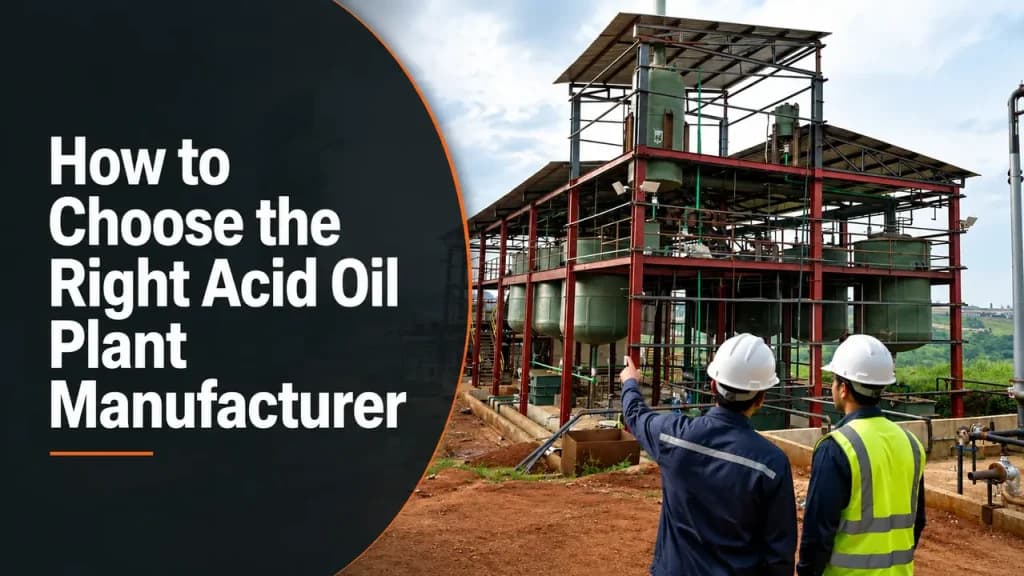
Choosing an acid oil plant manufacturer is not like buying a pump or a storage tank. It is a 20-year capital commitment that will define your refinery’s profitability, your regulatory standing, and your maintenance costs for decades. Yet most buyers still evaluate suppliers on price alone — and pay the real cost in downtime, repairs, and substandard yields for years afterward. This guide gives you the 7 critical factors to evaluate before you sign a purchase order.
Evaluate Every Manufacturer on These 7 Points
Open each factor below to understand what to look for, what questions to ask, and how FGPL performs on each criterion. A manufacturer that cannot answer these questions confidently and with evidence is not ready to build your plant.
1
Factor One
Material Quality & Construction Standard
▼
The soap stock splitting process involves concentrated sulfuric or hydrochloric acid, hot fatty acids at 60–90°C, and highly corrosive wastewater. The material used to construct tanks, reactors, pipelines, valves, and settlers determines whether your plant lasts 5 years or 25 years — and whether your acid oil product stays uncontaminated.
- ✓Vinyl ester or isophthalic FRP for acid-contact vessels
- ✓FRP or HDPE pipelines throughout acid zones
- ✓SS 316L or Hastelloy for high-temperature components
- ✓Rubber-lined reactors where applicable
- ✓Material test certificates (MTCs) on request
- ✗Mild steel (MS) for any acid-contact component
- ✗General-purpose polyester FRP (not acid-grade)
- ✗Unlined carbon steel storage or reactors
- ✗Rubber-sealed joints without secondary containment
- ✗Cannot provide MTC documentation
FGPL uses specialized, acid-grade FRP fabricated in-house — a technology developed and refined since our first fiberglass acid oil plant in 1990 under the technical expertise of Mr. Ashok Jain. Every critical acid-contact component uses corrosion-proof FRP or SS 316L, with documentation available on request. Our plants have operated continuously for 15–25 years with zero corrosion-related failures in acid-zone components.
2
Factor Two · Most Overlooked
Corrosion Resistance & Leak-Proof Design
▼
Material choice and corrosion-proof design are two separate things. Many manufacturers use the right material on paper but fail at fabrication joints, flanges, nozzle connections, and pipe transitions — the points where leaks actually occur. A plant that leaks acid is a safety hazard, an environmental violation, and a product contamination risk all at once.
- 🔍Ask to see the manufacturer’s FRP fabrication process — joints, laminate schedules, cure cycles. Poor lamination is invisible until it fails under acid.
- 🔍Request a leak test protocol. All acid-contact vessels should be hydrostatically tested before dispatch.
- 🔍Ask about their flange and gasket specifications for acid service. Standard rubber gaskets degrade rapidly in concentrated H₂SO₄.
- 🔍Check their pipe routing design — drainage slopes, vent points, and secondary containment provisions.
- 🔍Ask for references from plants that have operated for 10+ years and verify current condition of equipment.
FGPL’s acid oil plants are specifically designed as leak-proof and corrosion-proof systems — not just constructed from resistant materials, but engineered with corrosion-resistance as the primary design parameter at every joint, nozzle, and connection point. All vessels undergo hydrostatic testing. Our plant designs include secondary containment as standard, not an option.
3
Factor Three
Plant Capacity & Scalability
▼
A plant sized perfectly for today’s output may be a bottleneck within 3–5 years if your refinery expands. Equally, a plant that is massively oversized for your current soap stock volume wastes capital and has operational inefficiencies at partial loads. Getting capacity sizing right — and buying from a manufacturer who can scale with you — is a strategic decision.
| Refinery Input | Soap Stock/Day | Plant Size Needed | FGPL Can Supply |
|---|---|---|---|
| 50–150 MT/day | 2–12 MT/day | 5–15 MT/day plant | ✓ Yes |
| 150–400 MT/day | 8–32 MT/day | 10–40 MT/day plant | ✓ Yes |
| 400–800 MT/day | 16–64 MT/day | 20–80 MT/day plant | ✓ Yes |
| 800–2000 MT/day | 32–160 MT/day | 40–200 MT/day plant | ✓ Yes (modular) |
| 2000+ MT/day | 80–300+ MT/day | Multi-train systems | ✓ Custom design |
FGPL supplies acid oil plants across the full capacity range — from small refineries at 5 MT/day to large industrial complexes exceeding 300 MT/day. Our modular FRP-based design allows phased capacity expansion. We have successfully debottlenecked and upgraded existing installations, including those originally built by other manufacturers.
4
Factor Four
Process Efficiency & Proven Performance
▼
Two plants of identical capacity can have very different economics depending on their process efficiency. Acid oil yield, acid consumption per tonne, sludge volume, and effluent acidity are the four performance metrics that determine your plant’s real operating cost and revenue generation. A 10% difference in yield on a 30 MT/day plant can mean ₹10–20 lakh difference in annual revenue.
H₂SO₄ Consumption < 100 kg/MT
Moisture in Product < 1%
FFA Content ≥ 85%
Sludge Volume < 15%
Avoid: Yield < 80% “guaranteed”
Avoid: Acid >150 kg/MT
- 📋Request performance guarantees in the purchase contract — not just marketing brochure claims. Insist on a performance test protocol within the first 30 days of commissioning.
- 📋Ask for data from reference installations — actual yield percentages, acid consumption figures, and sludge volumes from operating plants.
- 📋Understand what happens if performance guarantees are not met — is there a remedy, a penalty, or just silence?
FGPL’s soap stock splitting plants achieve over 95% process efficiency with reduced acid consumption, low sludge generation, lower effluent acidity, and high-quality acid oil output — consistently across all 200+ commissioned installations. Our performance claims are backed by reference plant data and contractual performance guarantees.
5
Factor Five
Maintenance Requirements & Long-Term Reliability
▼
The acid oil plant that costs the least to buy is rarely the least expensive to own. High-maintenance plants demand frequent downtime, expensive replacement parts, and skilled technicians on-site. In a process that generates revenue every hour it runs, every day of unplanned downtime is direct lost profit.
- 🔧Scheduled maintenance intervals: Ask how often key components (agitator seals, pump internals, valves) require service. Best plants are designed for annual major maintenance with minimal daily intervention.
- 🔧Spare parts availability: Are critical spares available domestically or must they be imported? What is typical lead time for your region?
- 🔧Equipment design simplicity: Overly complex automation or proprietary components create dependency on the manufacturer. Ask if local engineers can maintain the plant independently after training.
- 🔧Wear part consumption: Acid-resistant pump impellers, valve seats, and gaskets in acid service have finite life. Understand the expected replacement frequency and cost per year.
- 🔧10-year TCO estimate: Ask suppliers to provide a 10-year Total Cost of Ownership estimate — CAPEX + installation + annual maintenance + acid + spare parts. Compare this number, not just the purchase price.
FGPL plants are specifically designed for minimum maintenance requirements and long service life. Our FRP construction eliminates the corrosion-driven replacement cycle that plagues metal-based plants. Key rotating equipment uses standard, globally available components. Clients in remote locations operate FGPL plants independently after our initial commissioning and training program.
6
Factor Six
Regulatory Compliance & Environmental Design
▼
Acid oil plants operate at the intersection of three regulatory domains: air quality (acid fume emissions), water quality (effluent discharge), and product quality (acid oil specifications for its end market). A plant that is not designed with all three in mind is a future liability — regardless of how well it performs on yield and efficiency.
- 📜Fume scrubbing: The splitting reaction generates HCl or SO₂ fumes that must be scrubbed before discharge. Verify the manufacturer includes an FRP fume scrubber as standard and can provide guaranteed outlet emission levels.
- 📜Effluent treatment: The acidic wastewater stream must be neutralized and treated. Ask whether effluent treatment is included in the plant package or a separate scope — and what the treated effluent pH will be.
- 📜Acid storage safety: Concentrated H₂SO₄ storage requires secondary containment bunds, leak detection, and emergency neutralization provisions per OSHA, CPCB (India), EU REACH, or local equivalent standards.
- 📜Product quality for target market: If you plan to sell acid oil for animal feed in Europe, it must meet EU Reg. 68/2013. For biodiesel use, free fatty acid content and impurity levels must meet the refinery’s feedstock specification. Confirm the plant’s output consistently meets your target market’s requirements.
FGPL plants are designed to meet all applicable regulatory requirements and quality standards. Our standard plant package includes FRP fume scrubbing and effluent neutralization provisions. Our acid oil output consistently meets international trade specifications including EU Reg. 68/2013 for animal feed applications. We provide full documentation support for regulatory submissions.
7
Factor Seven · Often Decided Too Late
After-Sales Support, Commissioning & Track Record
▼
More buyers regret their choice of acid oil plant manufacturer for after-sales failures than for any technical reason. A manufacturer who disappears after delivery — or who sends a junior technician who cannot commission the plant properly — costs you weeks of lost production and months of suboptimal performance. The quality of commissioning and the depth of ongoing support is as important as the quality of the equipment.
FGPL provides full commissioning, operator training, and long-term technical support as part of our standard offering. With over 200 plants commissioned since 1990, our engineering team has seen and solved every operational challenge an acid oil plant can present. We are a pioneer in fiberglass-based acid oil plant technology in India — our track record across 35 years and across diverse geographies is our strongest credential. We welcome reference site visits before purchase.
Red Flags: When to Walk Away
Beyond evaluating the 7 factors above, watch for these warning signs during your supplier conversations. Any one of them should prompt deeper scrutiny — multiple red flags should prompt you to look elsewhere.
- 🚩Cannot provide a list of reference installations with contact details for verification
- 🚩Uses mild steel for any acid-contact component, or cannot specify materials clearly
- 🚩Refuses to include performance guarantees (yield, acid consumption) in the contract
- 🚩Has no in-house FRP fabrication — outsources all manufacturing to unknown sub-vendors
- 🚩Cannot demonstrate a fume scrubber or effluent treatment solution in the plant scope
- 🚩Offers the lowest price in the market by a significant margin — understand what has been removed
- 🚩Has fewer than 10–15 verifiable installed plants, regardless of years in business
- 🚩Commissioning is offered as a paid add-on, not included in the plant package
The Manufacturer Evaluation Matrix
Use this matrix as a quick reference when comparing multiple suppliers side by side. Score each supplier 1–5 on each factor. The total will surface the right choice faster than any brochure.
| Evaluation Factor | Weight | What Top Score (5) Looks Like |
|---|---|---|
| Material Quality & Construction | High | Acid-grade FRP / SS316L throughout, MTCs provided, in-house fabrication |
| Corrosion Resistance & Leak-Proof Design | High | Hydrostatic tested, secondary containment standard, 10+ yr references confirm |
| Capacity & Scalability | Medium | Full range from 5–300+ MT/day, modular design, expansion path documented |
| Process Efficiency & Performance | High | ≥95% yield, <100kg acid/MT guaranteed in contract, verified by references |
| Maintenance & Reliability | Medium | Annual maintenance cycle, locally available parts, independently operable |
| Regulatory Compliance | Medium | Fume scrubber + effluent treatment standard, meets EU/CPCB/OSHA norms |
| After-Sales & Track Record | High | 200+ plants, 35+ years, full commissioning included, reference visits welcome |
India’s Pioneer in Fiberglass Acid Oil Plant Technology
Fibrograts (FGPL) has been manufacturing soap stock splitting / acid oil plants since 1990 — longer than most current players have been in business. With over 200 plants commissioned across diverse geographies and refinery sizes, we bring a depth of real-world experience that no brochure can substitute. Our plants score top marks on every factor in this guide — and we can prove it with reference sites you can visit.